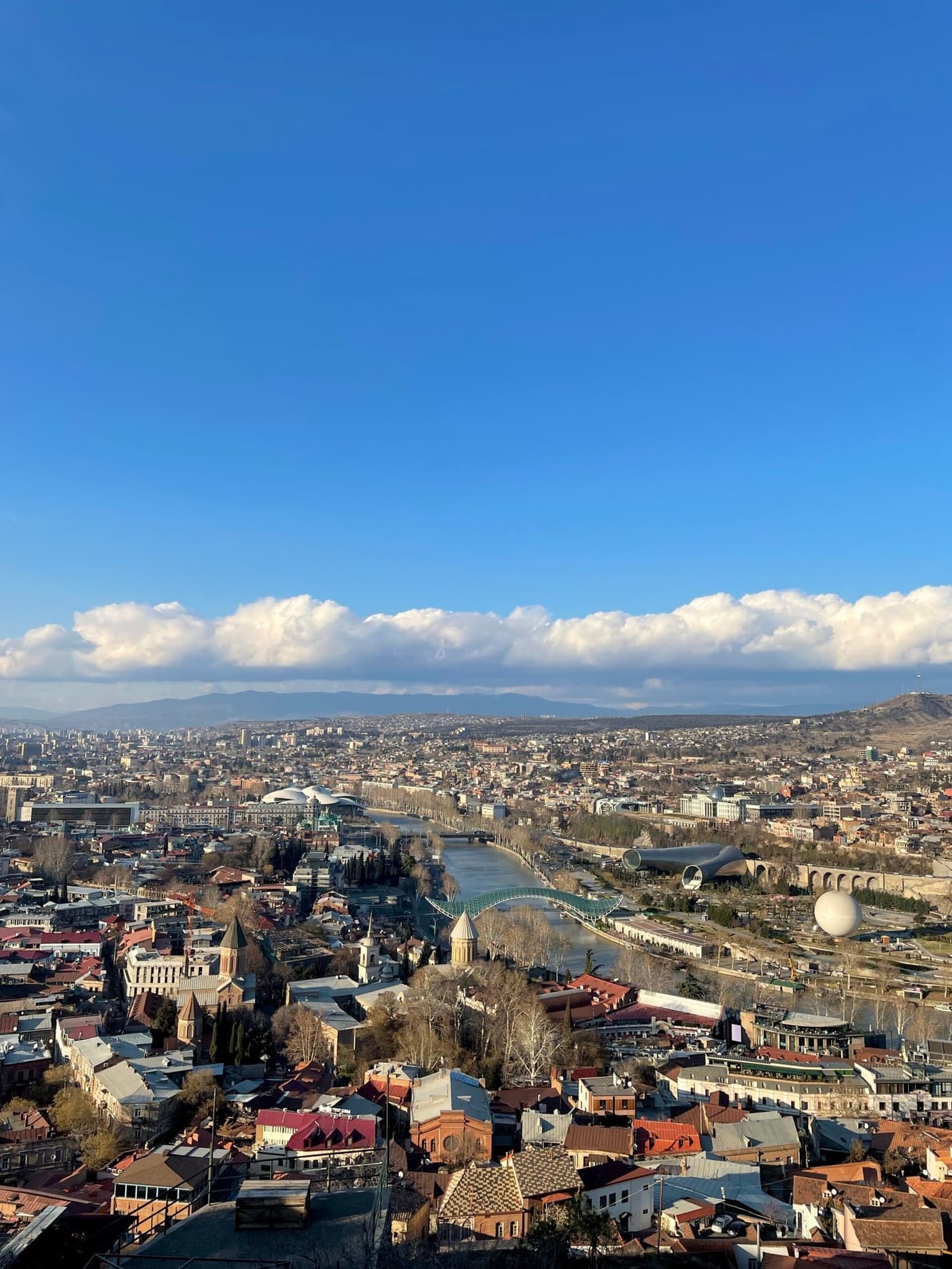
In 2026, Georgia remains one of the most accessible countries for digital nomads: visa-free entry for up to 365 days for eligible passports, a 1% tax for individual entrepreneurs, and a relatively simple bank account opening. At the same time, since March 1, 2026 the rules for foreigners who work have changed significantly: legal business activity now requires a work permit.
Key facts about Georgia for a remote worker in 2026:
| Parameter | Details |
|---|---|
| Visa-free stay | 365 days (for eligible passports; check the rules for yours) |
| Insurance on entry | mandatory since 01.01.2026, coverage from 30,000 GEL (~$11,200) |
| Tax for individual entrepreneurs (small business) | 1% of turnover up to 500,000 GEL/year |
| Tax for individual entrepreneurs (micro business) | 0% on turnover up to 30,000 GEL/year |
| Work permit | mandatory since 01.03.2026, cost 200–400 GEL |
| Fine for working without a work permit | 2,000 GEL (first offense) |
| Residence permit via an individual entrepreneur status | turnover from 50,000 GEL/year + work permit |
| Residence permit via real estate / investment | real estate from $150,000 (1-year permit), investment from $300,000 (5-year permit) |
| Lari exchange rate | 1 USD ≈ 2.67 GEL (check the current rate) |
Below I break down each point in detail: how it works in practice, where to apply, how much it costs and what to watch out for.
Entry and the visa-free regime
When I checked in October 2026, eligible passports could enter Georgia without a visa and stay up to 365 days a year, which is one of the most generous visa-free regimes in the world. Please confirm the rules for your own passport with the Georgian authorities before you travel.
Since January 1, 2026 there is a new mandatory requirement: health insurance on entry. The minimum coverage is 30,000 GEL (about $11,200). The insurance must be valid for the whole length of your stay. Patrol police officers may check it at border crossing points, and you need it on paper or in digital form. The requirement was set by Government of Georgia Decree No. 602 of 26 December 2025; the decree does not specify a fine or mention refusal of entry, so it is safest to buy a policy in advance.
An important clarification: Some sources say "$30,000", which is a mistake. The requirement is officially set in Georgian lari, not in dollars.
Georgia's National Tourism Administration says travellers from most countries need a passport valid for at least 6 months beyond the date of entry (georgia.travel).
Border control has become stricter since 2025–2026. Border officers may ask about the purpose of your visit, your sources of income and where you will live. It is best to have proof of accommodation (a booking or a rental agreement) and clear answers to the standard questions.
Print your accommodation booking and the contact details of the person you will stay with. If you bring a laptop with professional equipment, be ready to explain that it is for personal use.
The 2026 reform: the work permit
This is the most important thing for anyone planning to work in Georgia. New rules came into force on March 1, 2026 that significantly change the "I live and work without any permits" approach, and applications are accepted through the official portal of the Ministry of Labor of Georgia.
A foreigner can no longer legally carry out employment or business activity in Georgia while only in the visa-free regime. Now you need either a residence permit or a work permit (a permit for work activity, in Georgian: samushao nebartva).
What this means in practice: the permit is needed by people who work for a Georgian employer or Georgian clients and by those who operate through a Georgian sole proprietorship. Amendments in summer 2026 exempted foreign nationals who work for a non-resident when that work relates to the non-resident's activities outside Georgia (as reported by EY and law firms when we checked in October 2026). The line between the cases is thin: for example, if part of your work comes from Georgian clients, the exemption no longer applies. Confirm with the Ministry of Labour or a lawyer.
Fines for working without a work permit: 2,000 GEL for the first offense, doubling and tripling for repeat violations. The fine applies both to the individual and to the employer — more details on legal.ge.
Transition period: Self-employed people and individual entrepreneurs who were already working in Georgia on March 1, 2026 had to put their affairs in order by May 1, 2026. Those who had an active status in the Ministry of Labor database on March 1 have until January 1, 2027 to apply for a residence permit under the new rules. If you are only arriving now, start with the current requirements.
How to get a work permit
The application is submitted through the official portal of the Ministry of Labor of Georgia: labourmigration.moh.gov.ge
Document package: a standard application form, a copy of your passport, and documents confirming your activity (an individual entrepreneur extract, contracts with clients, account statements). Self-employed people and individual entrepreneurs must also pass a video interview with the State Employment Support Agency.
Cost: 200 GEL for standard processing of 30 calendar days, 400 GEL for expedited processing of 10 business days. A full walkthrough of the procedure is in the ibccs.ge guide to the 2026 work permit.
You can apply on your own, but many people go through lawyers or migration agencies, who know the current practice and save you a lot of stress. The average cost of such support is $100–300.
It is important to understand that enforcement practice is still taking shape. There are no mass inspections. But the risk exists, especially when extending your stay or when dealing with government bodies.
Residence permit in Georgia: grounds and conditions in 2026
A residence permit is a legal status for long-term living and working. You can get one on several grounds.
Individual entrepreneur status as grounds for a residence permit
To get a residence permit through an individual entrepreneur status, you need to run at least 50,000 lari (~$18,700 at the May 2026 rate) through the account of your Georgian individual entrepreneur status over a year and pay the corresponding taxes. In addition, from 2026 you must hold a valid work permit. The business cannot be "dormant": the tax authority checks that real transactions take place. If you leave Georgia for more than 6 months, the residence permit may be canceled.
Registering as an individual entrepreneur alone does not give you a residence permit. You need turnover + a work permit + real activity.
In April 2026, amendments were made to the legislation that may change the formal turnover threshold. Until the relevant government resolution is published, the previous requirement of 50,000 lari applies. Follow updates on sda.gov.ge.
Buying real estate
Since March 1, 2026 the minimum amount is $150,000 (it used to be $100,000) — legal.ge recorded this change right after the amendments came into force. The property must be residential and registered in the applicant's name. You will need an independent appraiser's opinion on the market value. The residence permit is for one year, but in practice it is renewed for as long as you keep owning the property. Those who received a residence permit under the old rules ($100,000) keep the previous conditions when they renew.
Batumi is a popular destination: new buildings are being actively built and prices are lower than in Tbilisi. The $150,000 threshold is reachable there when buying an apartment in a new residential complex.
Investment in the economy
An investment of $300,000 or more in a Georgian business, real estate or securities gives the right to a 5-year residence permit that can be converted into a permanent one. The $150,000 threshold applies only to buying real estate (see above), not to investments. According to data from the Public Service Development Agency of Georgia (sda.gov.ge), an investment residence permit additionally requires confirmed turnover: $50,000 in the first year, $100,000 in the second, and $120,000 in the following years.
Employment with a Georgian company
If a Georgian company hires you officially, it helps with the work permit and the residence permit. Finding a job in Georgia on decent terms on your own is not easy: the local labor market is small and salaries are significantly lower than in Europe.
Studying at a Georgian university
A student residence permit is valid for the length of the studies. Options include Tbilisi State University and Ilia State University, and there are programs in English.
Individual entrepreneur status in Georgia: registration in 2026
Despite the new rules, registering as an individual entrepreneur in Georgia remains one of the simplest procedures in the world. The procedure itself has not changed; what has changed are the requirements for working legally after registration.
What you need: a valid passport, a personal identification number for foreigners (PIK), a registration address in Georgia (a rental agreement) and a Georgian phone number.
Where to register: at the House of Justice (Sakhelmtsifo Samsakhuri), which has branches in Tbilisi, Batumi and Kutaisi. The state fee is about 20 lari. The whole process takes one business day, sometimes just a few hours.
Online registration is possible through the e-Georgia portal, but for foreigners it often requires a visit in person for the initial identification.
After registering as an individual entrepreneur you need to: open an account with a Georgian bank, get a work permit through labourmigration.moh.gov.ge, and, if your turnover exceeds 30,000 lari/year, apply for small business status (1% tax) through rs.ge.
Taxes for individual entrepreneurs in Georgia in 2026: in detail
Georgia's tax system is one of the most attractive in the world for small business. Here is a breakdown by level, based on data from the official database of the Revenue Service of Georgia and taking into account the February 2026 amendments analyzed by Eurofast.
Individual without a special status: standard income tax of 20%.
Micro business status: annual turnover up to 30,000 lari (~$11,200) — 0% tax. Restrictions: you cannot hire employees, and only certain types of activity qualify (consulting, software development, design and copywriting are suitable).
Small business status (Small Business Status, SBS): turnover from 30,000 to 500,000 lari/year — 1% tax on turnover (not on profit, but on any money received in your account). This is the key feature: regardless of your expenses, you pay 1% of everything that came in. It is very beneficial for freelancers, developers, designers and consultants.
New in 2026: small business status takes effect from the date of the application. If turnover exceeds 500,000 lari during the year, the excess amount is taxed at 3%. If the threshold is exceeded two years in a row, the status is canceled from January 1 of the third year, and ExpatHub.ge analyzed all the changes in detail.
VAT (18%) is mandatory only when turnover exceeds 100,000 lari a year (~$37,400). Below that threshold there is no VAT. Most freelancers never reach it.
There are no social contributions — an individual entrepreneur does not have to pay fixed contributions regardless of income.
Reporting: a return is filed once a year (or monthly under small business status). The system is digital, through rs.ge. The first time, it is better to do it with a local accountant (50–150 lari/month).
Banks in Georgia in 2026: how to open an account
The banking question is the most practical and the one that changes most often. I have put together the current picture as of today.
Credo Bank
Credo is a small bank originally focused on microfinance that has become the main option for non-residents with a limited history. Its main advantage is a high approval rate and simple requirements. A passport is enough to open an account, and an instant card is issued the same day. They check the source of income less strictly than TBC or BoG.
On the downside, there is less functionality (a simpler online bank, lower cash withdrawal limits, not all types of SWIFT transfers are available). But for everyday payments and receiving payments from foreign clients it works fine.
My recommendation: open Credo first, as a "safety net" option. Then try TBC or BoG for a multi-currency account with broader capabilities.
TBC Bank
TBC is one of the two largest banks in Georgia. In 2026 it opens accounts for non-residents during an in-person visit with a package of documents.
What you need: a passport, proof of your source of income (a letter from your employer, contracts with clients, Wise or PayPal statements) and proof of an address in Georgia (a rental agreement).
TBC charges a non-refundable fee of 50 lari for reviewing a non-resident's application. It is paid when you apply, regardless of the decision. The account is multi-currency (GEL, USD, EUR), and SWIFT transfers work very well.
TBC is becoming more demanding: it can refuse without giving a reason, especially if your transaction history looks unusual. The best approach is to come with the most complete package of documents possible.
Bank of Georgia (BoG)
The second-largest bank. Requirements are similar to TBC. Accounts are opened for foreigners, but the procedure can take several visits. It is a good fit if you have Georgian partners or local connections.
Liberty Bank
The third largest. It is oriented more toward the local market and does not open accounts for foreigners.
Practical tips
Go in person: remote opening for non-residents is officially not available at any Georgian bank. Take with you: your passport, a rental agreement in Georgia, and proof of income (PayPal, Wise or Upwork statements, contracts). If you have registered as an individual entrepreneur, bring the registry extract and the work permit extract. Come on a weekday morning, preferably Tuesday to Thursday.
If one bank refuses you, try another. Banks in Georgia compete for customers, and often different managers at the same bank make different decisions.
How to transfer money to Georgia
Wise (TransferWise) is the most popular way. Transfers in GEL, USD and EUR with minimal fees. It works if you have a card from a country supported by Wise (Kazakhstan, Armenia and Georgia all work).
SWIFT transfers go through a Georgian bank account, once it is open.
Cash is a reliable backup option. When entering Georgia you must declare an amount over 30,000 GEL (~$11,200); this is the threshold set by the Georgian customs (Revenue Service of Georgia). In Tbilisi, exchange offices with good rates are on Pushkin Street and near the Dezerter Bazaar.
Cryptocurrency — some people convert money through P2P platforms. Using crypto is legal in Georgia: since 2026 the regulator of the virtual asset market is the National Bank of Georgia, and all crypto services are required to obtain a VASP license. Personal P2P transactions do not need special permission, but the platform must be licensed.
How much it costs to live in Georgia
The cost of living depends heavily on the city and the neighborhood. Tbilisi is more expensive and busier, Batumi is cheaper and calmer, and Kutaisi is for those who want minimum expenses and maximum local flavor. Rental prices have gone up in recent years. The best place to see current apartment rental listings in Tbilisi is myhome.ge (the main Georgian real estate portal) and ss.ge (a local classifieds site).
Tbilisi
Saburtalo is not central, with plenty of housing and good infrastructure. A studio is $350–500/month. One or two bedrooms are $500–700. A good choice for the money.
Vera, Chugureti are closer to the center, atmospheric, with cafes and coworking spaces within walking distance. A studio is $500–700. One or two bedrooms are $700–1,000.
Mtatsminda, Sololaki is the old town: beautiful but noisy. There are fewer long-term options and they cost more, because apartments often go to tourists on a daily basis.
Didube, Nakhalovka are cheaper but less convenient for remote workers. A studio is from $250–350.
Batumi
Batumi has lower housing prices, the sea nearby and a subtropical climate. A studio in the center is $300–500, and $200 farther out. The infrastructure for remote work is less developed than in Tbilisi, but there are coworking spaces.
Kutaisi
The cheapest of the three main cities. A studio is $200–350. There are fewer foreigners and fewer services for expats.
Food, transport and everyday life
Dinner for two at an ordinary Georgian restaurant is 60–80 lari ($22–30): khinkali at 8–12 lari per portion (5–6 pieces), a bottle of Saperavi 25–35 lari. Coffee at a cafe is 4–7 lari.
Transport within Tbilisi: the metro and bus cost 1 lari (~$0.37) per ride. A taxi via Bolt is 5–15 lari across the city. Renting a car for a month starts at $400, but in central Tbilisi you practically don't need one.
Utilities when renting an apartment: electricity 20–50 lari/month depending on the season, water 10–20 lari. In summer, air conditioning adds another 30–60 lari. Home internet is 25–45 lari/month (100–300 Mbps from Magti Fiber or Silknet).
Total: how much you need per month
With a modest lifestyle, $900–1,200 for one person (rent $400 + food $250 + transport $100 + utilities and communications $80 + other $200). Comfortably, with cafes and trips, $1,400–2,000. If you want detailed information, I recommend my article about prices in Tbilisi.
Internet, coworking spaces and work infrastructure
Internet in Georgia is good. Home plans from Magti Fiber or Silknet are 100–300 Mbps for 25–45 lari/month (~$9–16). You can set one up with a passport in 1–2 business days.
Mobile 4G internet works in cities and is unstable in the mountains. A starter package from Magti or Silknet costs 15–25 lari. If you work on the move, it is better to have two operators.
Coworking spaces in Tbilisi:
Impact Hub Tbilisi is located inside Fabrika (8 Egnate Ninoshvili St., Chugureti district, Marjanishvili metro). Fabrika is a former Soviet sewing factory, now a cultural cluster with cafes, bars and showrooms, and Impact Hub occupies the coworking space inside. It is part of a global network (100+ cities), and membership gives access to other hubs. A day pass is 40 GEL, an unlimited month is 410 GEL.
Terminal is the largest coworking network in Tbilisi: 6 locations, 9,000 sq. m, more than 1,100 seats. It has one of the best internet connections in the city and meeting rooms. A day pass is 40 GEL, a month with a dedicated desk is from 425 GEL.
D Block (14 Kostava St., Stamba building) is a coworking space in the historic building of a former publishing house, in the city center. An atmospheric place and a good choice if you work around Rustaveli. A day pass is 40 GEL, a month is 500 GEL.
In total there are 30+ coworking spaces in Tbilisi. An up-to-date list with prices and reviews is at coworker.com/georgia/tbilisi.
Tbilisi coffee shops with decent Wi-Fi are unofficial coworking spaces. Coffee Lab (several locations, including 27 Kazbegi Ave.) and Double B Coffee & Tea (9 Tabidze St.). Buy a coffee and a snack, sit down, and nobody will bother you.
Lifestyle: a day's rhythm in Tbilisi
Morning: coffee at a cafe. Coffee culture in Tbilisi is strong: Fabrika, Entree, Coffee LAB, Stamba Hotel Coffee. Most cafes open at 9:00–10:00, there is Wi-Fi everywhere and outlets are available.
Daytime: work or a walk. Vera and Vake are districts with parks and greenery. Mtatsminda has a view over the whole city. In good weather you can work on open terraces: from Tbilisi you can see the mountains of the Caucasus range.
Evening: food and wine. Khinkali are 8–12 lari for 5–6 pieces. A bottle of Saperavi is 25–35 lari. Dinner for two at a decent place is 60–80 lari.
Climate: spring and autumn in Tbilisi are ideal (+20–25°C, dry). Summer is hot (up to +38°C), and many people work early in the morning or leave for the mountains. Winter is cool (+5–8°C), without long frosts. Before your trip, my Georgia travel guide will be useful.
The expat community in Tbilisi
Since 2022 a large expat community has formed in Tbilisi: online groups with thousands of members, shared events and mutual-help networks. That is also where you will find up-to-date advice on banks, housing and bureaucracy.
Georgia vs. other countries for digital nomads
An honest answer: Georgia is not the best country in the world for a remote worker, but it is the best for a particular type of need. Here is a breakdown by country.
Thailand is the main competitor. The climate is consistently warm year-round, living is cheaper than in Georgia, especially food and rent outside Bangkok, and the infrastructure for remote workers in Chiang Mai or on Phuket is excellent. The main downside: the UTC+7 time zone, so if you work with European clients, an afternoon call in Europe turns into an evening one for you. The visa question: there is the DTV (Destination Thailand Visa), a five-year visa that costs about $300 and requires proof of savings of at least 500,000 baht (~$14,000) in your account. There is not much to walk around in Thailand: life is centered on shopping malls and beaches, and the European "walk out to a cafe" does not really work.
Bali, Indonesia is the mecca of digital nomads: social scene, surfing, rice fields, coworking spaces in the jungle. It is cheaper than Georgia for food and entertainment. The same time zone downside: UTC+8. The visa question: the KITAS (a long-stay permit), essentially the equivalent of a residence permit, is arranged through a sponsor or an investment and costs from $500–1,000 a year. The climate is stable but humid, and not for everyone.
Vietnam is the cheapest of the Asian options. Da Nang is actively developing as a nomad hub. Downsides: the visa regime is more complicated (an e-visa for 90 days, then you have to leave), the UTC+7 time zone, and street noise and traffic are not for everyone.
Brazil is a non-obvious but strong option. Florianopolis and Curitiba in southern Brazil are developed nomad hubs with a European way of life, beaches and low prices. The UTC-3 time zone is more convenient for working with Europe than Asia is, and ideal for working with the US. The Portuguese language creates a barrier, but when I checked, entry rules for eligible passports were simple: 90 days + 90 days without a visa. Check the rules for your own passport. There are many different visas for longer stays.
Armenia is Georgia's closest competitor in the "individual entrepreneur + bank + living" logic. Downsides: no sea, less infrastructure for expats, and Yerevan lags behind Tbilisi in gastronomy and walkable atmosphere. A detailed comparison is in the article: Georgia or Armenia for relocating.
UAE has zero taxes, high service levels and predictable rules. But the cost of living is 3–4 times higher than in Georgia, and the cultural environment is fundamentally different. It is an option for those who earn $5,000/month or more and value infrastructure above atmosphere.
Spain — Barcelona and Valencia are popular with those who want a European lifestyle with a warm climate. Downsides: visas are harder, you need a digital nomad visa or residency, and taxes are higher. On the other hand, you get a European time zone and a high level of service.
Where Georgia loses: climate: the Tbilisi summer (+35–38°C) and the raw winter are no match for the steady warmth of Asia. Prices: food and rent in Thailand or Vietnam are noticeably cheaper. Social scene: Asian nomad hubs are more "international" in the makeup of their communities.
Where Georgia wins: the UTC+4 time zone is golden for working with Europe. Walkability: Tbilisi is a living city where you can pop out to a coffee shop, stroll along old streets and head to the mountains for the weekend. Taxes: 1% for individual entrepreneurs is hard to beat anywhere else. Visa rules: 365 days without paperwork, whereas in Asia you either have to leave or apply for special visas.
Is it worth going to Georgia in 2026
An honest answer: yes, if you are ready for the fact that the setup has become more complicated.
The pluses remain: no visa for a year, 1% tax for individual entrepreneurs, decent banking access, good infrastructure (internet, coworking spaces), a pleasant climate in spring and autumn, a convenient base for trips around the Caucasus and to Turkey, a lively expat community, and Georgian cuisine.
The minuses have become more real: you need to get a work permit (extra bureaucracy and expense), opening an account requires preparation, border control is stricter, and housing prices have gone up.
Who Georgia is still a good choice for: freelancers and self-employed people ready to set up an individual entrepreneur status + work permit; people with real, provable income; people who want to live in Tbilisi for a year or longer; people for whom a European time zone matters.
Who the setup has become less convenient for: those who wanted to come for 3 months and work without paperwork, which is now formally illegal; people with an unclear source of income who will struggle to open a bank account.
Health and insurance
Since 2026 insurance on entry is mandatory. But even if it were not, healthcare in Georgia is paid, and you take a risk without insurance.
Healthcare in Tbilisi is decent at private clinics: a GP consultation is $20–40, tests are from $10–30, and a basic ambulance call is about 100 lari. Large private networks include Avalon and Medintermed.
Insurance for digital nomads (current 2026 prices):
SafetyWing — Essential plan: $62.72 for 4 weeks (~$68/month) for ages 18–39. Complete plan: $161.50/month. Rates rose noticeably in 2026 compared with previous years.
Heymondo and Genki are alternatives to SafetyWing, competitive on price, and worth comparing on terms. My husband and I have been using Genki for many years.
Important: the insurance must cover at least 30,000 GEL. SafetyWing Essential, with $250,000 of coverage, meets this requirement.
A practical relocation checklist
For those who have decided to go, I put together a sequence of steps:
- Get insurance before you fly (with coverage from 30,000 GEL / ~$11,200).
- Rent a place short-term (1–2 weeks) through Airbnb or Booking.
- Get a local SIM card and open an account with Credo Bank in the first few days.
- Register as an individual entrepreneur at the House of Justice.
- Apply for the work permit through labourmigration.moh.gov.ge (200 GEL standard or 400 GEL express).
- Start looking for a long-term rental.
All of this takes from 2 to 6 weeks depending on how fast the work permit is processed. A lawyer costs money but saves you stress.
FAQ: common questions about Georgia for remote workers
Do I need a visa for Georgia in 2026?
It depends on your passport. When I checked in October 2026, eligible passports could enter without a visa for up to 365 days; confirm the rules for yours with the Georgian authorities. Since January 1, 2026, health insurance with coverage from 30,000 GEL (~$11,200) is mandatory. The decree does not specify a fine for not having a policy, so arrange insurance in advance.
Can I work remotely in Georgia without permits?
It depends on who you work for. Since March 1, 2026, working for a Georgian employer or Georgian clients, or through a Georgian sole proprietorship, requires a work permit; the fine for a violation is 2,000 GEL. Work for a foreign employer or clients that relates to their activities outside Georgia was exempted by amendments in summer 2026 (per EY and law firms, as of October 2026). Confirm with the Ministry of Labour or a lawyer.
How can a foreigner open an individual entrepreneur status in Georgia?
In person through the House of Justice, which takes one business day. You need: a passport, a foreigner identification number and an address in Georgia. Registration costs about 20 lari. Afterwards you also need a work permit through labourmigration.moh.gov.ge.
What tax does an individual entrepreneur pay in Georgia in 2026?
Under small business status, 1% of turnover (from 30,000 to 500,000 lari/year). With turnover up to 30,000 lari, micro business status, the tax is 0%. There are no social contributions. VAT applies only when turnover exceeds 100,000 lari. Current rates are on the official page of the Revenue Service of Georgia.
Which bank opens an account for foreigners in Georgia in 2026?
The most welcoming is Credo Bank: they open an account with a passport and issue the card on the day you apply. TBC Bank opens accounts during an in-person visit with proof of income and charges 50 lari to review the application. Bank of Georgia is possible, but more demanding.
Can I open an account with a Georgian bank remotely?
No. All the leading banks in Georgia, BoG, TBC and Credo Bank, officially do not open accounts remotely. You need to be present at a branch in person.
What is the work permit and how do I get it?
The work permit is an authorization for employment activity, mandatory since March 2026. It is submitted through labourmigration.moh.gov.ge. Standard processing: 200 GEL, 30 days. Expedited: 400 GEL, 10 business days. Self-employed people must pass a video interview.
Does registering as an individual entrepreneur give a residence permit?
No. Registration alone does not give a residence permit. A residence permit through an individual entrepreneur status requires turnover from 50,000 lari/year (~$18,700) + a valid work permit + real activity. Other grounds: buying residential real estate from $150,000, investment from $300,000, employment with a Georgian company.
How much does it cost to live in Tbilisi in 2026?
With a modest lifestyle, $900–1,200/month for one person (rent $400 + food $250 + transport $100 + utilities and communications $80 + other $200). Comfortably, $1,400–2,000.
How do I transfer money to Georgia?
Wise is the most popular way, but you need a card from a supported country: Kazakhstan, Armenia, Georgia itself. SWIFT through a Georgian bank. Cash on entry: a declaration is mandatory for amounts over 30,000 GEL (~$11,200), according to the rules of the Revenue Service of Georgia. Crypto through licensed VASP exchangers.
What insurance do I need to enter Georgia?
Minimum coverage of 30,000 GEL (~$11,200). SafetyWing Essential ($62.72/4 weeks) meets this requirement. Any insurance from a Georgian or foreign company with coverage from 30,000 GEL, issued in English or Georgian, will do.