The long neck villages are one of the most talked-about and controversial places in northern Thailand. From childhood, Padaung women (a branch of the Karen people) wear heavy brass coils around their necks that make them look longer. Tourists come to look, take photos and buy souvenirs. Human rights advocates criticize the whole thing. The truth is somewhere in between.
Before you go, it helps to understand the context.
Who the Karen are and where the tradition of the rings comes from
The Karen are one of the largest ethnic groups in Myanmar, about 7 million people. Within them is a subgroup called the Padaung (also known as Kayan Lahwi), who became famous for the tradition of brass coils. Most Karen in Thailand are refugees or descendants of refugees who fled the military conflicts in Myanmar in the 1980s and 1990s. Many of them still do not have Thai citizenship and live in legal limbo: they cannot work officially, move freely around the country or fully use the healthcare system.
The tradition of wearing the coils goes back several centuries. There are a few versions of where it came from: some sources say the coils protected women from tiger bites in the jungle, others say they were a sign of beauty and social status. A third version holds that the coils were a way to make women less attractive to slave traders from neighboring tribes. Most likely it is a mix of different reasons that over time became a lasting ritual.
Girls get their first coils at the age of 5–7. By adulthood there can be 15 to 25 of them. The total weight of the "necklace" reaches 4–5 kg (about 9–11 lb). Taking the coils off is technically possible, and some women do it, especially younger ones who grew up in Thailand and want to live differently. But those who have worn them since childhood often keep them on: the neck muscles have adapted, and without the support it is uncomfortable.
What the rings actually do to the neck
A common misconception is that the coils "stretch" the neck. In fact the neck does not get longer: the coils press down on the collarbones and shoulders, pushing them lower. The cervical vertebrae do not change position. The elongated look comes from the deformation of the shoulder girdle, with the shoulders literally sinking down. Medically, the process is irreversible only after long wear from early childhood: muscles and bones adapt to the load.
This matters because the answer to "does it hurt them?" is not simple. Adult women who have worn the coils all their lives do not describe it as pain. Discomfort can come in hot weather. The coils are not taken off for sleeping or bathing.
Where the long neck villages are
The villages are spread across several locations in northern Thailand, and they differ a lot in character.
Mae Hong Son Province
The best-known and most authentic villages are in Mae Hong Son Province, near the border with Myanmar. There are three main settlements: Ban Huay Suea Thao, Nam Piang Din and Huay Pu Keng. The distance from Chiang Mai is about 250 km (155 miles), so this is a separate trip of 2–3 days. The villages are small, life moves slowly and there is less commercial pressure than in tourist parks. Some of the women sell handmade items right by their homes: fabric, bracelets and bags with traditional patterns.
You can get there by bus from Chiang Mai to Mae Hong Son (about 8 hours along a mountain road), then by motorbike or tuk-tuk to the village. The alternative is to rent a bike in Chiang Mai and ride yourself, which takes 5–6 hours one way over mountain passes. The route is beautiful, but it requires experience riding on mountain roads.
Baan Tong Luang near Chiang Mai
An ethnographic park about 30 km (19 miles) north of Chiang Mai. Several hill tribes are gathered in one place: Karen with coils, Akha and Lahu. The format is openly touristy: there is a parking lot, a ticket booth and tidy paths between the houses. Residents demonstrate crafts and sell souvenirs. It is not a fake, since people really do live on the grounds, but there is a "human zoo" feeling.
Admission is about 500 baht. It is easy to reach from Chiang Mai by bike or as part of an organized tour. A good option if you want to get to know several hill-tribe cultures in one trip and do not have time for Mae Hong Son.
The village near Pai
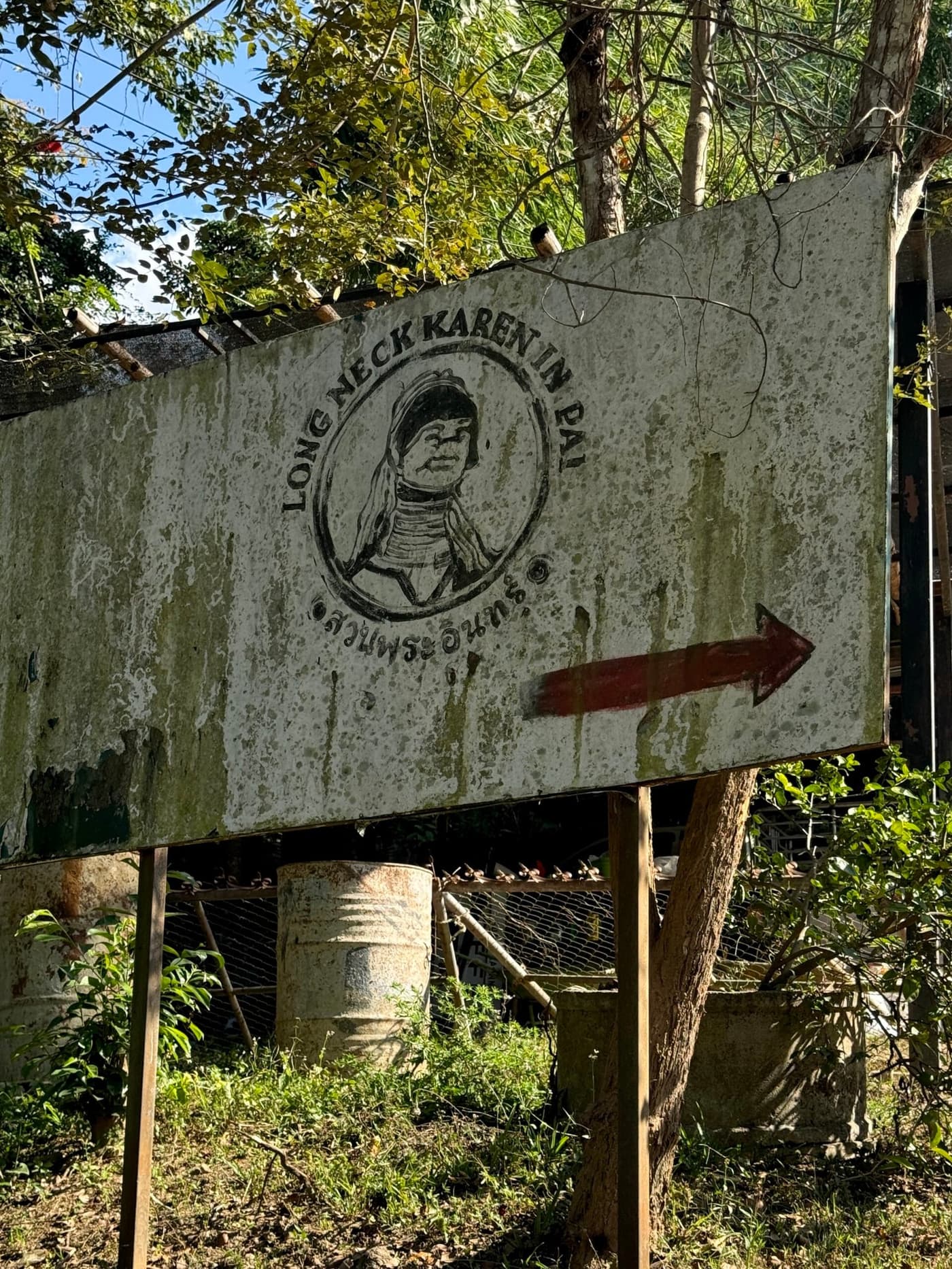
A small Karen settlement with coils is in the area around Pai, about 15 km (9 miles) from the town center. It is often included in bus tours from Pai or Chiang Mai. This is the most compact and tourist-packaged option: a few families, souvenir stalls and very little authenticity. It works if you are already going to Pai and want to add this stop without a separate trip.
I cover this in detail in a separate article: Pai: what to see, what to do and how to get there.
How to get there
Baan Tong Luang (near Chiang Mai) — drive yourself by bike or car, about 30 minutes from the center of Chiang Mai. The address is easy to find on Google Maps. There is parking, and it is free. Admission is about 500 baht and includes visiting several ethnic villages on the grounds.
The village near Pai — 20–30 minutes from Pai by bike. You can find the coordinates in advance or ask at a hostel in Pai. Admission is usually 100–200 baht. To rent a bike or car you need a license, and I wrote about how to get a driving license in Thailand in another article.
Mae Hong Son — a bus from Chiang Mai takes about 8 hours, or you can ride a bike along the mountain route (5–6 hours). The villages are 30–40 km (19–25 miles) from Mae Hong Son town itself, reached by motorbike or as part of a tour.
An organized tour from Chiang Mai — an option if you do not want to think about logistics. These are usually group tours for a full day that visit several hill villages. Check Klook or GetYourGuide.
Itinerary: how to combine it with other sights
If you are coming from Chiang Mai and want the Karen villages plus something else, there are a few combinations that work.
Doi Inthanon — one day. Ethnic park in the morning (30 km from Chiang Mai), then south to Doi Inthanon National Park (95 km). A packed day, but doable.
Pai — a standard one day in Pai: canyon, waterfalls, mountain views and the Karen village. Everything is within 15–20 km of the town center.
Mae Hong Son — a separate two-to-three-day trip around the mountain loop: Chiang Mai → mountain passes → Mae Hong Son (Karen villages) → Pai → Chiang Mai. One of the most beautiful motorcycle trips in northern Thailand. The road with 1,864 curves is no joke.
What to expect in the village
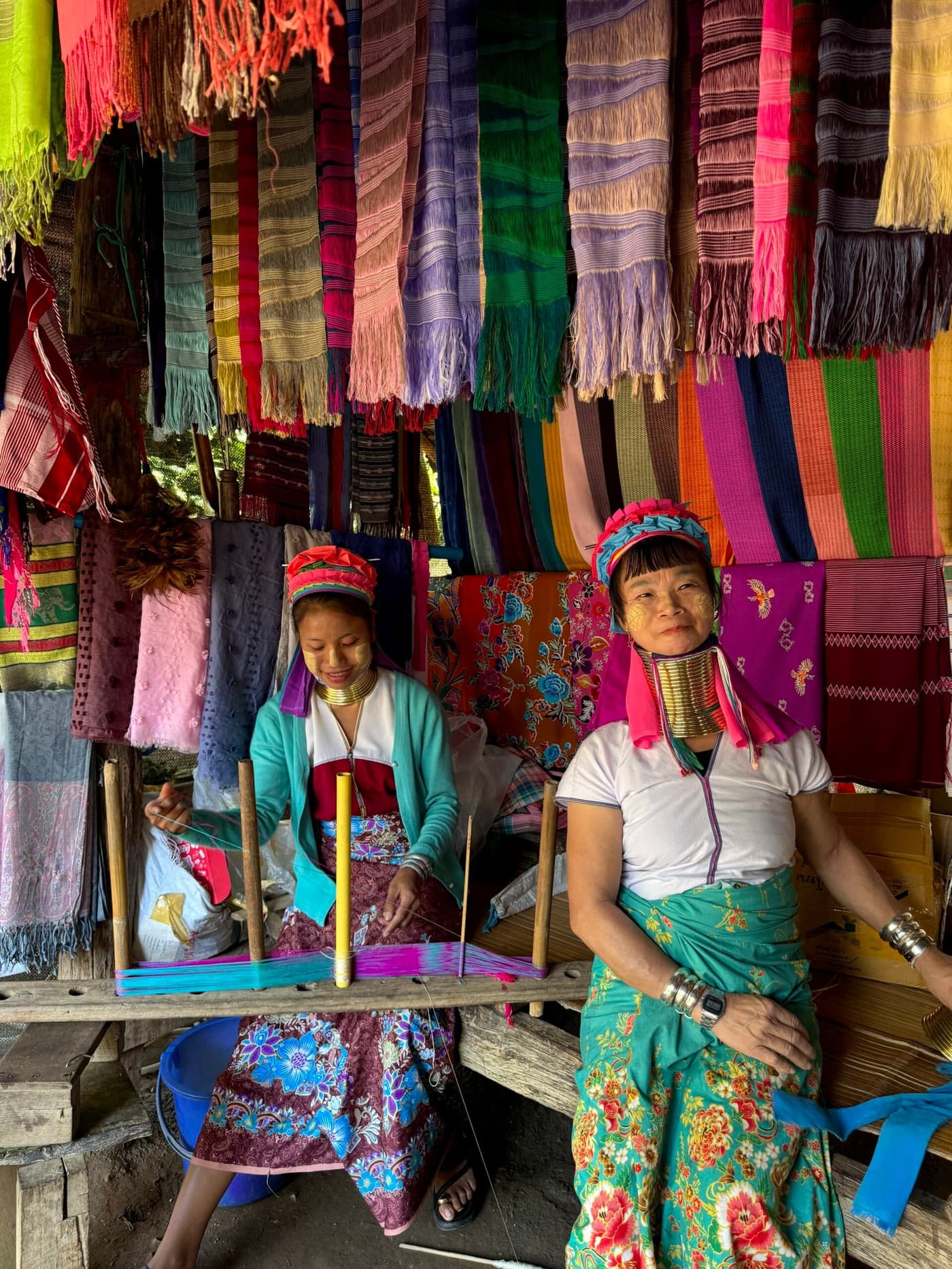
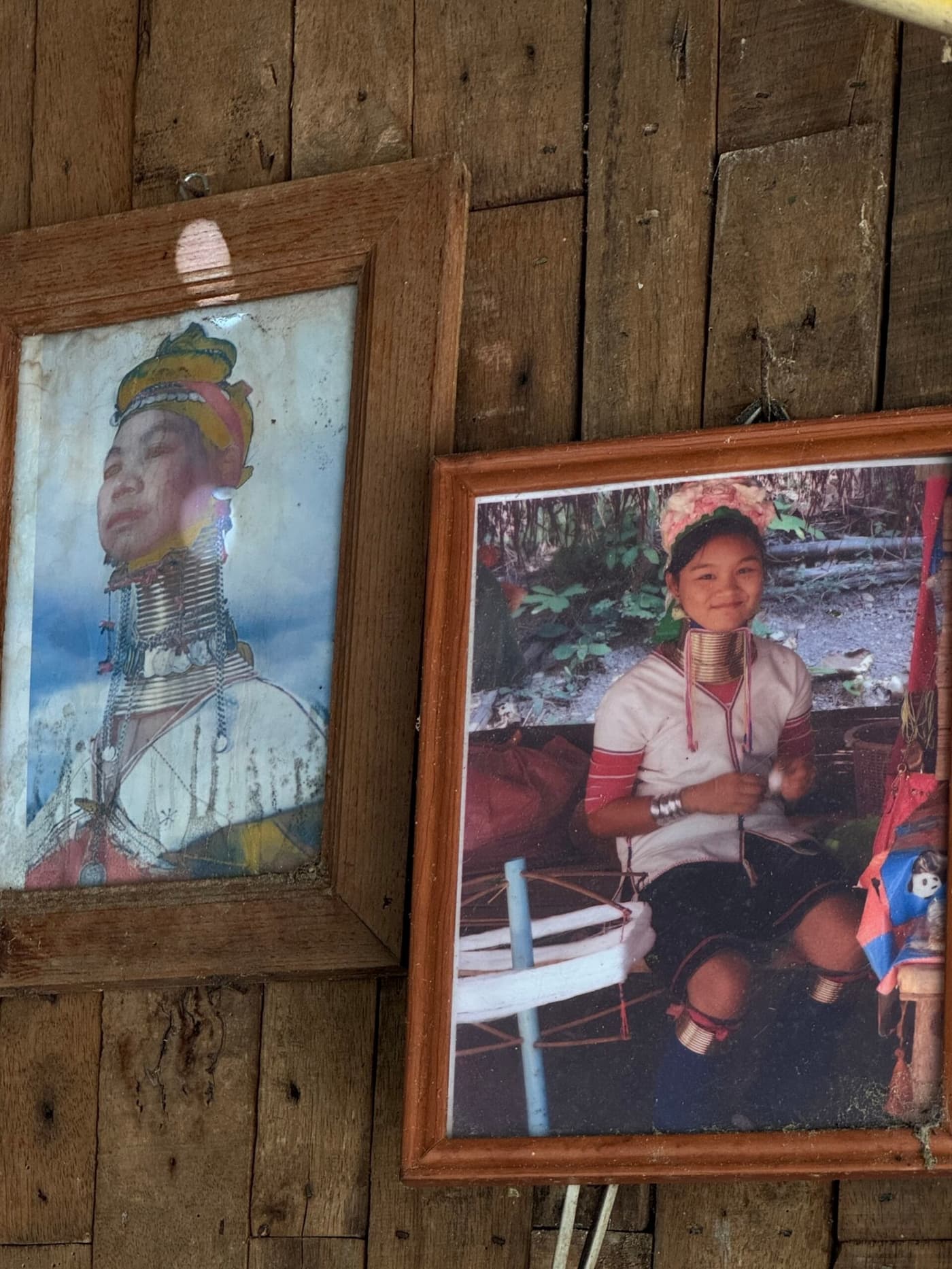
Whichever location you pick, the scenario is much the same. You arrive at the village and see women in traditional dress: colorful, with brass coils around their necks, sometimes on their wrists and shins too. Some of them weave, sew or do other work. Around the edges are souvenir stalls with woven goods, bracelets, belts and purses.
You can take photos, but you need to ask permission. In most places the women are used to it and react calmly. Some happily pose, especially if you have bought something. Some prefer not to be photographed, and that must be respected.
The level of commercialization varies a lot. At the ethnic park near Chiang Mai it is high: everything is organized for tourists. In the villages of Mae Hong Son it is much lower, and it feels more like real life that you watch from the side, with sales happening in the background rather than front and center.
The handmade items there are genuinely good: fabric with traditional patterns, embroidery. If you buy, buy from the women themselves rather than from the shops at the entrance. That way the money reaches them directly.
The ethics of visiting: two views
Opinion on this is divided, and it is important to understand that before you go.
Some human rights organizations call these villages "human zoos". The logic is that tourists pay for the chance to look at people as exhibits. The women are forced to display the tradition to earn money because they have no other options: no citizenship and no right to work in Thailand outside the village. It is not a free choice but a forced adaptation.
The other side: for many women the stream of tourists is a real source of income under extremely limited rights. The money tourism brings gives the villages a degree of protection and visibility. Some women, especially of the older generation, say they value the tradition themselves and keep it up consciously. Among the young, more and more are taking the coils off.
My view: you can go, but how you go matters. Buy from them directly. Do not photograph without permission. Do not look at people as an attraction. These are real people's lives in very difficult circumstances, and they should be treated accordingly.
I filmed our trip to the long neck village for an episode on YouTube. A like and a subscribe from you would be great 🙂
Frequently asked questions about the Karen villages
Here are answers to the questions that come up most often before a trip.
Can you photograph Karen women?
Yes, but only with permission. In most places the women are used to tourists and take photos calmly. Still, always ask: just walk up, smile and point to your camera. Do not photograph children without clear consent from the adults.
Are these real villages or a tourist set-up?
It depends on the place. The Baan Tong Luang ethnic park near Chiang Mai is an organized area created for tourists, although people really do live there. The villages in Mae Hong Son Province are real settlements with real life, and tourism there is secondary. You feel the difference right away.
Do you have to pay to enter?
Yes, almost everywhere. About 500 baht at the Baan Tong Luang ethnic park and 100–200 baht in the villages near Pai. In the Mae Hong Son villages the entrance fee may be symbolic or included in the tour price.
Does it hurt the women to wear the coils?
Those who have worn them since childhood describe it not as pain but as a familiar state. Their muscles and skeleton adapted from an early age. Discomfort can come in hot weather. The coils are not removed at night or while bathing.
Can you buy items from Karen women?
Yes, and it is a good idea. Woven goods, bracelets and handmade embroidery. Buy from the women themselves rather than from the souvenir stalls at the entrance. That way the money reaches them directly.
What should you bring?
Bring cash, because cards are not accepted everywhere. Wear light clothing that covers the shoulders (out of respect for the locals). Take water and a snack if you are going to Mae Hong Son, where the road is long and cafes are rare.
Is it worth going with kids?
Absolutely. The village is safe, and children treat visitors with curiosity. But it is important to talk to your child beforehand: explain that this is not a zoo, that staring at people in silence is rude, and that asking permission before taking a photo is a must.
How long does a visit take?
At the Baan Tong Luang ethnic park, 1.5–2 hours. In the Mae Hong Son villages you can spend half a day if you want to chat and buy something. Near Pai, 1–1.5 hours.