What to eat in Georgia: khinkali, Adjarian khachapuri, mtsvadi, lobiani, pkhali, churchkhela and orange wine from a kvevri. These are the dishes people come back to Georgia for.
Khinkali with hot broth inside, Adjarian khachapuri straight from a wood-fired oven, orange wine from a clay jar and shoti bread for 1.5 lari from a neighborhood bakery: this is the food that makes you want to return to Georgia.
We lived in Georgia for a year, and in this guide I've collected what to eat, where to look for the best versions, how to read a menu and what to expect from the wine. If you are still planning your trip, my Georgia travel guide will help.
Why Georgian cuisine is special
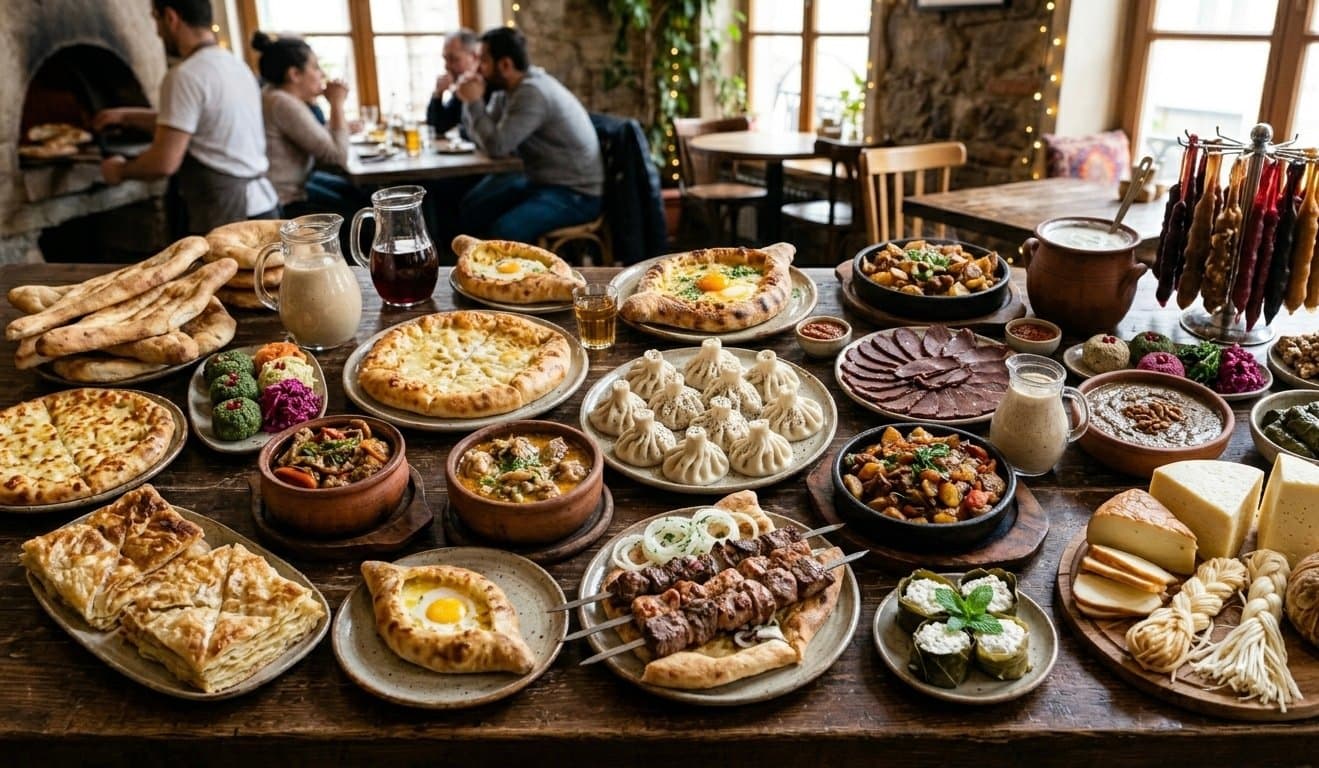
Georgia sits at a crossroads of civilizations. Persian, Turkish, Greek, Armenian and Russian influences have all passed through, and yet Georgian cuisine has managed to stay itself. It is unlike anything else.
A few principles make it stand out. Nuts are a base ingredient: walnuts show up in sauces, fillings and seasonings. Winemaking in a kvevri is done with the grape skins and seeds. There are fermented dairy products such as matsoni, Imeretian cheese, and herbs like tarragon, cilantro, fenugreek and coriander in unusual combinations. And there is a whole philosophy of the table: a Georgian meal is never quick.
Khachapuri: a family of dishes, not just one
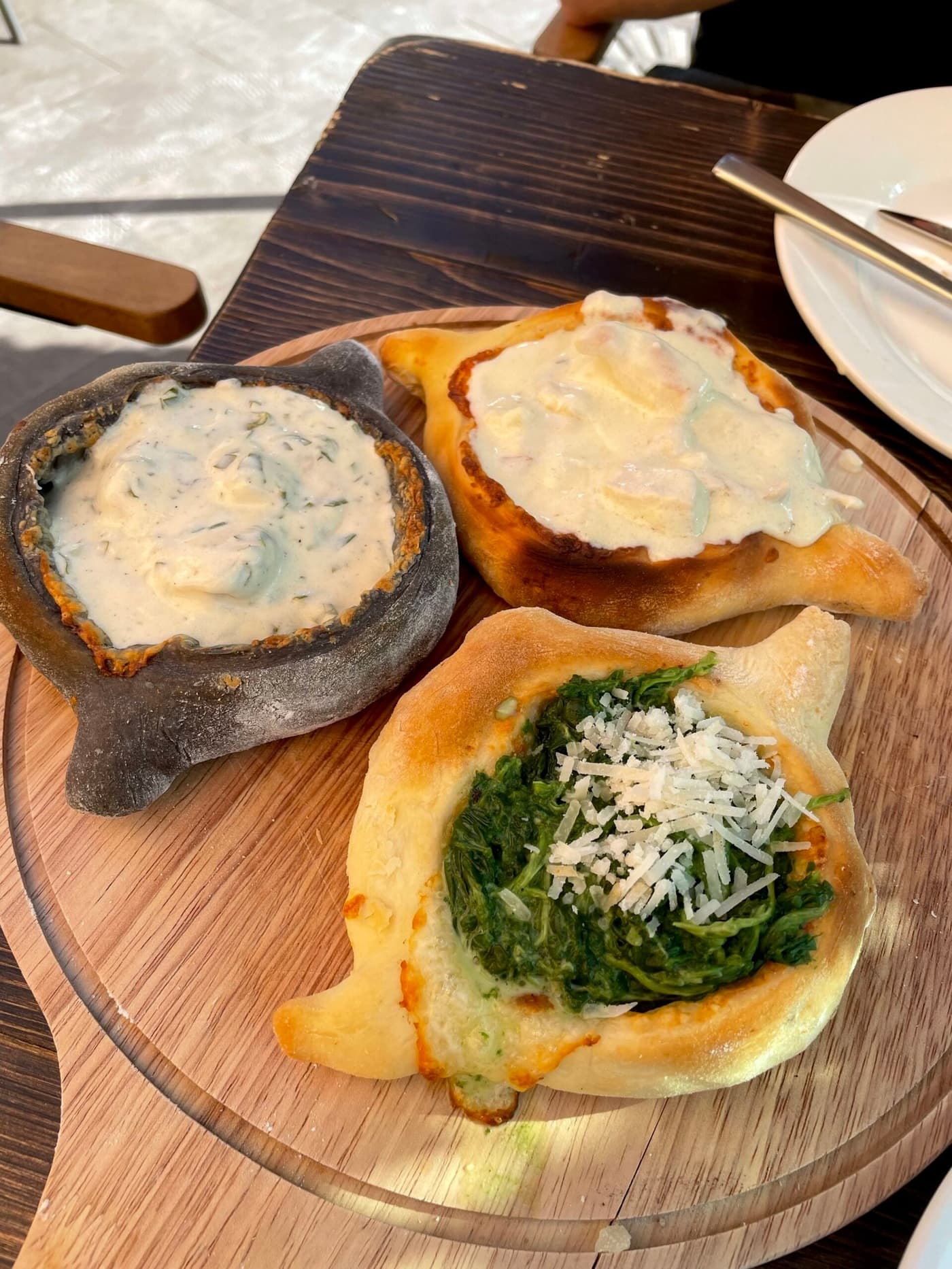
Khachapuri is not a single dish but a whole family. Every region of Georgia has its own version, and they differ a lot. A tourist who has only tried the Tbilisi khachapuri knows only half of the story.
What unites all the types is dough plus cheese. Everything else is a variation.
Adjarian khachapuri (the boat)
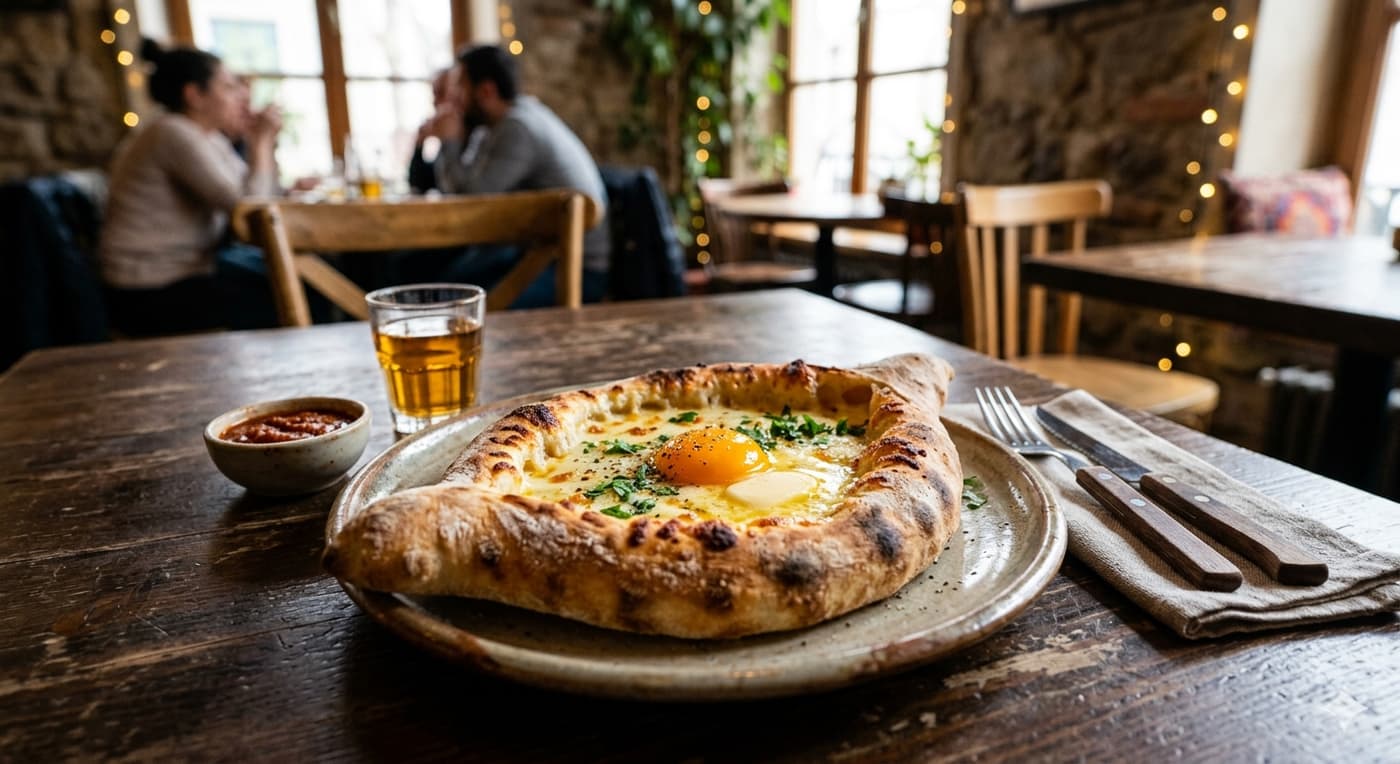
This is the best-known and most photogenic version. The dough is shaped like a boat, filled with melted sulguni, and topped with a raw egg and a piece of butter. The egg cooks through in the heat of the cheese. Stir everything together with the edges of the dough and eat it right away while it is hot. Adjarian khachapuri that has gone cold tastes like a different dish.
Its homeland is Adjara (Batumi and the surrounding area). The best Adjarian khachapuri I had was not in tourist restaurants but in simple bakeries in Batumi's residential neighborhoods, where it is baked from family recipes and served at 7 a.m. One khachapuri is already a filling lunch, since a Georgian portion looks like it is meant for two.
In Tbilisi, find the best Adjarian khachapuri by the "lots of locals" rule. If you are heading to the Georgian capital, I recommend my Tbilisi city guide.
Imeretian khachapuri
A round flatbread with Imeretian cheese inside, baked. No egg and no butter, just dough and cheese. Imeretian cheese is softer and less salty than sulguni. This is the most everyday version: people eat it for breakfast and as a snack all over Georgia.
Megrelian khachapuri
Similar to the Imeretian one, but cheese is also sprinkled thickly on top and baked to a golden crust, so cheese both inside and out. A double dose. Its homeland is Samegrelo, the region around Zugdidi and Senaki.
Gurian khachapuri
A half-moon of layered dough filled with Imeretian cheese and a boiled egg. Traditionally eaten on holidays, especially at Christmas. A rarer variety that you won't find everywhere.
Achma
A multilayered pie of thin sheets of dough with cheese between them, baked. More like lasagna or a casserole than a flatbread. Rich and filling, popular in western Georgia.
Penovani
Puff pastry with cheese. A crispy, light variety. Most bakeries in Tbilisi sell it as a quick snack for 3-5 lari.
Khinkali: the rules, the ritual and where to find the real thing
Khinkali are large dumplings filled with meat and hot broth. They are one of Georgia's main dishes, with their own eating culture.
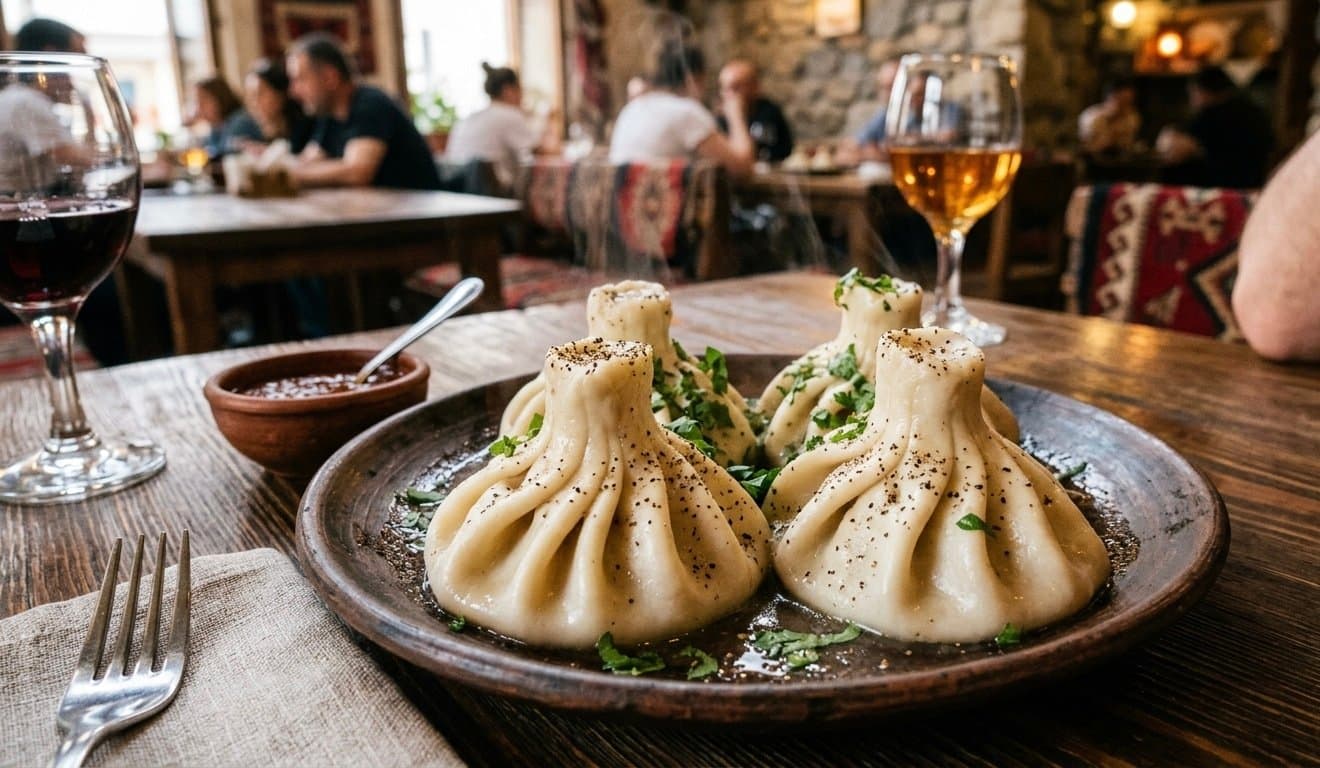
The dough is kneaded stiff, and the filling is much more generous than in ordinary dumplings. The top is pinched into a characteristic fold (the "tail"). While the khinkali cook, broth forms inside, and that is the whole point.
The fillings: meat khinkali (kalakuri, "city style") are made with beef and a little pork, onion, pepper and herbs. Mountain khinkali (mtiuluri) have chopped meat with lamb fat and herbs, without onion. There are also vegetarian versions: potato with cheese, and mushrooms. Each tastes different.
How to eat them properly: pick one up by the "tail", bite into the side near the bottom, and sip the broth slowly so it doesn't spill. Then eat the meat with the dough. Leave the tail on the plate: it is how the pieces eaten are counted. Eating khinkali with a fork is acceptable, but locals look on with mild bewilderment.
One khinkali weighs 80-100 grams. A normal portion is 5-8 pieces. In a good place the price is 1.5-2.5 lari apiece. In tourist restaurants it is 3-5 lari.
In the mountains (Kazbegi, Stepantsminda) khinkali are made differently: the dough is thicker and the filling has lamb and mountain herbs. This is the Kazbegi style, and it tastes completely different.
Where to find the best khinkali in Tbilisi: in dedicated khinkali places, not in restaurants aimed at tourists:
-
Racha (Dukhan Racha) (Lermontov St., near Freedom Square). This is not just a place to eat, it is a portal to the past. A real Tbilisi dukhan in a half-basement. No polish: plain tables and stern but colorful women at the serving counter. The khinkali here are the benchmark, with thin dough, juicy meat and lots of herbs. Bonus: try the homemade wine and lori (Georgian ham) here too.
-
Pasanauri (a chain across the city, one of the most popular on Griboedov St.). A great example of a chain that keeps its standard. Both locals and well-informed tourists go here. Evening lines are normal. Their signature is Pasanauri khinkali with hand-chopped meat (not ground meat). The texture is incredible and there is a lot of broth inside.
Meat: mtsvadi, chkmeruli, chanakhi
Georgia is a meat country, and the meat here is done well.
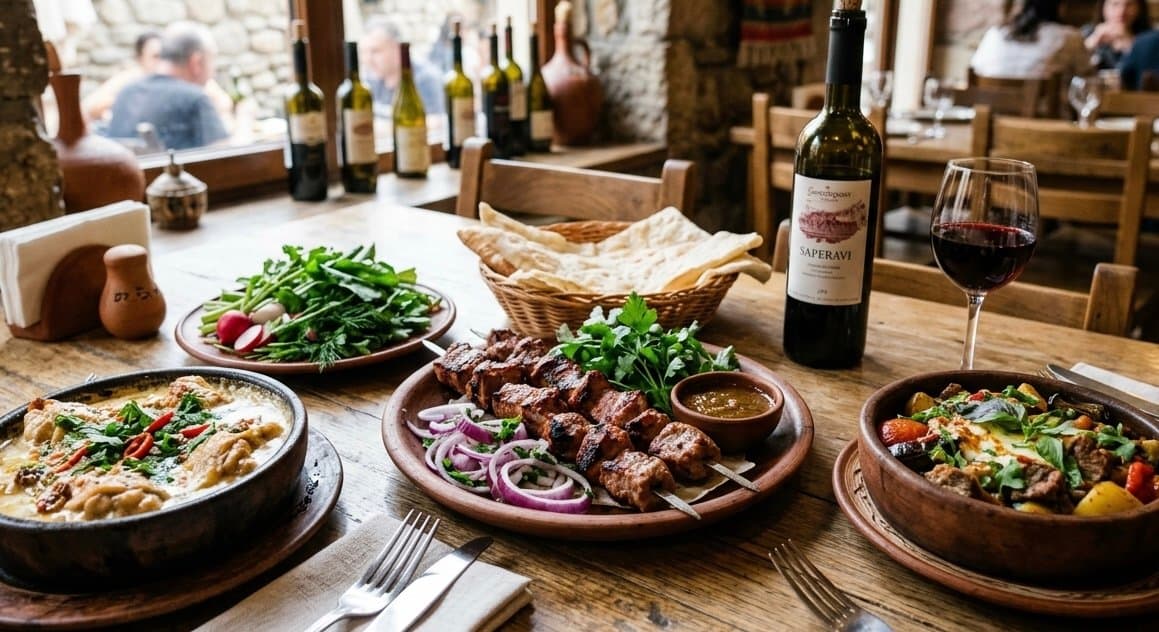
Mtsvadi is Georgian shashlik, and it is a different product from the Central Asian kind. The meat is marinated in onion and grilled over a mangal, and the main secret is the coals from grapevine, which give a distinctive aroma without bitterness. No extra spices: salt, sometimes a little black pepper. Beef, pork or lamb. The best mtsvadi is at simple grill places with a line of locals, not in tourist restaurants.
Chkmeruli is chicken in a creamy garlic sauce. A dish from the mountainous Racha region, named after the village of Chkmeri, that became a national favorite. Tender and fragrant, with a thick sauce you can dip bread in. It is served in a ketsi (a clay pan).
Chanakhi is stewed lamb with vegetables (potatoes, tomatoes, eggplant, onion, herbs) in a clay pot. Slow cooking, deep flavor. Especially good in cold weather.
Satsivi is chicken or turkey in a walnut sauce with spices (cinnamon, cloves, saffron, garlic). It is served cold. It has an unusual flavor and may not win you over the first time, but afterward you want it again.
Ojakhuri is fried pork with potatoes and onion in a ketsi. Simple, filling, homestyle. It is on the menu almost everywhere.
Basturma is cured spiced meat. Armenian in origin, but common in Georgia too.
Fish and seafood
By and large Georgia is not a fish country, but in Batumi and along the Black Sea coast the fish is fresh and good. Red mullet, gray mullet, Black Sea horse mackerel and mussels. The fish market by the embankment in Batumi is the best place to choose.
The mountain rivers have trout. Restaurants in Kazbegi and Svaneti often serve trout raised in mountain rivers, either grilled over coals with herbs or baked.
Vegetable and vegetarian dishes
Georgian cuisine is not only meat. There is a whole layer of meatless dishes, very rich and tasty. Fasting dishes are well developed in the Georgian Orthodox tradition, and the fasts here are strict.
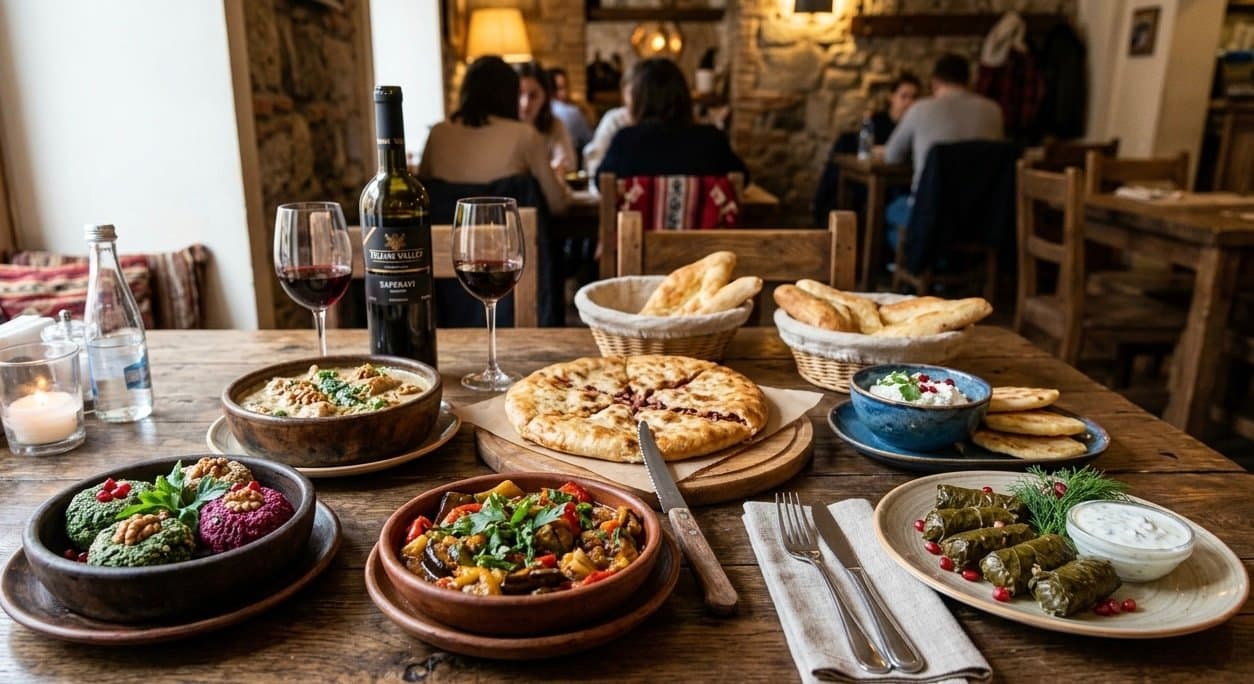
Pkhali is a must-try. A cold appetizer of boiled or stewed vegetables (spinach, cabbage, beet, green beans) ground with walnuts, garlic, fenugreek and pomegranate. It is served as small balls with a pomegranate seed on top. A plate usually has 2-3 kinds made from different vegetables.
Bazhe is a sauce of walnuts with garlic, vinegar and spices. It is poured over fish, chicken and vegetables, a universal Georgian dressing.
Lobiani is a flatbread filled with stewed beans, onion and spices. Filling, cheap and very much a people's food. In mountain areas (Kazbegi, Svaneti) it is the main street food.
Ajapsandali is a stewed ragout of eggplant, sweet pepper, tomatoes, onion and herbs. A summer dish, especially good made from fresh seasonal vegetables.
Nadugi is a delicate whey cheese wrapped in mint leaves. Fresh, light and unlike anything else. Sold at markets and in expensive restaurants.
Dolma (tolma) is grape leaves stuffed with rice and meat, or with rice only. A pan-Caucasian dish with its own Georgian version.
Bread and baked goods
Shoti is Georgian wheat bread baked in a tone (a clay oven dug into the ground). Long, with a characteristic "banana" shape, crisp outside and soft and airy inside. Hot shoti from a bakery for 1-1.5 lari is one of Georgia's best simple pleasures. Eat it immediately, without putting it off.
Tone is the name of both the oven itself and the baking tradition. In many bakeries you can watch the dough being slapped onto the red-hot walls of the oven by hand, a spectacle in itself.
Churchkhela is a Georgian "candy": walnuts or hazelnuts strung on a thread and dipped several times in thickened grape juice with flour. Sold at markets, by the roadside in Kakheti and in souvenir shops everywhere. It comes in dark and light grape juice versions. The taste is rich and sweet with a nutty bitterness. Good-quality churchkhela is soft on the outside and not too hard inside.
Gozinaki is slices of walnuts in a caramel of honey and sugar. Traditionally made for New Year. Sold in shops all year round.
Georgian cheeses
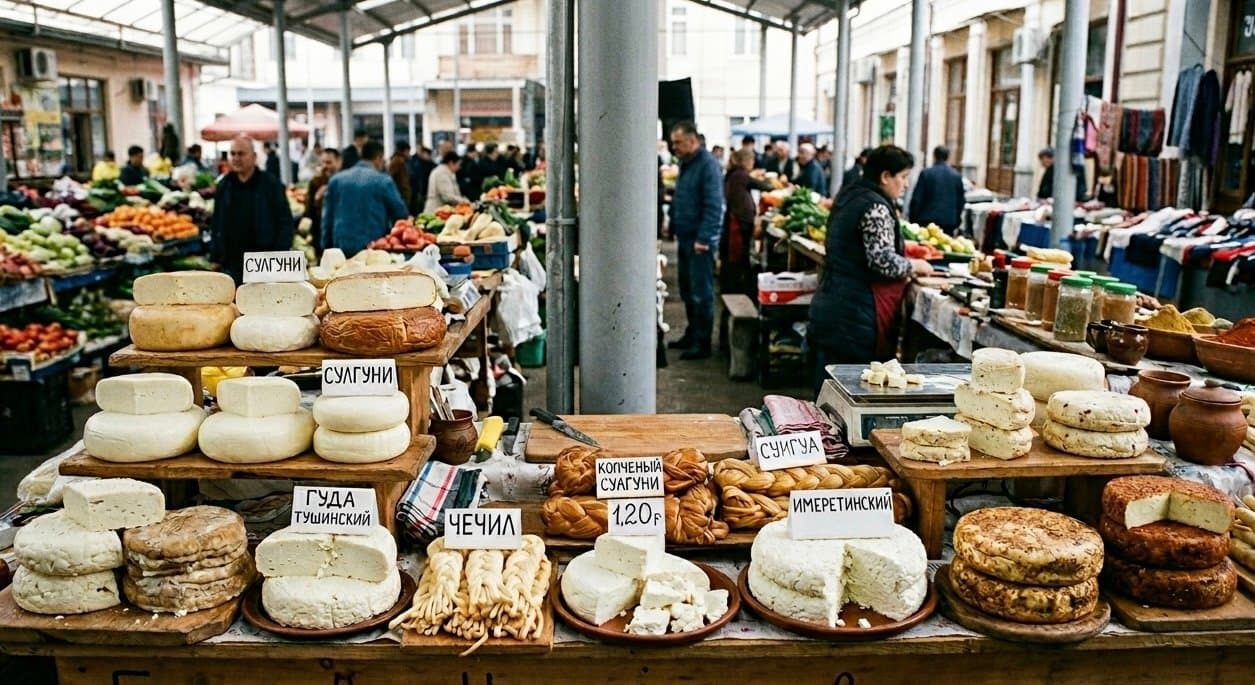
Sulguni is the best known. Salty, elastic and melts well. It is the cheese inside most khachapuri. Fresh sulguni tastes completely different from the vacuum-packed kind in a shop: moist, soft, with a slightly sour milky note.
Imeretian cheese is white, soft, and less salty and fatty than sulguni. Used in Imeretian khachapuri. In taste it is closer to cottage cheese or mozzarella.
Guda is an aged sheep's-milk cheese with a characteristic sharp, "mountain" flavor. It is made in high-mountain areas. At the Dezerter Bazaar in Tbilisi you can find the real thing from farmers.
Tenili is from Samtskhe-Javakheti and looks like skeins of cheese threads. Handmade and rarely found in ordinary shops.
Matsoni is a fermented dairy product, something between yogurt and kefir. Eaten with honey for breakfast or as a side with meat.
Georgian wine: a full breakdown
Georgia is one of the oldest wine-producing regions in the world: wine has been made here for 8,000 years. The country has about 500 indigenous grape varieties, and nowhere else in the world has anything comparable. The main region is Kakheti, with 70-80% of all production.
Kvevri winemaking
Georgia's main contribution to world winemaking is the kvevri. It is a clay jar with a capacity of 100 to several thousand liters, buried in the ground. The grapes are pressed whole, with skins, stems and seeds (chacha), and kept in the kvevri for several months. This is called skin contact, and it gives white wines an orange color, tannins (which white wine normally doesn't have) and a complex, layered flavor.
Kvevri winemaking is on UNESCO's list of intangible cultural heritage. Orange wines from Georgia are riding a wave of worldwide interest, from wine festivals to restaurants in big cities. But drinking them in Kakheti, straight from the jar, is something else entirely.
The first glass of orange wine can surprise you: this is not a European white. The taste is dense, sometimes slightly astringent, with bitterness in the aftertaste. After that, it usually hooks you. Give yourself at least two or three glasses to understand this style.
Key grape varieties
Rkatsiteli is the main white grape of Kakheti. In the orange style it is rich, with notes of dried fruit and nuts and a long finish. In the European style (without skin contact) it is lighter and fruitier.
Mtsvane is the second important white grape of Kakheti. More aromatic and floral. Often blended with Rkatsiteli.
Saperavi is Georgia's main red wine grape. One of the few varieties with colored flesh (most red wines get their color only from the skin). Dark, with high acidity and good aging potential. Saperavi is used for both light everyday wines and serious aged ones.
Khvanchkara is the famous semi-sweet red from Racha (a mountain region in northern Georgia). Made from the Aleksandrouli and Mujuretuli varieties. It is the one Stalin is generally believed to have loved.
Kindzmarauli is a semi-sweet red made from Saperavi, from the micro-region of the same name in Kakheti. Softer and sweeter than dry Saperavi.
Tvishi is a rare semi-sweet white from Racha. Look for it in specialist wine shops.
Where to drink wine in Tbilisi
Vino Underground is one of the best wine bars in Tbilisi. A small half-basement space with a large selection of natural wines from small producers. The sommeliers will help you choose. A glass costs 8-20 lari.
8000 Vintages has a large range of Georgian wines (and international ones), a good place to compare styles. Shop plus bar.
Wine Factory No. 1 is on the grounds of a former factory, in a large space. Tastings and tours.
In Kakheti, go straight to family maranis (wineries). In Telavi and Sighnaghi many producers receive tourists. A tasting of 4-6 wines with a snack costs 20-40 lari per person.
How to choose wine in a shop
A bottle of decent Georgian wine in a supermarket costs 15-35 lari ($5-12). A good natural wine from a small producer is 40-80 lari. In a restaurant a bottle starts at 50-100 lari.
Reliable producers (for different budgets): Pheasant's Tears (natural, Sighnaghi), Iago's Wine (kvevri), Schuchmann, Marani, Tbilvino (more mass-market, good quality).
Other drinks
Chacha is grape vodka (grappa). Homemade is 50-70% ABV, factory-made 40-45%. Homemade chacha is a very different thing from the factory kind. Guesthouses often treat you to their own; drink it in small shots as an aperitif and take your time.
Natakhtari and Zedazeni lemonade are Georgian sodas with a Soviet history. The flavors are tarragon (estragon), pear, cream soda and chocolate. The tarragon one is green and questionable to look at, but give it a try. Sold in any shop for 1-2 lari a bottle.
Matsoni is a fermented milk drink that refreshes in the heat.
Georgian tea is grown in western Georgia (Samegrelo, Adjara). Simple, not refined, but its own.
Where to eat in Tbilisi: specific recommendations
- Khinkali at Pasanauri is a popular chain (on Freedom Square, Griboedov St. and elsewhere). The khinkali are excellent, the places are open around the clock or until late at night, and lines at peak hours are normal.
- Racha is a legendary, colorful dukhan. The atmosphere of old Tbilisi, low prices, plain tables and regulars.
- Khinkali places near the Didube bus station are gastronomic extreme sports for diving into everyday life. Maximally down to earth, very cheap, with huge meaty khinkali. Not a place for aesthetics but for hearty food "for the regulars" before a journey.
- Georgian cuisine at the Chveni restaurant, a branch of a well-known brand.
- Barbarestan cooks from old 19th-century cookbooks, with unique dishes. Shavi Lomi in the Vera district has a lively atmosphere and good food.
- Dezerter Bazaar is for stocking up on food: cheeses, spices, nuts, fresh vegetables, fresh bread. The best prices and freshness in the city.
- Shoti bakeries are in every residential area. Follow the smell and the line; fresh bread sells out in 15-20 minutes.
More on where to eat in Tbilisi in a companion article.
Where to eat in Batumi
- Adjarian khachapuri is best in bakeries in residential neighborhoods, not in the tourist restaurants on the embankment. Ask your hosts where they go themselves. Follow the smell of the wood-fired oven and the line of locals.
- Fish is at the fish market by the embankment (in the morning, before 9:00). You choose fresh fish there and it is cooked on the spot, or you take it home. Red mullet, horse mackerel, gray mullet, all from the Black Sea.
- Sazandari restaurant at 78a Gorgiladze St. has live music in the evenings, local prices and good food without the tourist markup.
- Lagoon cafe at 18 Gorgiladze St. has been open for more than 25 years, and its Adjarian khachapuri is considered one of the best in the city.
- The main rule: the best food in Batumi is not on the embankment. On the embankment you pay for the view: the same food costs 1.5-2 times more. On the parallel streets, such as Khimshiashvili Street and the side lanes of the Old Town, the prices and the quality are different.
A detailed article: where to eat in Batumi, a list of cafes and restaurants
What to bring home from Georgia
For those who want to take the flavors home: Svan salt (a blend of salt with garlic, fenugreek and chili, sold in every souvenir shop for 5-15 lari). Khmeli-suneli and utskho-suneli, Georgian spice blends. Churchkhela, but choose a soft one, not a dry one. Homemade wine or a bottle from a good shop. Georgian tea from western Georgia. Adjika, a hot paste of pepper and herbs: it burns, but it is aromatic.
Regional cuisines of Georgia
Georgia is a small country with great culinary diversity. Every region has its own identity, its own products and its own dishes that you won't find elsewhere.
Kakhetian cuisine is the best known outside Georgia. Here you get mtsvadi over grapevine coals, pelamushi (a thick dessert of grape juice with flour and nuts) and badrijani nigvzit, eggplant with a walnut filling and pomegranate seeds. Kakheti is also orange wine straight from the marani (the family winery). If you can, go on a tasting in Sighnaghi or Telavi.
Megrelian cuisine is the spiciest in Georgia. Megrelian adjika, a red paste of hot pepper, garlic and spices, accompanies almost every dish. Megrelian khachapuri with a double layer of cheese. Gebzhalia is cheese in a mint sauce. Egrisi is a walnut soup. Samegrelo is for those who like real fire on the tongue.
Adjarian cuisine has a noticeable Turkish accent. Fish: Black Sea red mullet, horse mackerel, gray mullet; Adjarian khachapuri in the boat shape; the local adjika is a little milder than the Megrelian one. Turkey's influence is felt in the spices and in tea culture: tea in armudu glasses (pear-shaped glasses) is an Adjarian tradition.
Svan cuisine is mountain food, hearty and distinct. Kubdari, a pie with chopped meat and spices, is the main Svan dish. Chvishtari is a cornmeal flatbread with Imeretian cheese, served hot. Svan salt, a blend of salt with garlic, fenugreek, red pepper and mountain herbs, is the main souvenir from Mestia and is used everywhere: on meat, vegetables and bread.
Georgian markets: shop and soak it in
A Georgian market is a whole social institution, worth visiting at least once.
Dezerter Bazaar in Tbilisi is a huge covered market in the city center, next to the railway station. They sell everything here: fresh sulguni and guda straight from the wheel, homemade wine and chacha in plastic bottles, pkhali, tklapi (dried fruit leather), spices by weight, walnuts in honey, fresh herbs in bunches. Vendors offer you a taste without obligation to buy, so don't be shy.
The market in Batumi by the port sells fish and groceries. In the morning (before 9:00) the catch is fresh: Black Sea horse mackerel, gray mullet, red mullet. You can ask them to fry the fish on the spot.
The market in Telavi (Kakheti) is for wine and local products. Homemade wine in plastic jugs starts at $2 a liter, and it can be very good wine. Taste before you buy.
The supra (feast): if you are invited
If locals invite you to a feast, don't refuse. It is one of the liveliest cultural experiences Georgia offers.
The tamada is the toastmaster, who delivers the toasts. First to God, then to the country, the host of the house, the guests, the departed, and peace. You drink in turn for each toast. Refusing food is bad manners. Eat everything that is offered. Don't hurry; a Georgian feast lasts for hours. Listen to the stories.
FAQ: Answers to common questions about what to eat in Georgia
What should I definitely try in Georgia?
Khinkali with hot broth, Adjarian khachapuri (the boat with an egg), mtsvadi over grapevine coals, pkhali, orange wine from a kvevri and homemade chacha as an aperitif. That is the basic food list.
How is Georgian cuisine different from Armenian?
Both have walnut sauces and lamb. But Georgia has the unique khinkali and several kinds of khachapuri, a developed cheese culture and an incomparably rich winemaking tradition. Armenia is known for dolma, khorovats and brandy.
What is orange wine?
White wine made with long contact between the juice and the grape skins (skin contact). Orange color, tannins, complex flavor. A traditional Georgian technique (kvevri) that is now popular worldwide.
Do you eat khinkali with your hands?
Yes, traditionally. You hold it by the tail, bite in from below and drink the broth. A fork is acceptable but not traditional.
How much does it cost to eat in Georgia?
Lunch in a local cafe is 15-25 lari. Khinkali are 1.5-2.5 lari apiece at a non-tourist place. Dinner for two with wine at a good restaurant is 80-150 lari. More about prices in Tbilisi.
Is there vegetarian food in Georgia?
Yes, and plenty. Pkhali, lobiani, ajapsandali, nadugi and Imeretian khachapuri are all meat-free. Fasting dishes are well developed in Georgian tradition because of the strict Orthodox fasts.
Where can I buy good Georgian wine?
In Tbilisi: Vino Underground, 8000 Vintages, Wine Factory No. 1. In Kakheti, at family maranis directly from the producer. The supermarkets Carrefour and Smart have a decent selection.
What is chacha?
Grape moonshine (grappa), Georgia's national strong drink. Homemade is 50-70% ABV, factory-made 40-45%. Drunk as an aperitif in small shots. Being offered homemade chacha is a good sign of hospitality.
Is it worth going to Kakheti specifically for the food and wine?
Yes. Kakheti is a food route in its own right: tastings at family maranis, mtsvadi over real grapevine coals, pelamushi, homemade cheese. It is worth setting aside at least one day from Tbilisi. A trip to Sighnaghi or Telavi is not a tourist attraction, it is another layer of Georgia.
What is Svan salt and why bring it home?
Svan salt is a blend of ordinary salt with garlic, fenugreek, red pepper and mountain herbs. It is used as a universal seasoning for meat, fish, bread and vegetables. The best is bought in Mestia (Svaneti) directly from locals, but souvenir shops in Tbilisi and Batumi have it too, for 5-15 lari.
Is Georgian food suitable for children?
Generally yes. Shoti, Imeretian khachapuri, chkmeruli, ojakhuri and khinkali (without hot spices) are usually eaten by kids with pleasure. It is better to ask in advance about spicy dishes: Megrelian adjika and some sauces are very hot.
Can I eat well in Georgia without speaking Georgian?
Menus in most tourist places are in English. In small local cafes it is enough to know a few words: "khinkali", "khachapuri", "mtsvadi" and "madloba" (thank you). Georgians are very warm toward anyone who makes even a small effort.