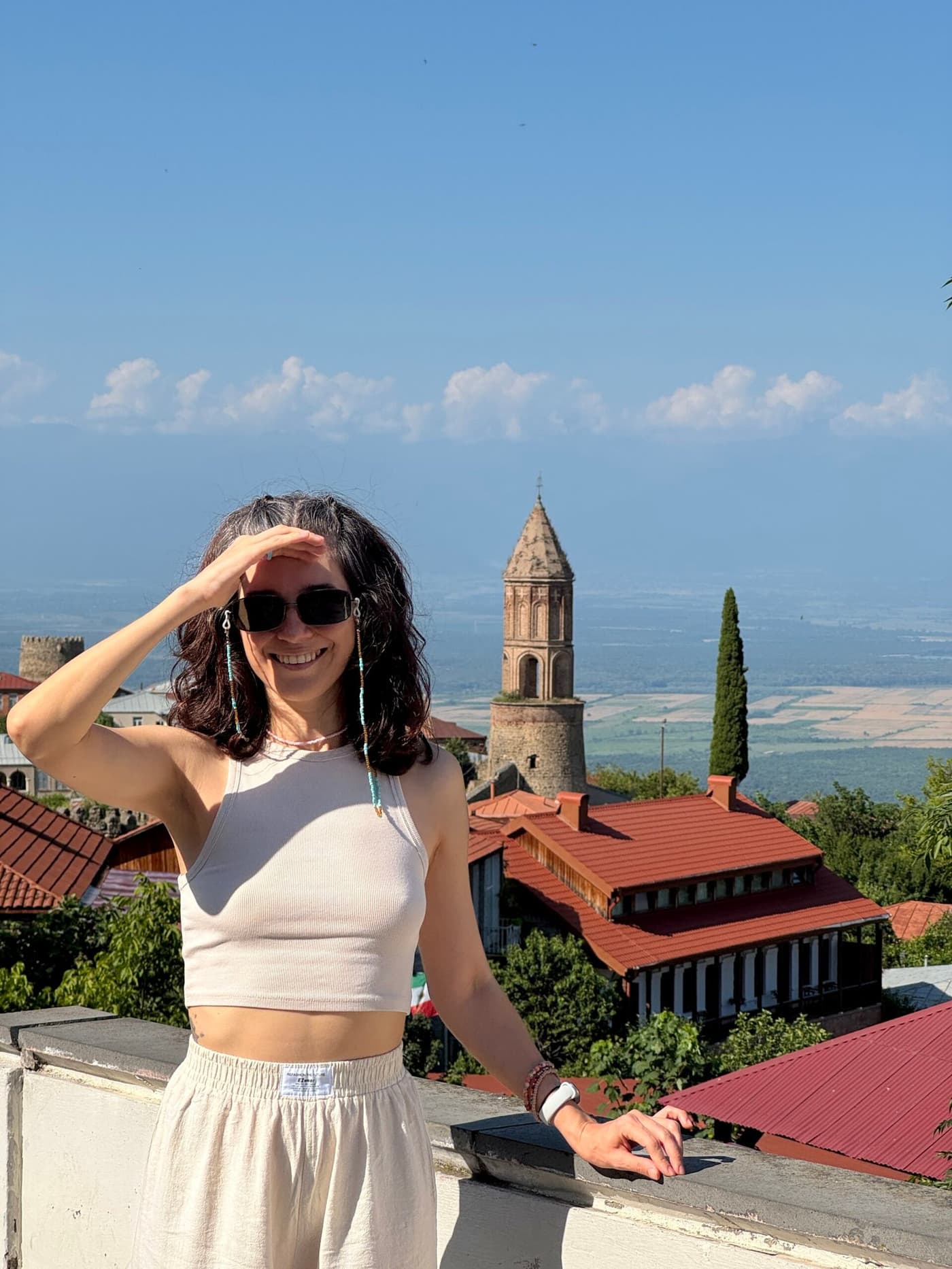
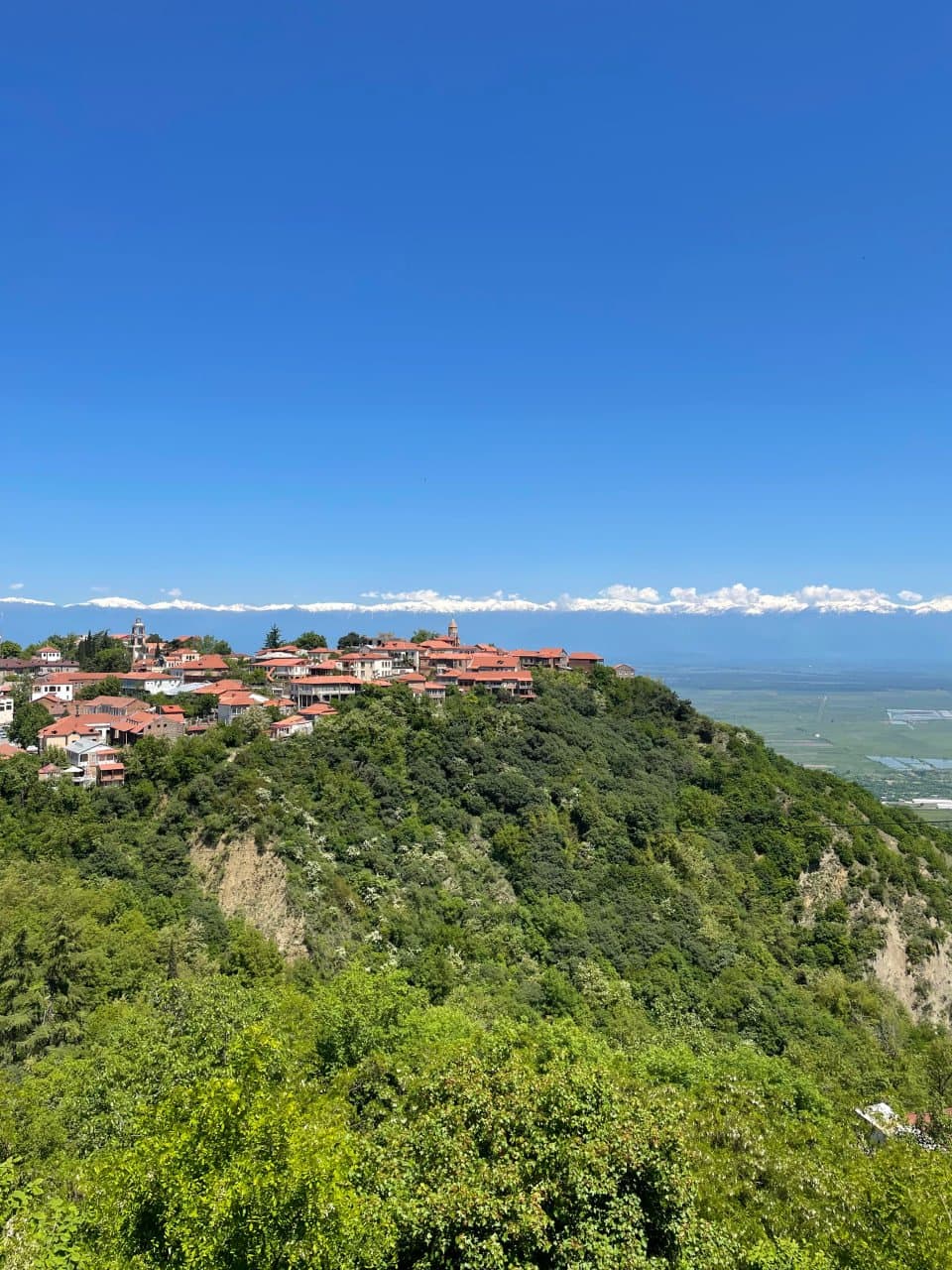
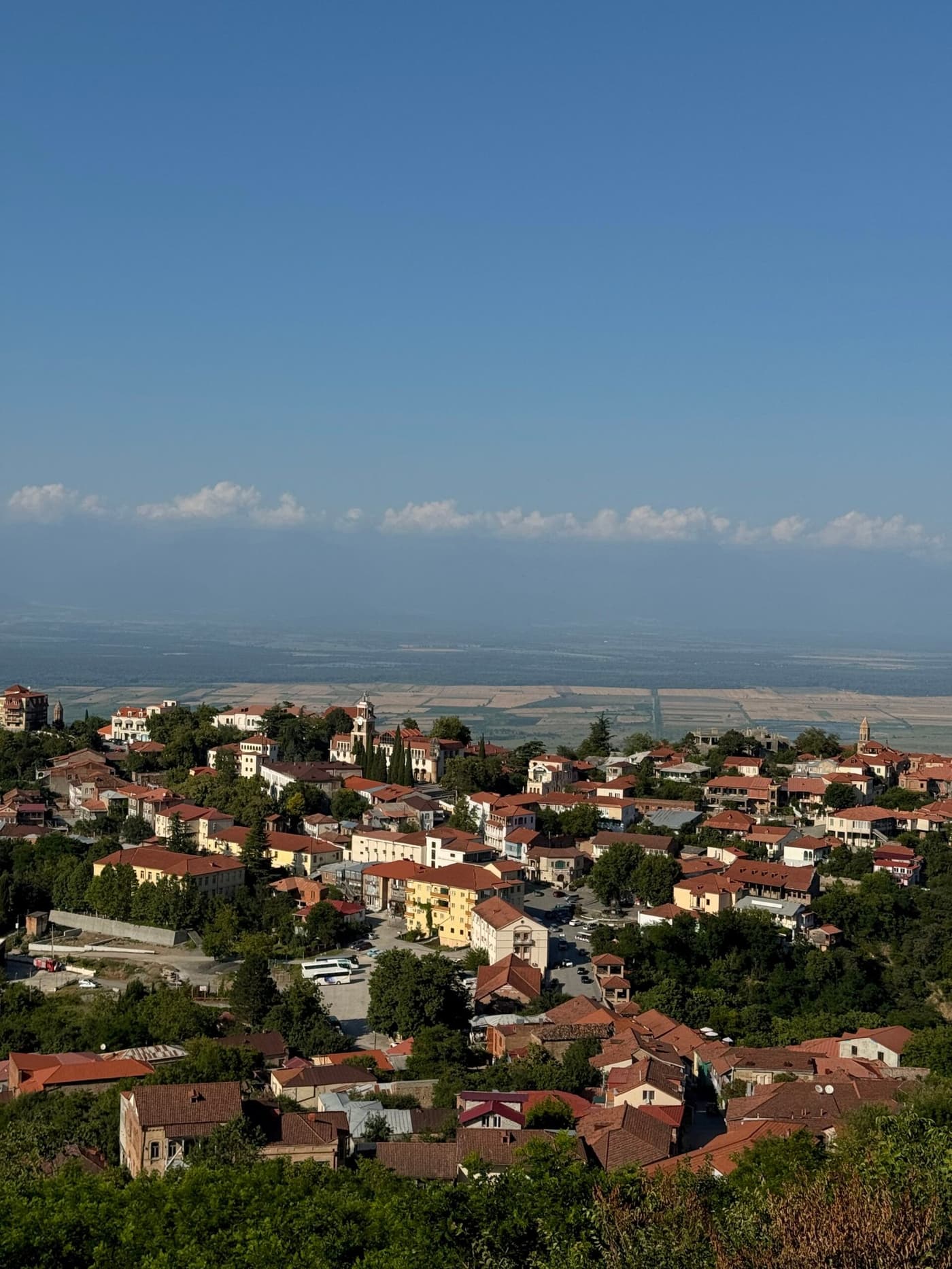
Signagi is called the "city of love," and the nickname has stuck so well that it has become a brand. But I would call it the city of wine and views. It sits on a hill above the Alazani Valley, ringed by a fortress wall with 23 towers, with cobbled lanes inside, balconies full of geraniums and taverns pouring homemade wine. The Greater Caucasus mountains on the horizon are not going anywhere. They are part of every shot you take here.
It is one of the few places in Georgia where the tourist infrastructure is done properly: there is somewhere to stay, somewhere to eat, and it is clear how to get around. And yet it does not feel like a theme park. It is a real, living town with real people and real wine from the courtyards next door.
We have been to Signagi several times, and it is one of my favorite places to escape to for a day from Tbilisi. In this article I put together a full Signagi guide: how to get there from Tbilisi, and what to see in the town itself and along the way. If you are only planning your trip, my Tbilisi city guide will come in handy too.
A Brief History of Signagi
By Georgian standards, Signagi is a young town. It was founded in the 18th century on the site of older settlements as a defensive outpost of Kakheti. The fortress wall around the town was built in the 18th century under King Erekle II, the same king under whom Georgia signed the Treaty of Georgievsk with Russia in 1783, placing itself under Russian protection from Persian raids. The wall, about 4 km long with 23 towers, enclosed the whole town and let residents take shelter from enemy attacks.
In the Soviet era Signagi fell into decline and the houses crumbled. A major restoration began in 2005–2007, and under Saakashvili the town was renewed almost completely: the cobblestones were relaid, the facades repainted and the infrastructure brought up to standard. That was when the round-the-clock wedding registry office opened here, unique in Georgia, which earned the town its reputation as the "Georgian Las Vegas." Tourists started coming, and the town came back to life.
Today Signagi is one of the most visited towns in Kakheti, and it has still kept a provincial rhythm of life.
What to See in Signagi
The town is small, and all the main sights fit into one day on foot. Here are the key stops on the route.
The Fortress Wall and Towers
The 18th-century wall, about 4 km long, circles the whole town. You can walk along a good part of it. The path runs along the top, between the towers, with views of the Alazani Valley and the mountains on the horizon. Of the 23 towers, some are well preserved and some are in ruins, but the overall scale is impressive.
Access to the wall is free. The best view is from the northern towers near the viewing point, especially in the morning or the second half of the day, when the Greater Caucasus is lit from the side. Early in the morning the valley is often covered in fog, which is beautiful in its own way. In the middle of the day, with the sun high, the light is harsh.
Walking the whole wall takes about 40–60 minutes at a relaxed pace, with stops for photos.
The Old Town
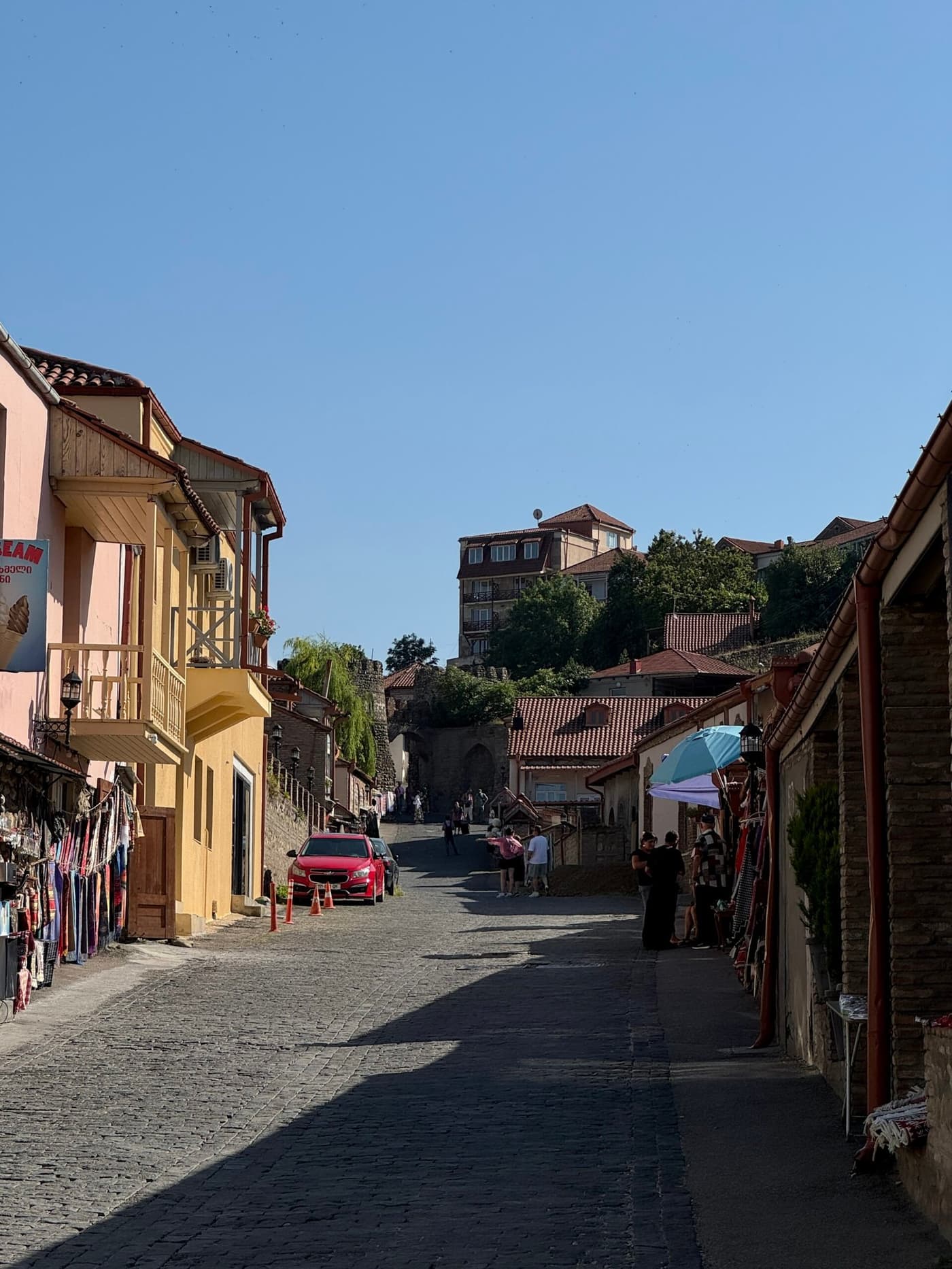
Narrow lanes, little houses with wooden balconies and geraniums, small cobbled squares: this is not scenery, it is a working residential neighborhood. People live here, front gardens bloom and grapes dry in the courtyards.
A walk around the old town works best without a plan. Just go wherever the street leads you, peek into open courtyards with grapevines and stop in the shade for a coffee. The whole old town fits within a radius of a kilometer and takes an hour to an hour and a half to cover.
The main square has several cafés and a small market with wine, churchkhela and cheese. The wedding registry office, which I cover in more detail below, is here too.
Bodbe Monastery
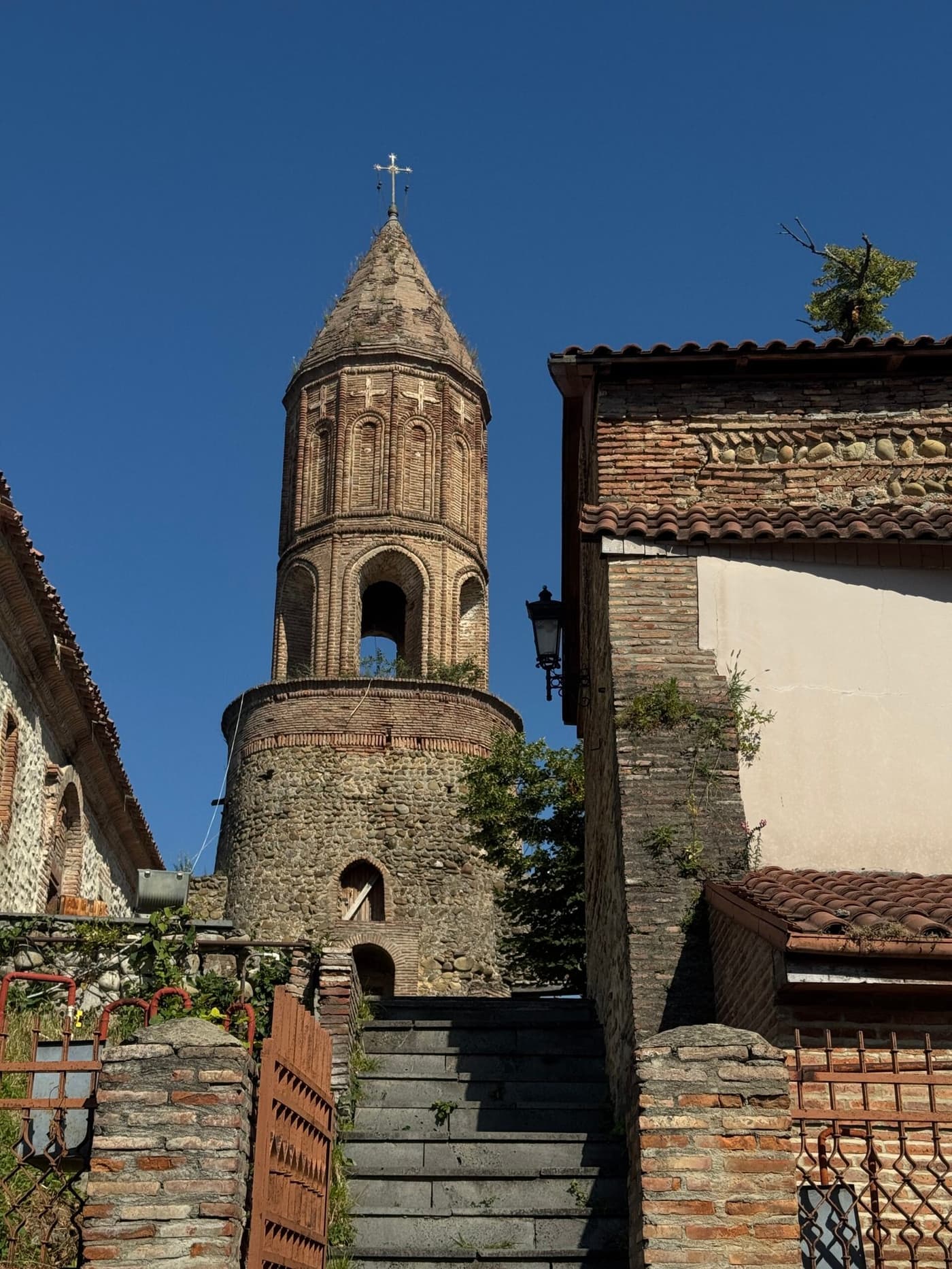
Bodbe Monastery is 2 km from Signagi. It is one of the main sacred sites of Kakheti and of Georgia as a whole: Saint Nino, the Cappadocian nun who brought Christianity to Georgia in the 4th century, is buried here. Nino spent the last years of her life in these parts and died at Bodbe around 338. At her request she was buried right here, in a thicket of blackberry bushes. King Mirian III built the first church on this spot, and it later grew into a monastery complex.
Today Bodbe is a working convent with beautiful gardens. The main church dates from the 9th century, and inside you will find frescoes and the relics of Saint Nino, along with a steady stream of pilgrims from Georgia and abroad. A flight of steps leads down from the monastery to a spring, and its water is considered healing.
The atmosphere at Bodbe is quiet and contemplative. Come in the morning or toward evening, because tour buses arrive in the middle of the day.
Entry is free. It is open from 10:00 to 18:00 (check the service schedule). The walk from Signagi takes 20–25 minutes, and a taxi costs 5–7 lari.
Signagi Museum
A small local history museum in the center of town. The collection includes artifacts from Kakheti, jewelry, everyday objects and examples of medieval painting. The collection of works by Niko Pirosmani, the famous Georgian primitivist painter, who was born in Kakheti, deserves special attention. Entry is 5 lari. A visit takes about an hour.
The Signagi Wedding Registry Office: What It Is and How It Works Now
The town earned its reputation as the "Georgian Las Vegas" after a registry office opened here in 2007 that married couples 24 hours a day. All you needed was your passports, with no advance booking and no bureaucracy. Couples would arrive in the middle of the night and leave married.
The rules have changed since then: the registry office now works from Wednesday to Sunday, 09:00 to 18:00. The round-the-clock schedule is a thing of the past. But the conditions are still simplified by Georgian standards: a couple's passports are enough, and there is usually no queue. If you are planning to do it, get in touch in advance to check the current conditions.
Wine in Signagi and Kakheti
Kakheti produces about 70% of all Georgian wine. The climate is dry continental, with hot summers and cool winters, which is ideal for growing grapes. The Alazani Valley, which you can see from Signagi's fortress wall, is one continuous vineyard.
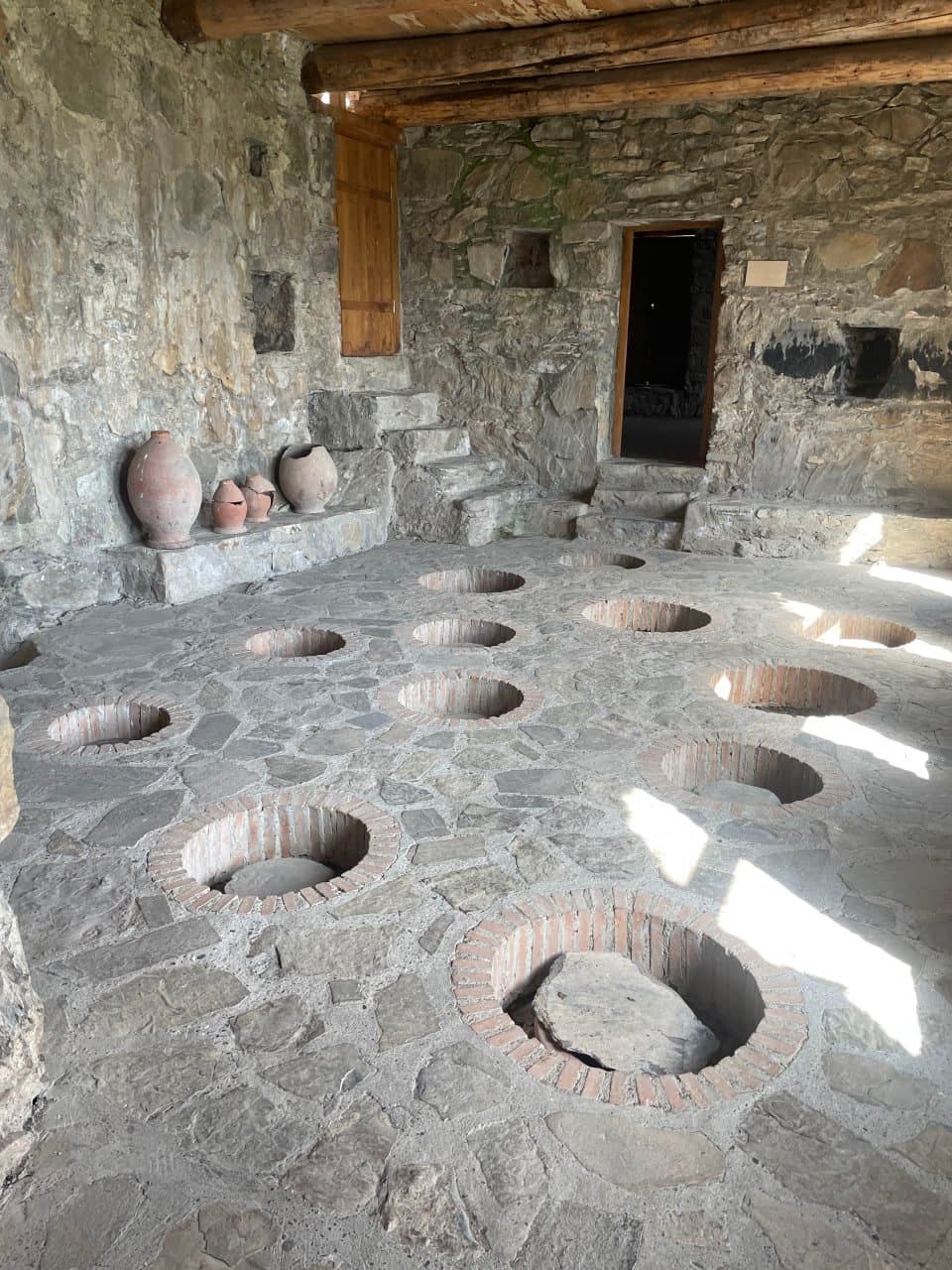
The traditional winemaking method in Kakheti is qvevri. These are large clay jars buried in the ground to a depth of up to two meters. The wine ferments in them together with the skins, seeds and stems for several months. The result is orange white wines with a rich flavor and tannins, nothing like a European white. This is called the "Kakhetian method," and it has been practiced here for more than eight thousand years.
The classic grape varieties are Rkatsiteli and Mtsvane for white, and Saperavi, the main red wine of Georgia. Try an orange Rkatsiteli made in qvevri. It is exactly what sets Kakheti apart from every other wine region in the world.
Family Wineries Nearby
If you want to end up where the wine is made right in the courtyard, it is worth driving a few kilometers out of town. Many families in the villages around Signagi receive guests by arrangement. Ask your guesthouse hosts: they are usually winemakers themselves or know neighbors who welcome visitors.
If you are traveling by car, be sure to stop at one of the wineries on the way to Signagi. For example, here is a small village winery: Cherkeza's Zedashe. In Signagi itself you can drop in at Kerovani Winery, and if you are driving to or from Telavi, there is Kakhetian House Vakirelebi. Here you can taste the wine, learn about the qvevri (clay vessel) production tradition and buy a bottle.
A typical home tasting is 4–6 wines with cheese, nuts and churchkhela, at the host's own table, and he will tell you himself how the grapes grew and how many months the wine rested in the qvevri. It is a completely different experience from a touristy tasting in a café.
Where to Eat in Signagi
Signagi is a great place for an authentic lunch and a taste of Georgian cuisine. Many cafés and restaurants are in old houses with balconies, and the terraces open onto stunning views of the Alazani Valley. I do not like Georgian food, especially the way it is cooked in Georgia. To me the food in Georgia is too salty and too heavy. Still, I have put together a few decent places and am sharing them with you.
The center of town has plenty of cozy cafés and small restaurants serving everything Georgia is loved for: khachapuri, ojakhuri, satsivi, khinkali and homemade wine.
- Okro's Wine Restaurant & Cellar — A great choice of wines: Okro's Wine Restaurant & Cellar serves its own and regional wines and has a terrace with a view.
- Terrace Panorama — A panoramic restaurant with Georgian cuisine and its own homemade wine.
- Host of Signagi — A family restaurant with big portions, though the food is not always tasty.
- ChikChiki Cafe — A café in the center of the old town where you can have coffee as well as wine.
- Kerovani Winery — Taste and buy Kakhetian wine straight from the winery.
When to Go to Kakheti
September and October are the best time, no caveats. This is the rtveli season, the grape harvest. The vineyards are heavy with bunches, the villages are pressing wine and the air smells of fermenting juice. At tastings at this time of year you can try young wine straight from the qvevri. The Caucasus mountains are in autumn gold, and the weather is warm and stable.
April and May are the second-best option. The vineyards are just starting to turn green, there are noticeably fewer tourists than in autumn and prices are lower. The monasteries and mountains are beautiful, and the hills are covered in greenery.
July and August are high season, with lots of tourists. Signagi is noisy at this time, and you need to book accommodation in advance. The heat in Kakheti is dry and fairly intense, +35°C (95°F) and above.
In winter there are almost no tourists. Guesthouses are inexpensive and restaurants are quiet. The grapes have already been harvested, and the wineries have nothing new yet. It suits anyone who values peace and quiet.
How to Get from Tbilisi to Signagi
The distance is about 110 km east of Tbilisi, through the Kakhetian vineyards.
By marshrutka (minibus), departures are from the Samgori or Ortachala bus stations in Tbilisi. There are several runs a day, with the first around 10:00. The price is 10–15 lari, and the trip takes about 2 to 2.5 hours. Check the schedule at the station, as it changes with the season. This is the cheapest option, but you cannot stop at wineries on the way.
By taxi it is 120–150 lari one way. It is convenient for a group of two or three people. You can also agree on a full day around Kakheti with a driver, with stops at monasteries and vineyards and then back to Tbilisi. For this they charge 250–350 lari per car.
By rental car is the most convenient option, especially if you want to stop at monasteries and family wineries on the way. The road is good and GPS leads you accurately. It costs 90–120 lari a day for an economy car. On the way from Tbilisi it is worth stopping at the monasteries of Bodbe (more convenient on the way into Signagi) or Alaverdi.
A One-Day Signagi Itinerary
If you have come for just one day, here is a convenient order.
In the morning, around ten, climb the fortress wall. The light is good for photos while the sun is not yet high. From there, go down into the old town, stroll the lanes and buy hot bread at a bakery.
Closer to lunch, visit Bodbe Monastery. It is a 20–25 minute walk or a taxi ride. It is quiet there, with a beautiful garden and a spring.
For lunch, pick one of the cafés in the center of town. Try Pheasant's Tears or any tavern on the square.
In the second half of the day, go for a wine tasting. Either at Pheasant's Tears or at a small family winery, but you need to book for the latter.
In the evening, head back to the wall for the sunset view over the valley.
A 3-Day Kakheti Route
If you have three days for Kakheti, Signagi fits nicely into a loop with Telavi. I wrote about what to see in the town of Telavi in a separate article.
Day one: Tbilisi to Telavi, 2.5 hours. Batonis Tsikhe fortress, the plane tree, a walk around town and dinner with wine. Overnight in Telavi.
Day two: the Alaverdi and Ikalto monasteries, a tasting at a family winery near Telavi, then the drive to Signagi along a scenic mountain road. Overnight in Signagi.
Day three: in the morning the fortress wall and old town, Bodbe Monastery, a tasting at Pheasant's Tears, then back to Tbilisi.
If you have time left over, I recommend visiting David Gareja Monastery and seeing the colorful desert. The David Gareja monastery complex is carved right into the rock. It is one of the most unusual places in Georgia: barren hills, ancient frescoes and a silence in which time seems to stand still. You can read more in my neighboring article, David Gareja Monastery and what to see there.
A trip to Signagi is a whole journey through Kakheti. The key is not to rush: the more stops you make, the more fully you feel the spirit of this region.
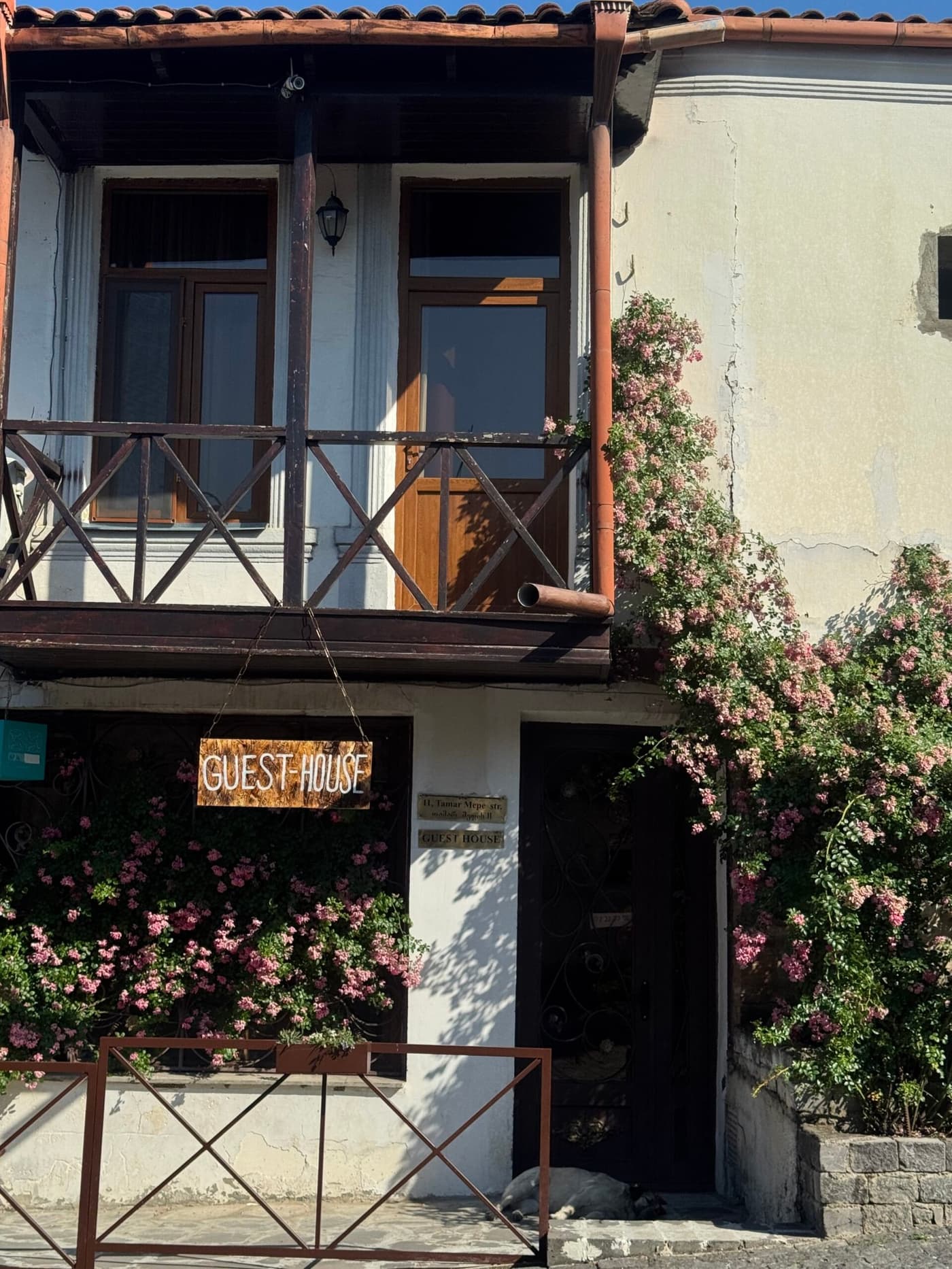
Where to Stay in Signagi
There are lots of guesthouses in town, often with terraces and views of the Alazani Valley. The views are exactly what to look for when choosing a place to stay: waking up in the morning with the window open onto the mountains is a pleasure in itself.
A guesthouse with breakfast costs 80–150 lari per night for two. Small hotels cost 150–250 lari per night. On Booking and Airbnb there are always options with ratings and photos that show whether there is a terrace. High season is September–October, so book in advance.
Budget for a Trip to Signagi
A trip of 2 days and 1 night from Tbilisi works out roughly like this. A round-trip marshrutka is 20–30 lari. A guesthouse is 80–150 lari per night. Food for two days is 80–120 lari. A wine tasting is 20–40 lari. Museum entry is 5 lari. A round-trip taxi to Bodbe is 15–20 lari. In total that is roughly 220–365 lari per person, which is about $80–135.
With a rental car for two days, add another 180–240 lari plus fuel.
I filmed how we spent our time in Georgia and Armenia in a YouTube episode
Frequently Asked Questions About Signagi
Why is Signagi called the "city of love"?
The town is called that because Signagi had a round-the-clock wedding registry office where you could officially get married at any time, even at night.
How far is Signagi from Tbilisi and how long does the trip take?
The distance is about 110 km, and the drive takes roughly 1.5–2.5 hours by car, depending on traffic.
How do I get from Tbilisi to Signagi by public transport?
You can take a marshrutka or a bus from Tbilisi, for example from the Samgori bus station. In Tbilisi's old town you can also find plenty of taxi, transfer and tour options.
Can I combine a trip to Signagi with a wine tour?
Yes. Signagi is in the Kakheti region, famous for its wine, and many wineries offer tastings.
What is the best itinerary for one day in Signagi?
Walk the fortress wall in the morning, visit the old town and Bodbe Monastery during the day, and have dinner with a view of the valley in the evening. This route lets you see the main sights in a single day.
How much time do I need in Signagi?
One full day plus a night is ideal. A day trip from Tbilisi without staying overnight is also doable, but then you will have to choose between walking around town and a wine tasting.
Is it true that the Signagi registry office is open 24 hours?
It used to be, and that was the main selling point for people who wanted to get married quickly. The schedule has changed since: the registry office now works from Wednesday to Sunday, 09:00 to 18:00. The conditions are still simplified, and passports are enough.
When is the best time to go to Kakheti?
September–October is the rtveli season, the grape harvest. The vineyards are full, the villages are pressing wine and the air smells of young wine. April–May means green mountains and fewer tourists.
Can I get to Signagi without a car?
Yes, by marshrutka from Samgori or Ortachala for 10–15 lari, taking about 2.5 hours. It is inconvenient for visiting wineries and monasteries outside town, but Signagi itself and Bodbe are reachable on foot.
What is there to see near Signagi?
Bodbe Monastery, 2 km away, is a must. Telavi is 50 km away if you are traveling by car. The Alaverdi and Ikalto monasteries are on the way to Telavi. It is ideal for the "Kakheti in 3 days" route.
What is qvevri wine?
A qvevri is a clay jar buried in the ground. The wine ferments in it together with the skins and seeds for several months. White wines take on an orange color and tannins, and it is nothing like a European white. This is what sets Kakheti apart from every other wine region in the world.