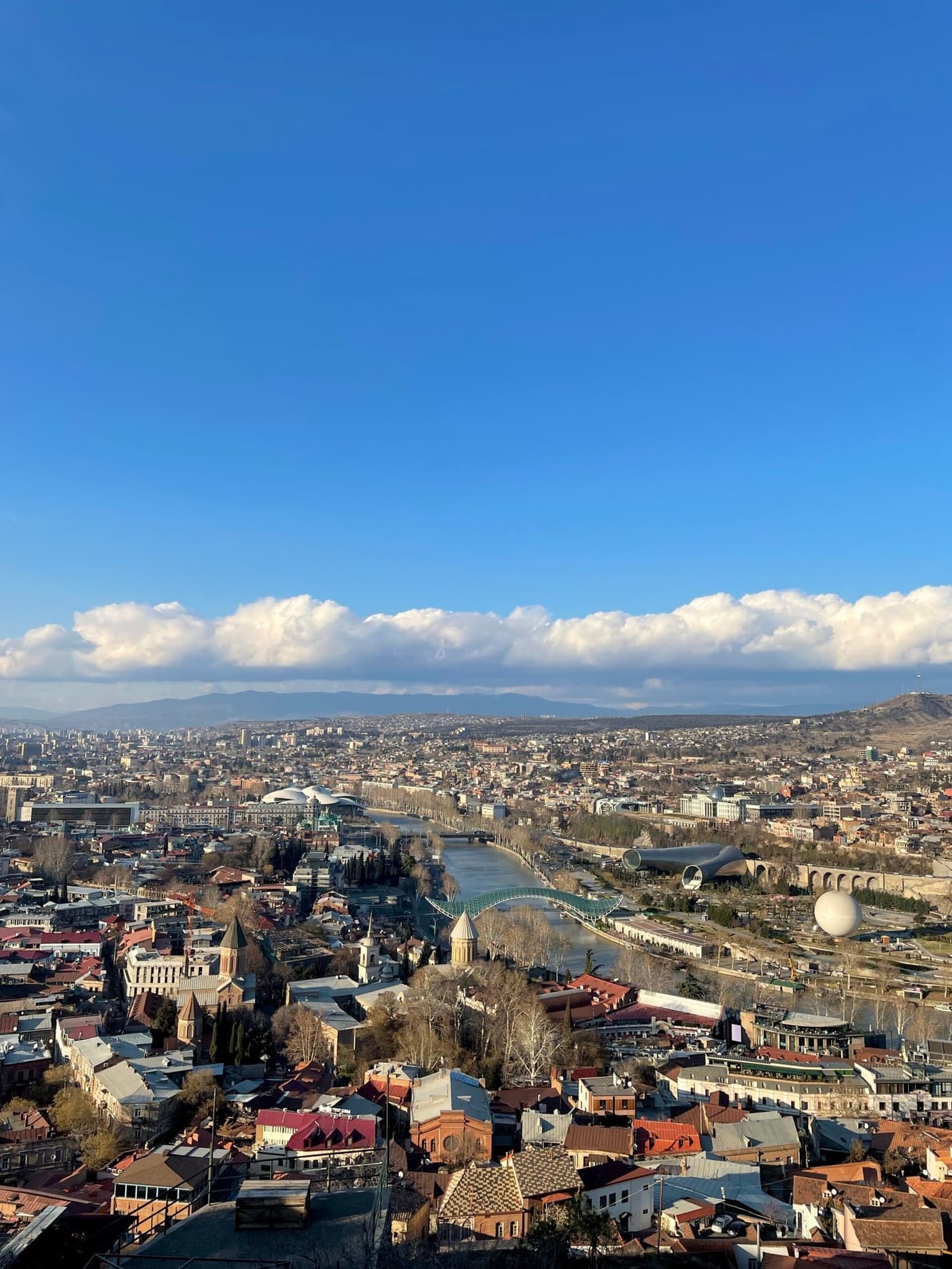
While traveling around Georgia, we couldn't pass up the chance to stop at Sno, a scenic high-mountain village in the Kazbegi district. Home to just 300 people, it sits at 1,760 meters above sea level and suits anyone who values peace and quiet and natural beauty. The Snostskali River flows past the village, washing its banks with clear water; it also gives its name to the local brand of bottled water, "Sno". Georgia in general has very clean, good water. Sno is surrounded by tall mountains, and the views will take your breath away: on one side you see majestic Mount Kazbek, on the other the mighty peaks of Chaukhi.
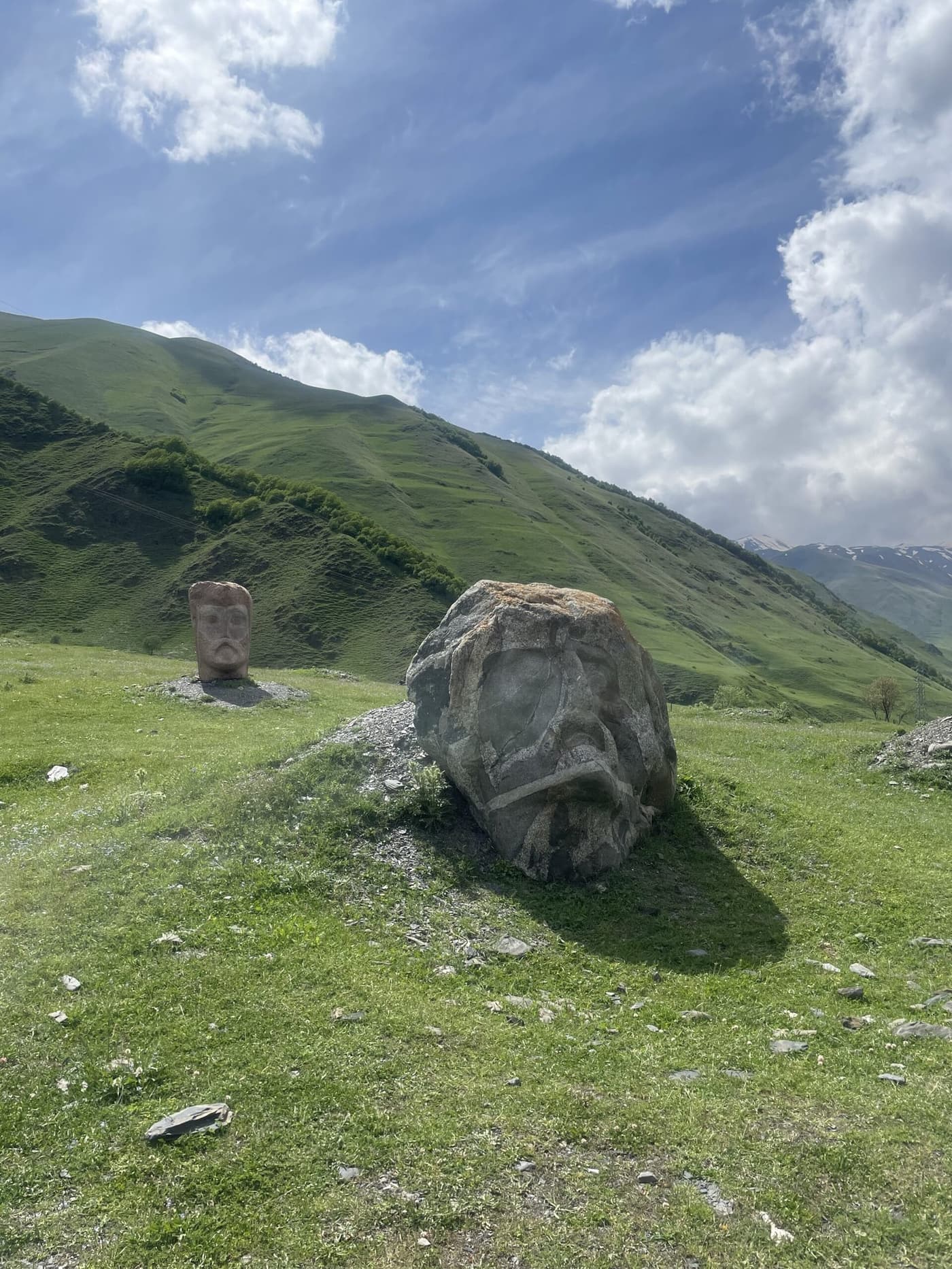
What Are the Stone Heads in Sno?
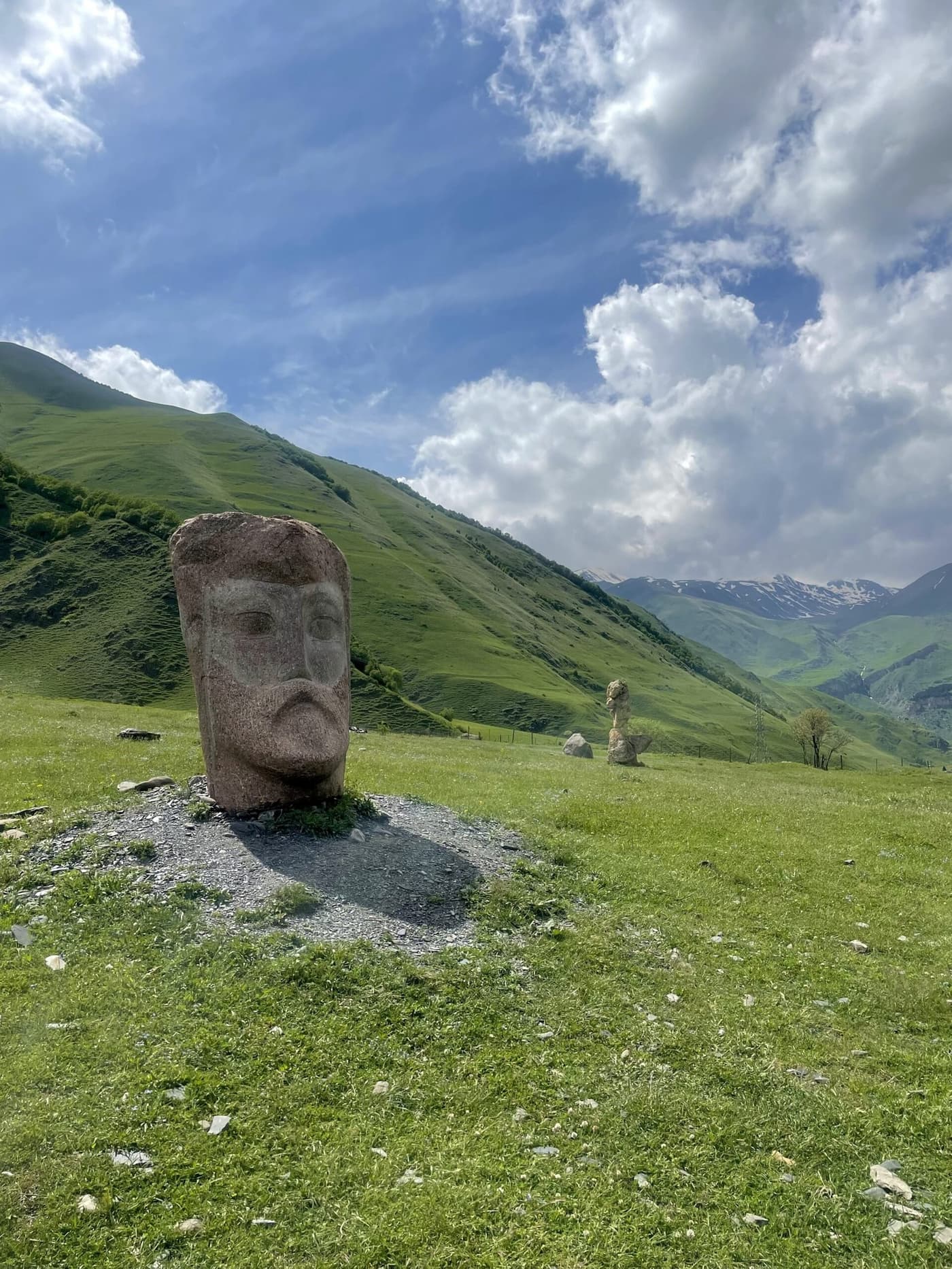
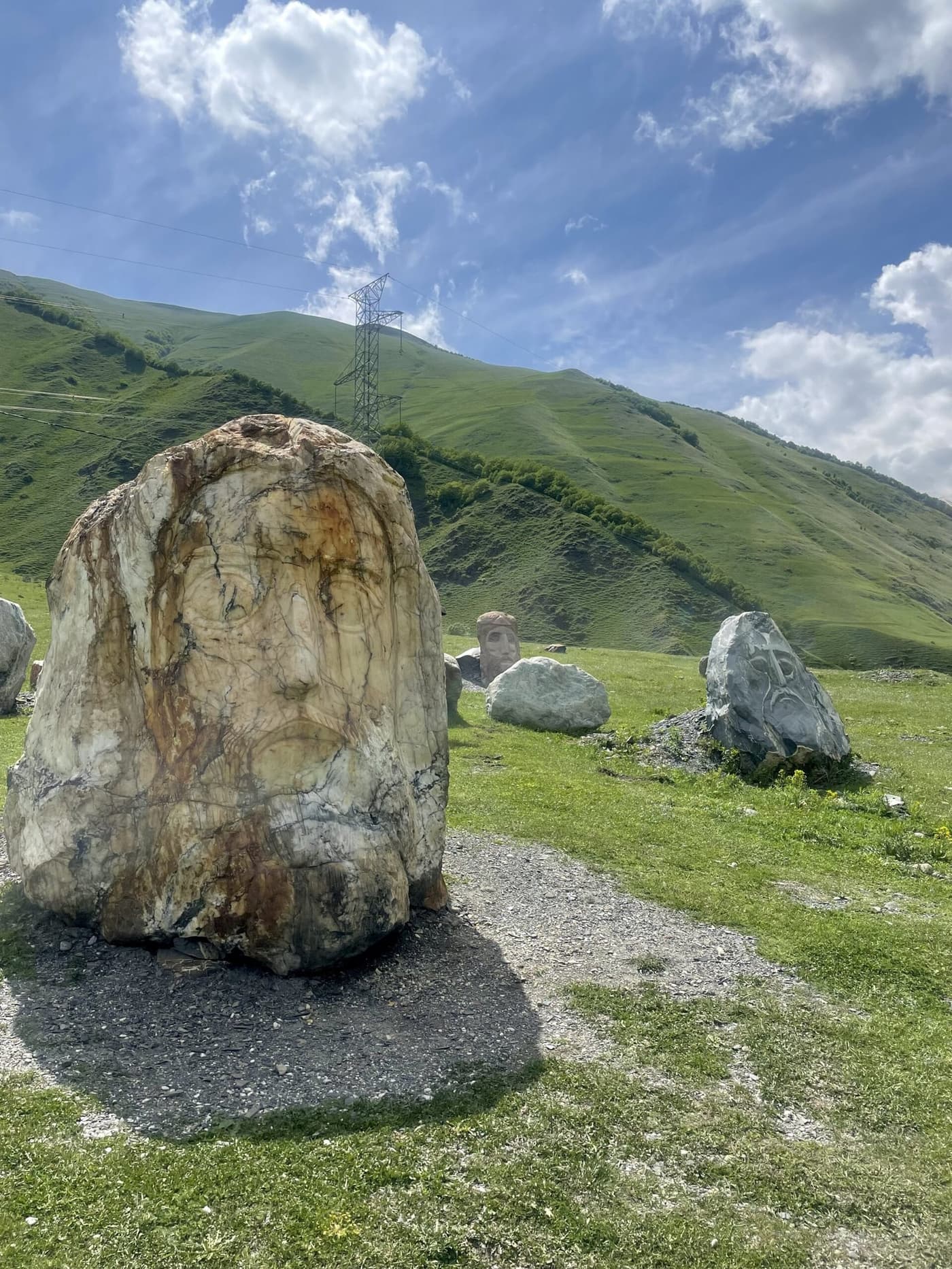
On a mountainside near the village of Sno stands a group of monumental sculptures carved right into boulders. They are portraits of famous Georgian figures: the poet Shota Rustaveli, the writer Alexander Kazbegi, the philosopher and poet Ilia Chavchavadze, and the poet Vazha-Pshavela.
The author is Merab Piranishvili, a local sculptor who was born in Sno. According to several sources he graduated from the Tbilisi Academy of Arts in 1977, although some guides call him self-taught. He created the sculptures as a personal memorial project, out of love for Georgian history and culture: in Soviet times the state supported the work, and today he pays for transporting the stone blocks himself.
That is what makes the place special. It is not an official monument or a tourist attraction built for visitors. It is the living statement of a man who simply lived nearby and did what he felt was important.
The sculptures stand right in the natural landscape: surrounded by bright greenery in summer and by snow in winter. Mount Kazbek looks down on the stone faces.
It was for these stone faces that we headed to this mountain village.
The 16th-Century Tower
Next to the sculptures stands a medieval watchtower. It is a typical example of highland Georgian defensive architecture: tall, narrow, and built from local stone without mortar, using only precise masonry.
There are hundreds of such towers across Georgia's mountain regions, and thousands in Svaneti. But here in Sno the setting is special: the tower stands beside the sculptures, the mountains and a quiet village, and together they create something unexpected.
According to local legend, the tower is linked to the mythical founder of the village, a man named Sno, who received these lands from King Vakhtang Gorgasali. In the center of the village there is a small sculpture of the king himself, holding a spear.
The Village of Sno
Elevation: 1,760 meters above sea level. Population: about 300. All around are mountain ranges, the Snostskali River and silence. The "Sno" water brand of the same name comes from right here.
The village is inhabited, not abandoned. People live here, graze livestock and keep vegetable gardens. You can stroll the streets, look at old stone houses with wooden balconies and meet the locals. There is no tourist infrastructure at all: no cafes, no souvenir shops, no guides. That is a plus, especially for anyone tired of touristy places.
Hiking from Sno
Sno is not only a cultural stop but also the starting point for routes into one of the most beautiful mountain areas of the Caucasus.
Sno → Juta
Juta is a mountain village 12 km from Sno along a dirt road. Its elevation is about 2,200 meters. It is the base for trekking to the Chaukhi massif and the Abudelauri lakes. The road from Sno to Juta is for 4x4 vehicles only; it's fine in summer, but in spring and fall it can be muddy.
If you don't have a 4x4, you can hire a car with a driver in Sno or in Stepantsminda (30–50 lari). Or you can walk the 12 km in 3–4 hours along a beautiful road, which is a route in itself.
Juta → Abudelauri Lakes Trail
A trail leads from Juta to the Chaukhi Pass (about 3,300 meters), beyond which lie the Abudelauri lakes. It is about 9 km and roughly 3 hours one way to the pass, so set aside a full day for the lakes and back. The difficulty is above moderate. You can hike it in summer, while there is no snow.
Juta → Chaukhi Pass → Roshka Trail
A harder route over the rocky Chaukhi Pass and past the Abudelauri lakes to the village of Roshka in Khevsureti. It is for experienced trekkers in good physical shape. Elevation gain is more than 1,000 meters. The pass is open only in summer.
Sno in Winter
In winter the Sno valley becomes a different place. The road to Sno is usually open and gets plowed because the village is inhabited. But in heavy snowfall it's better to check first.
Winter views: snowy Kazbek on one side, snow-covered Chaukhi on the other. Stone sculptures in the snow. The tower. An empty, quiet village. It is a completely different, very beautiful picture.
How to Get to the Village of Sno
The village of Sno is conveniently located about 3 km from the Tbilisi–Kazbegi highway, easy to reach for travelers heading to Kazbegi.
By Car from Tbilisi
Distance: about 150 km. Travel time: 2.5–3 hours.
From the Georgian Military Road, follow the signs and you will easily find this cozy corner. We drove from Tbilisi in our own car, and the road was good and paved the whole way. Sometimes there were traffic jams made up of trucks, but they were easy to get around. I wrote about what to see on the Georgian Military Road in another article.
You can rent a car:
- With Localrent
- With GetRentacar
- With DiscoverCars
By Marshrutka
The marshrutka to Kazbegi (from Didube, 15–20 lari) does not stop in Sno. Your options: a taxi from Stepantsminda to Sno (20–30 lari one way) or renting a car in Stepantsminda.
On a Tour
Some Tbilisi–Kazbegi tours include a stop in Sno. Check when you book.
What to Do Nearby
Sno is a convenient base for several routes.
Juta is 12 km away on a dirt road and is the base for trekking to Chaukhi and the Abudelauri lakes. 4x4 only.
Stepantsminda (Kazbegi) is 7 km from Sno. This is where you'll find lodging, restaurants, the climb to Gergeti Church and hiking bases.
The Snostskali River valley: you can walk along the river from the village, downstream or upstream. Clean mountain water, alpine meadows, mountain flowers.
How to Fit Sno into Your Itinerary
"Kazbegi in one day" route: Tbilisi → Mtskheta → Ananuri → Sno (30–40 minute stop) → Stepantsminda → Gergeti → Tbilisi. Set out before 7:30 a.m. Return around 9:00–10:00 p.m.
"Kazbegi in two days" route: Day one — Tbilisi → Ananuri → Stepantsminda (overnight). Day two — Gergeti in the morning, then Sno and Juta (by 4x4 or on foot), and back to Tbilisi in the evening.
"Kazbegi with trekking" route: Stepantsminda (2–3 nights) → day 1 Gergeti → day 2 Sno → Juta → Abudelauri lakes → return to Stepantsminda.
Practical Information
Admission: free. It is an open-air exhibit.
Coordinates of the sculptures in Google Maps: search for "Stone Heads of Sno" or use Maps.me.
Time needed: 20–40 minutes for the sculptures and the tower. With a walk around the village, about an hour.
Cafes and restrooms: none in the village. The nearest are in Stepantsminda.
Mobile coverage: not always available in the Sno valley, depending on your carrier. Download offline maps before you set out.
Stone Heads in the Sno Valley, Georgia: FAQ
What are the stone heads in the Sno Valley?
They are a series of monumental sculptures carved right into the rock. They depict well-known figures of Georgia: poets, writers, philosophers. They were created by the contemporary Georgian sculptor Merab Piranishvili.
Where are the stone heads located?
The sculptures are in the Sno Valley, not far from the village of Sno, on the way to Juta and Kazbegi (Stepantsminda). It is part of the scenic Georgian Military Road.
How much does a visit cost?
A visit is free. It is an open-air exhibit with no entrance fee and no fencing.
How do I get to the Sno Valley?
The most convenient way is by car along the Georgian Military Road. You can also take a marshrutka to Kazbegi and then a taxi, or rent a bike or scooter. Sometimes there are tours from Tbilisi with a stop at Sno.
How long does a visit take?
Seeing all the sculptures takes about 20–30 minutes. But we recommend allowing more time to enjoy the views and take photos.
Who is the author of the sculptures?
The author is Merab Piranishvili, a contemporary Georgian sculptor who works in a style of monumental realism. He dedicated this project to Georgian history, culture and the spirit of the mountains.
Can I get there in winter?
Yes, but keep the weather in mind: the road may be snowy, especially beyond Kazbegi. It's better to travel in dry weather or as part of a tour.