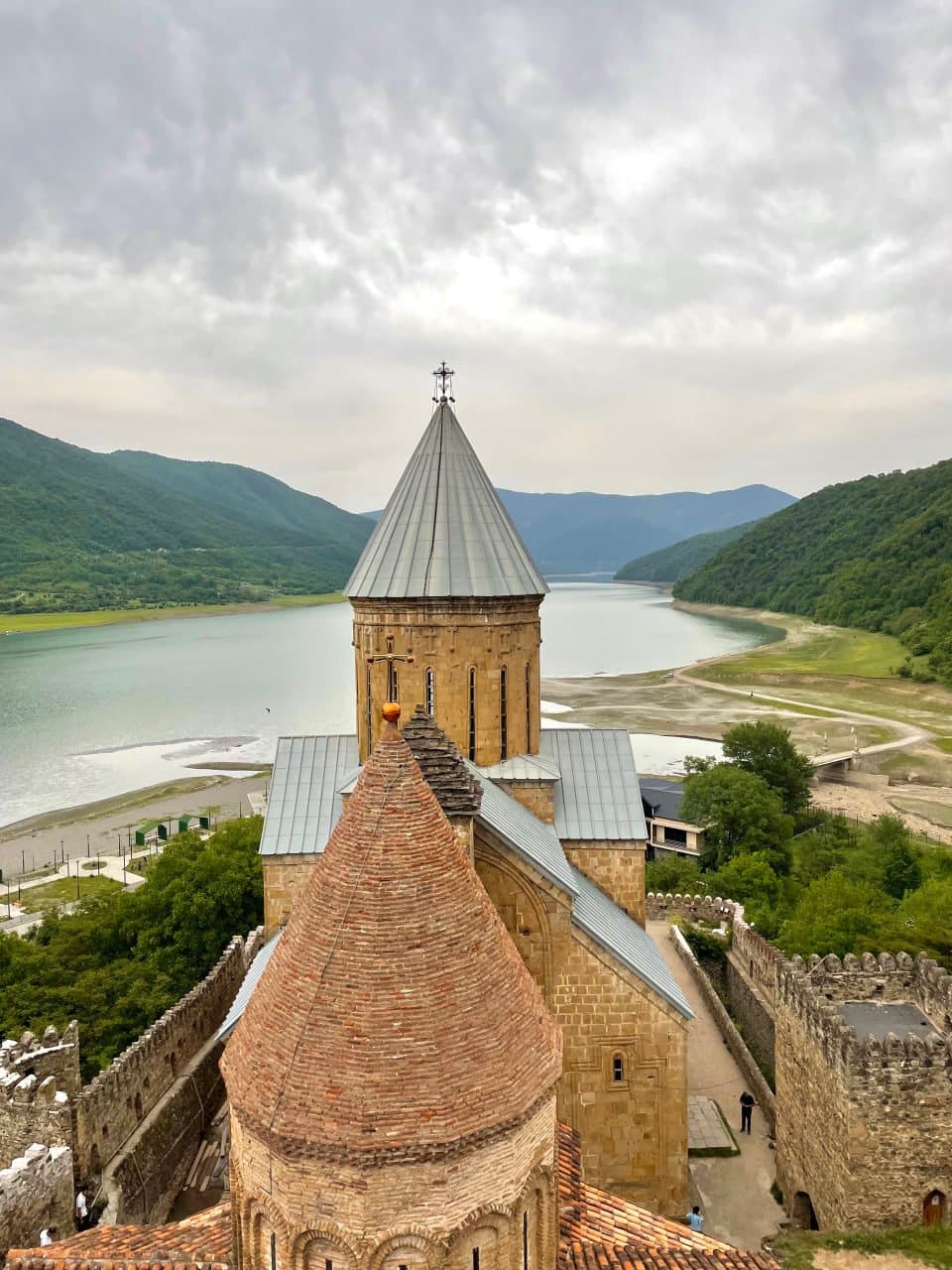
You are only 66 km along the Georgian Military Road, and it is already worth stopping. Ananuri Fortress on the shore of a turquoise reservoir is one of the most photogenic views in Georgia, and it doesn't need a separate trip: the site sits right beside the road.
Most travelers stop here for 15 minutes on the way to Kazbegi, take a photo and drive on. But Ananuri deserves more, and not only because of the beautiful view.
History of the fortress
Ananuri is a feudal fortress of the 16th–18th centuries, the residence and defensive outpost of the Eristavs of Aragvi. The Aragvi eristavs were among the most influential feudal lords in Georgia: they controlled the strategic Georgian Military Road, the main trade route from Tbilisi to the Caucasus range and beyond. Whoever held the gorge held the trade.
In 1739 something happened that changed the fortress's fate: it was attacked and taken by the rival Eristavs of Ksani, led by Shanshe. The siege was brutal. Most members of the ruling Aragvi family died. The fortress was burned.
A few decades later the complex was partially restored, this time by other hands. But Ananuri never regained its strategic importance. When Georgia became part of the Russian Empire in 1801 and the role of the road changed, the fortress finally became a monument rather than a military site.
In Soviet times, from the second half of the 1970s to the mid-1980s, several villages downstream on the Aragvi were flooded during the construction of the Zhinvali Reservoir. The residents were resettled. The water level rose, and today the fortress stands right on the shore, although originally it was located a considerable distance from the river.
What to see inside
The complex is compact, and you can see everything in 30–60 minutes at a relaxed pace.
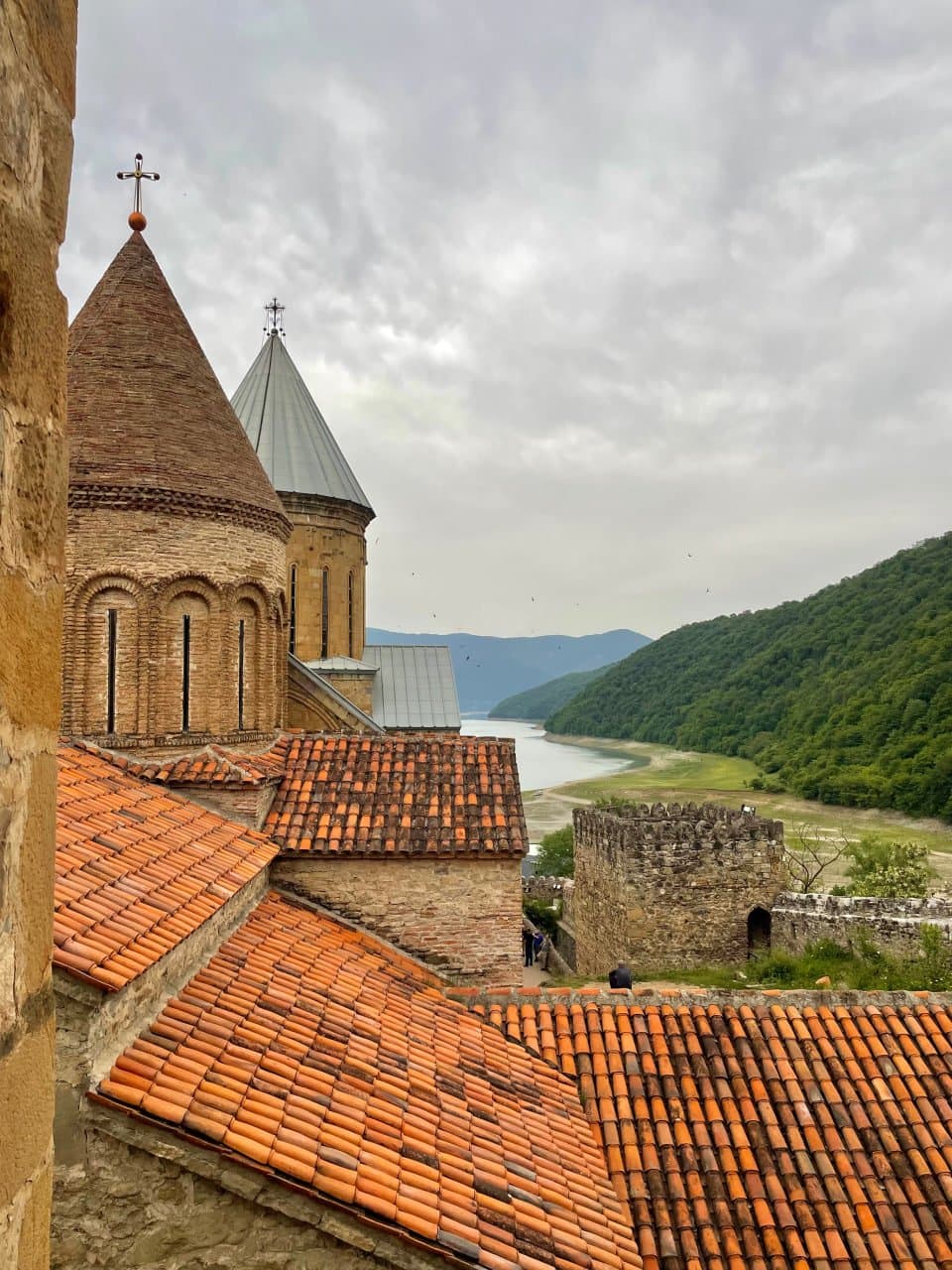
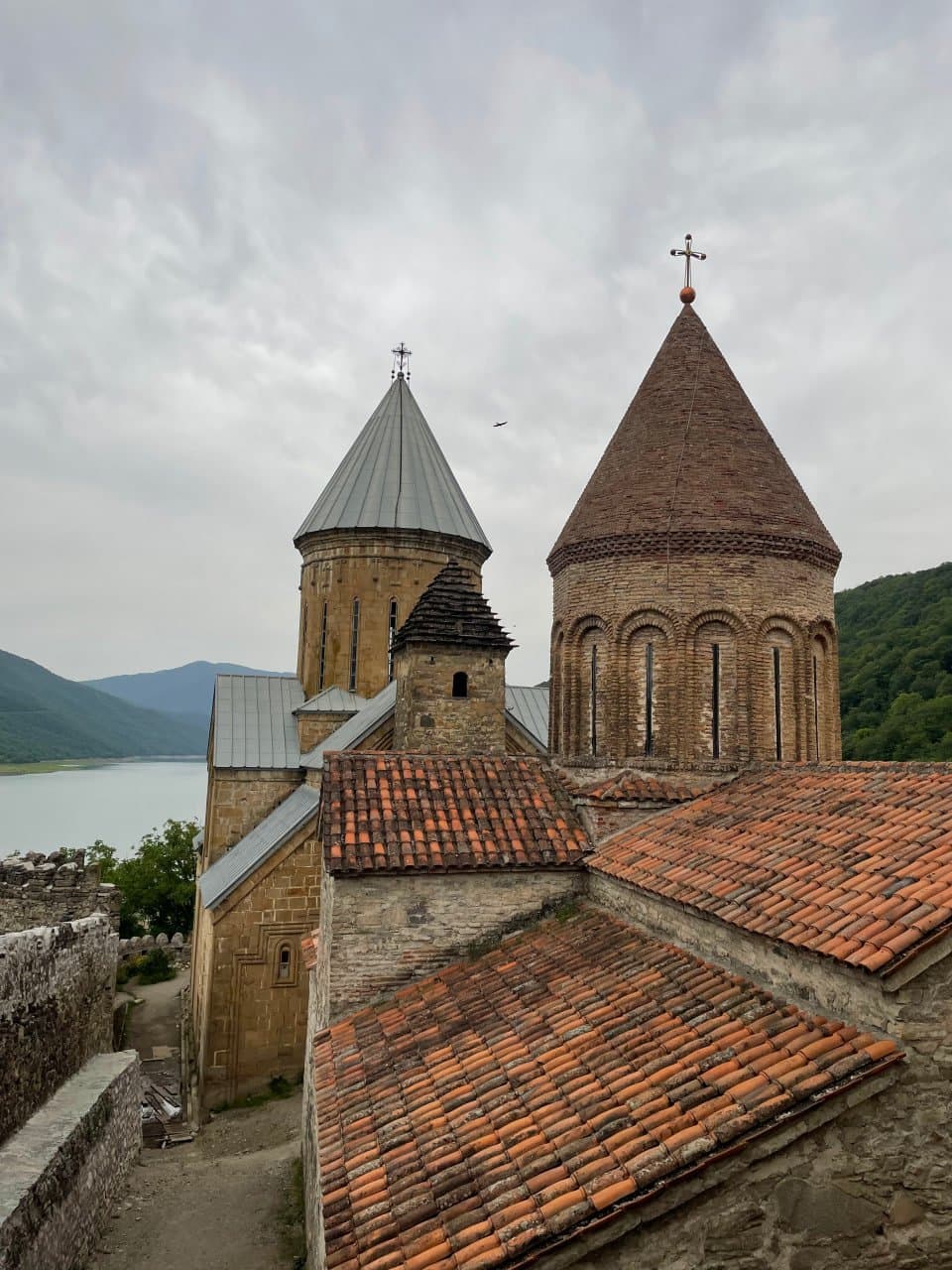
Church of the Mother of God (Gvtaeba, 1689)
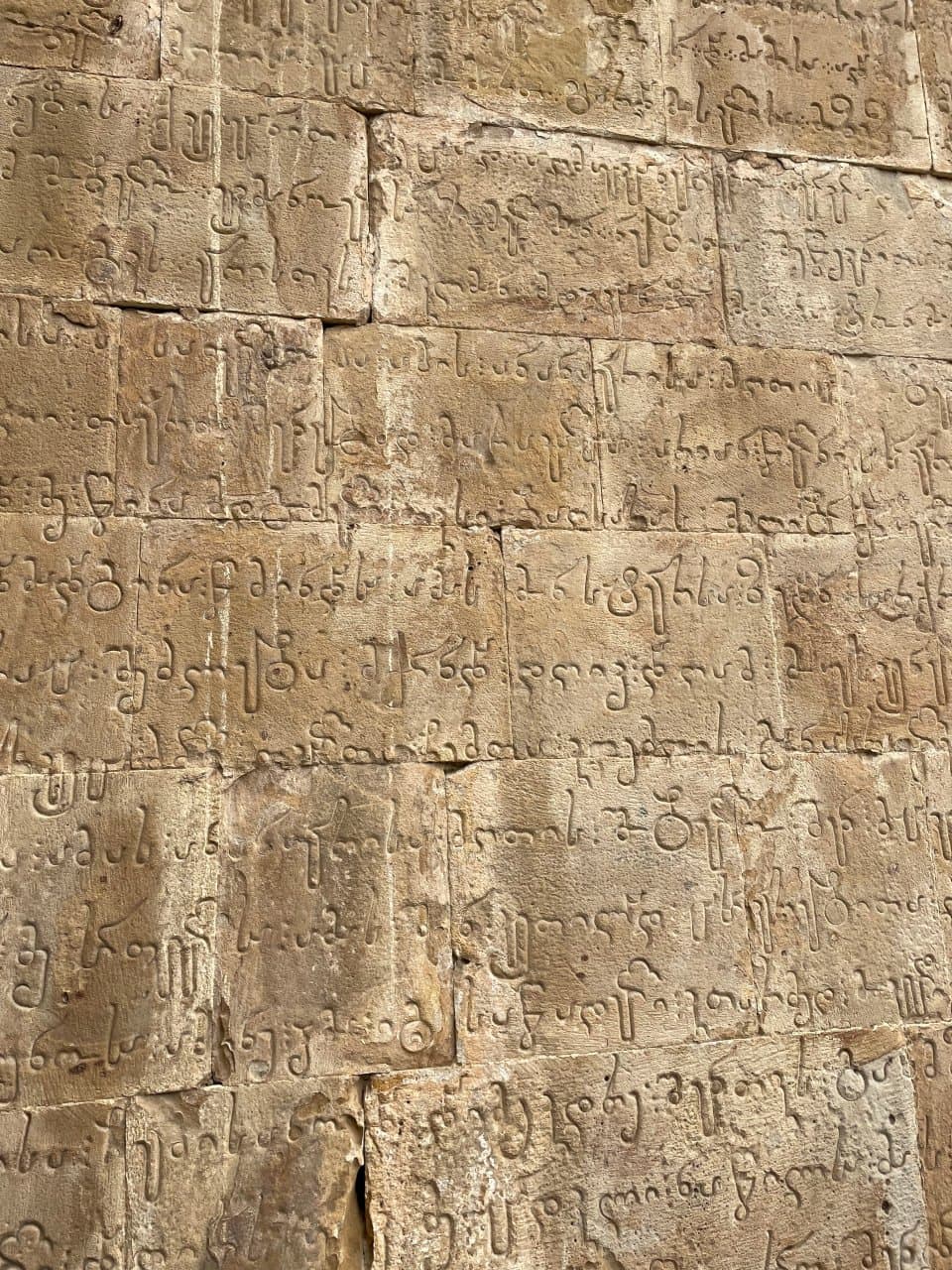
This is the fortress's main church, commissioned by Prince Begtan. It is the best-preserved and most beautiful part of the complex. The facade is decorated with bas-reliefs: crosses, griffins, birds and Georgian ornamental interlace. It is a characteristic style of medieval Georgian architecture, delicate and rich at the same time.
Inside there are fragments of 17th-century frescoes. Take a close look at the walls: you can see how several eras are layered on top of one another. The painting has survived only in part, but what remains is very expressive.
Church of the Savior (Kupatari)
An earlier church, austere and laconic, with no decoration on the outside. According to tradition, the princes of Aragvi were married and buried here. The atmosphere inside is different, more contemplative.
The tent-roofed (Mtavari) tower
A tall rectangular tower, the fortress's main lookout. It controlled the road and all the approaches to the gorge. If you climb the fortress walls next to the tower, you get a good view of the reservoir.
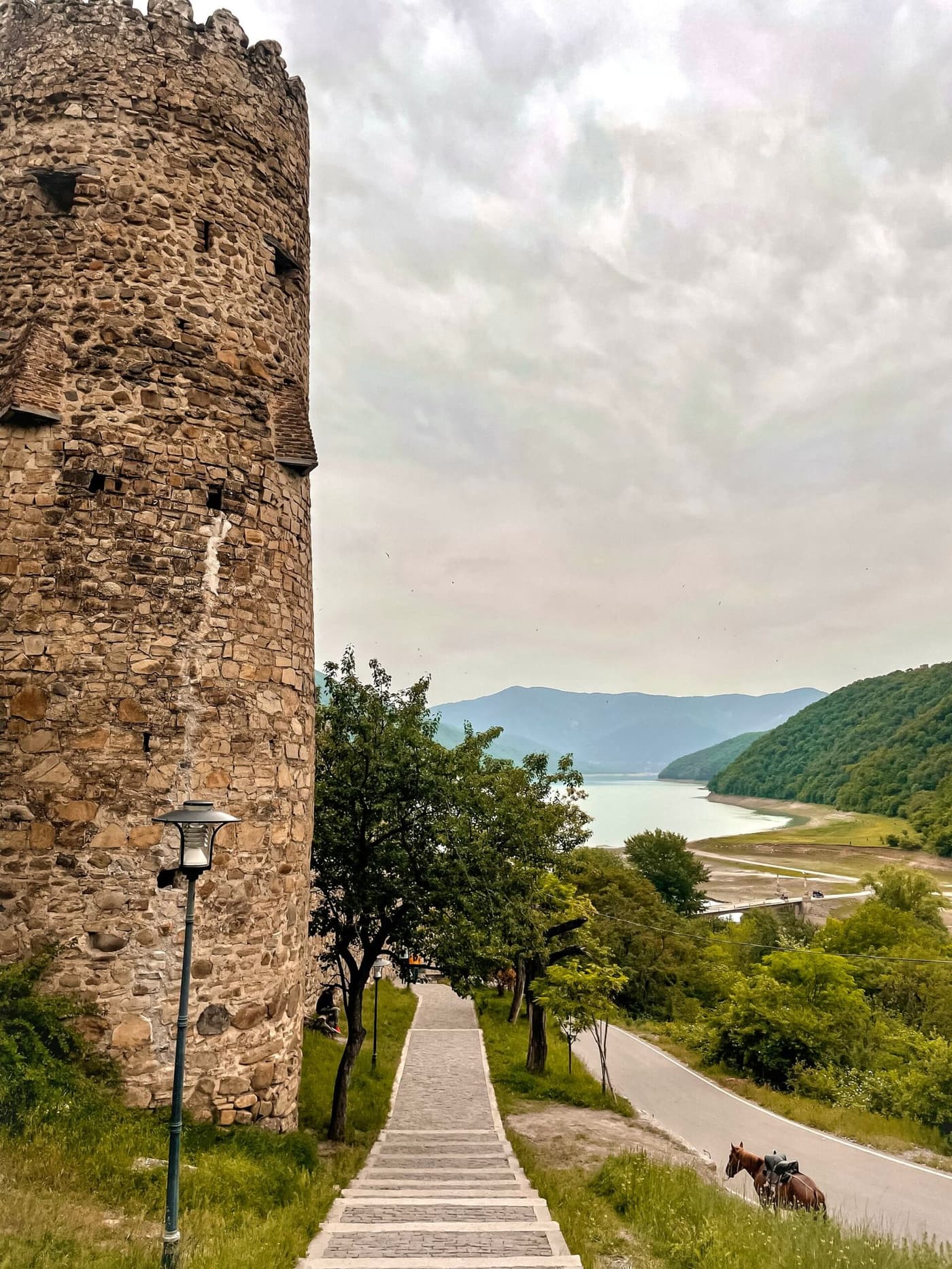
The round tower
A refuge during a siege, a common feature of medieval defensive architecture. It is small and well preserved.
The fortress walls
You can walk along part of the wall. It isn't wide, but it is possible. The best spot for photographing the reservoir is right here, from the height of the wall.
Zhinvali Reservoir
An artificial lake on the Aragvi River: the dam was built from the mid-1970s, and the reservoir was formed by 1985–1986 to supply Tbilisi with fresh water. Today it is the main source of drinking water for the Georgian capital.
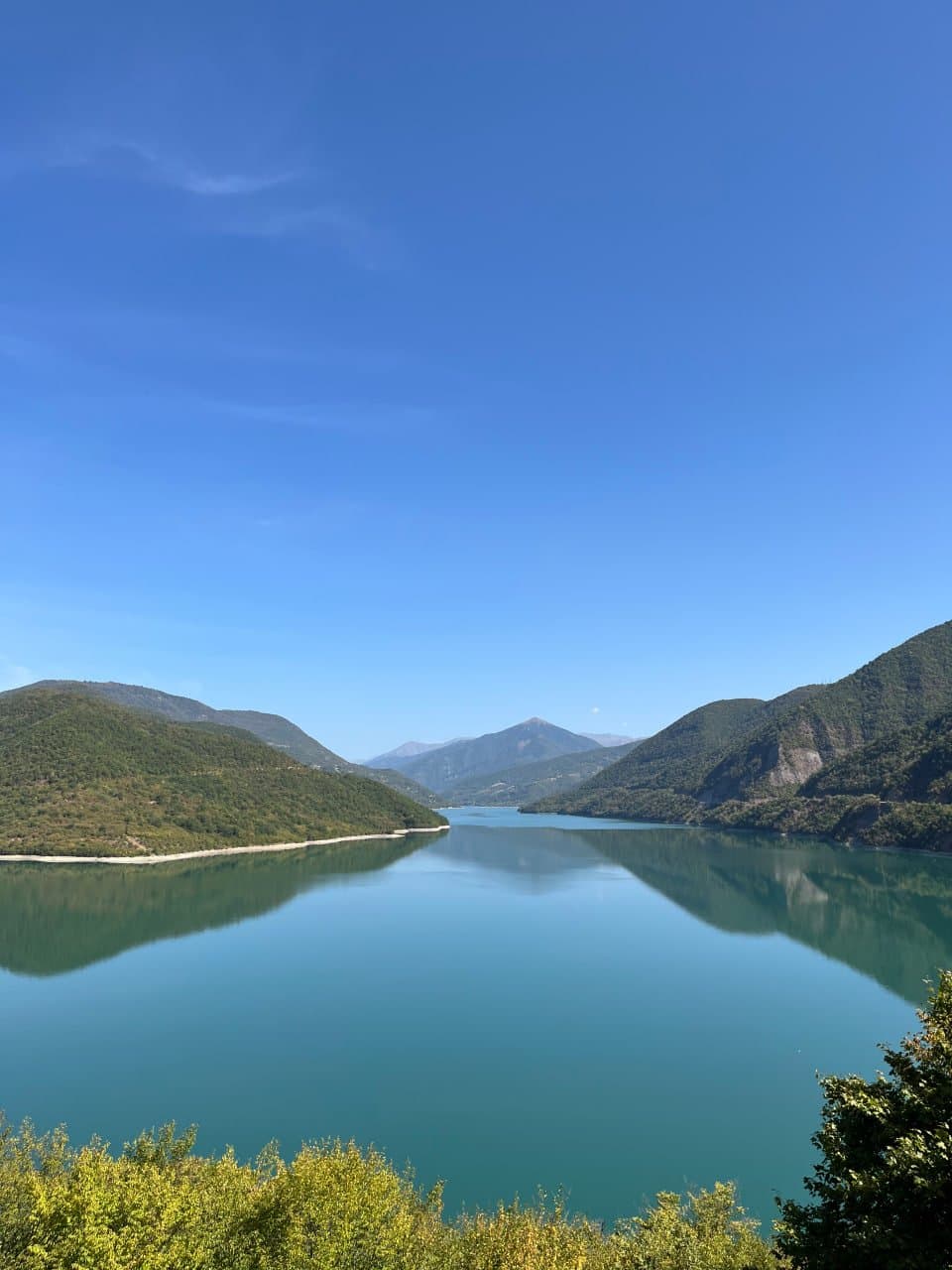
The color of the water is the biggest surprise for first-time visitors. It is a turquoise-azure shade that changes with the light, the weather and the season. On a clear spring day the water looks almost unnaturally blue. On an overcast day it turns steel gray.
Swimming in the reservoir is prohibited because it is a source of drinking water. You can take photos and walk along the shore.
An interesting detail: several villages were flooded when the reservoir was built. The local residents were resettled, and their homes went under the water. According to some accounts, in a drought or when the water level is low, the remains of old buildings rise from beneath the surface, an eerie and mesmerizing sight.
Viewpoints
The best views of the fortress and the reservoir open up from a few spots.
From the upper part of the fortress wall you get a panorama of water, mountains and the fortress towers. This is the best spot for a photo of the whole complex.
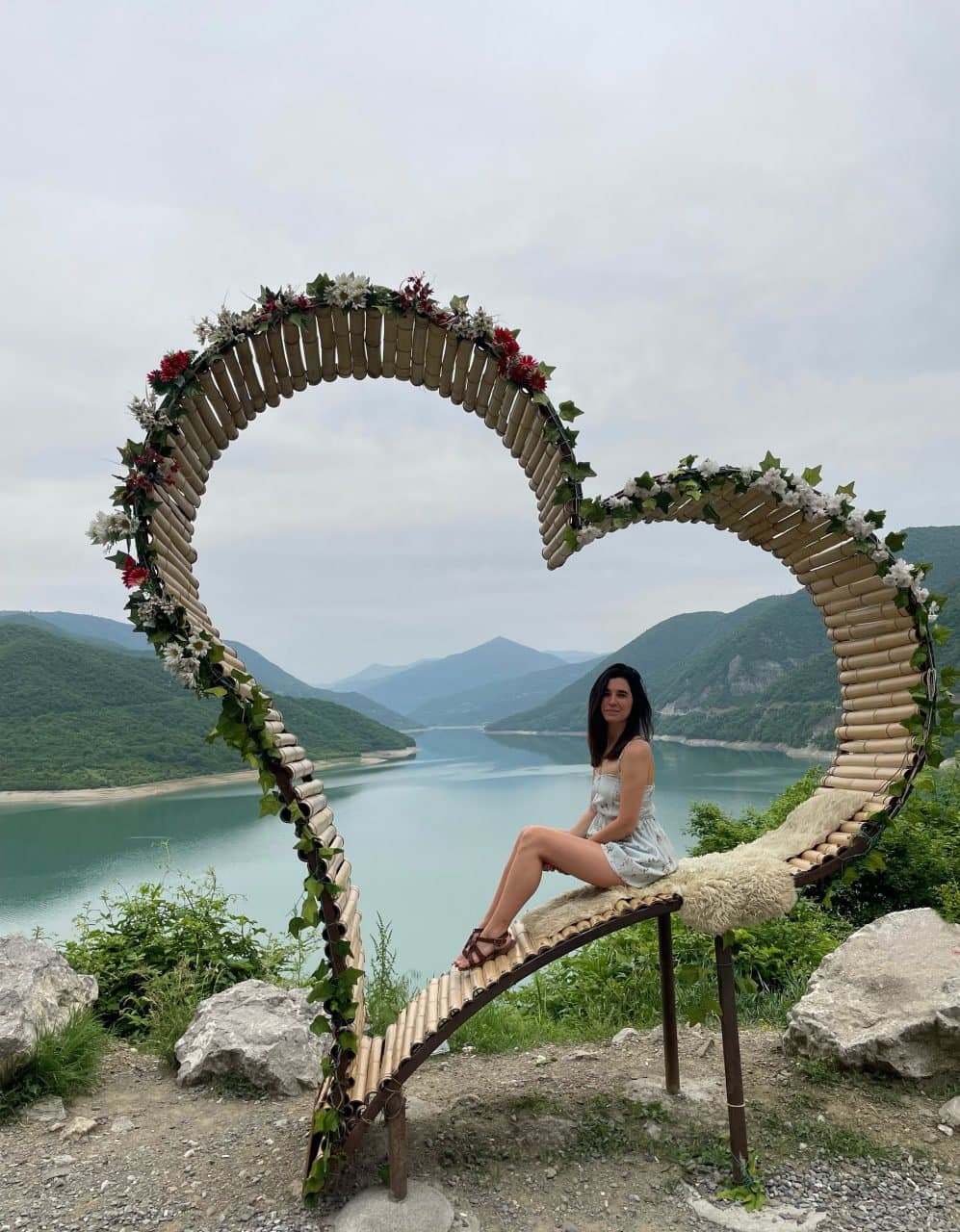
There is a viewpoint by the road, just before the turn to Ananuri, on the left if you are driving from Tbilisi. It is the standard spot for road-trippers, and it is easy to pull over here.
The shore of the reservoir by the parking lot gives you a horizontal perspective: in calm weather the fortress is reflected in the water.
Best light: in the morning (09:00–11:00) and toward evening (16:00–18:00). At noon, with the sun high, the water looks less saturated.
How to get to Ananuri from Tbilisi
Getting to Ananuri Fortress from Tbilisi is easy. The distance is about 66–70 kilometers, and the drive takes a little over an hour. The route follows the Georgian Military Road, one of the most scenic highways in the Caucasus, leading toward Gudauri and Kazbegi. I wrote about this road and what to see along the way in another article.
The most convenient way is to go by car or taxi. The road is in good condition and paved with asphalt.
If you're traveling without a car, a marshrutka (minibus) heading toward Tbilisi–Kazbegi will do. It leaves from the Didube bus station, tickets are cheap, and Ananuri Fortress is right on the highway, so drivers usually agree to make a short stop at the entrance.
Excursions to Ananuri also run daily from the capital, often as part of "Tbilisi – Ananuri – Gudauri – Kazbek" tours. This format is convenient because in one day you can see several of northern Georgia's main sights, including the reservoir panorama, the mountain passes and Gergeti Trinity Church at the foot of Mount Kazbek.
If you are planning a self-guided trip, it is best to leave early in the morning. That way you avoid traffic, have time to look around the fortress and other sights without rushing, and can get back to Tbilisi before night. Along the road there are cafes and gas stations, as well as several viewpoints with views of the valley and Zhinvali Reservoir.
What's nearby: fitting it into your route
Ananuri is the natural first stop on a route along the Georgian Military Road.
From Ananuri it is another 60 km to Gudauri, about 40 minutes. It has a ski resort and the Cross Pass. It is another 90 km or so to Stepantsminda (Kazbegi).
Before Ananuri comes Mtskheta, 25 km from Tbilisi. If you are coming from the capital, it makes a convenient stop: Svetitskhoveli Monastery and Jvari, 1.5–2 hours.
After Ananuri, on the way to Kazbegi, you will reach the Friendship Monument and the Cross Pass at 2,379 meters. The panorama of the Caucasus range is impressive.
A typical one-day route from Tbilisi: Mtskheta → Ananuri → Gudauri → Kazbegi → return. You need to set out before 08:00, and you get back around 21:00–22:00.
What else to see near Ananuri
If you have an hour or two after seeing the fortress, there are a few more stops.
The village of Pasanauri, 10 km farther along the road. It is known for khinkali: many Georgians believe they are made best here. There are several cafes by the road, a standard stop for a bite to eat.
Lomisoba Church is a small ancient church a few kilometers from Ananuri. It stands in the forest, a picturesque and quiet spot.
At the Aragvi nature reserve on the shore of the reservoir there are several picnic spots with a view. Swimming is prohibited, but you can sit by the water.
Photography
Ananuri is one of the most photographed places in Georgia. A few practical tips.
Golden hour: 1–1.5 hours before sunset the towers and churches are beautifully lit. This is also when the water is at its most turquoise.
Vertical shots with the towers and the water work well from shore level. For horizontal panoramas, go to the top of the fortress wall.
In winter, with snow, the scene is special: white mountains, blue water, the dark stone of the fortress. If you're heading to Gudauri in winter, don't skip the stop.
Ananuri in winter
Ananuri is open year-round. In winter you get snowy mountains and the green water of the reservoir, almost no tourists, and silence. If you're going to Gudauri to ski, make it a must-stop on the way back: a winter sunrise over the reservoir is worth a few minutes' delay.
Important: the Georgian Military Road can be closed during heavy snowfall and avalanche danger, especially the section from Gudauri to Kazbegi. Ananuri lies below the main danger zone and is always accessible.
Practical information
Fortress entrance: free. The complex is open from dawn to dusk.
Parking: paid, at the gates. In summer season it can be full, in which case stop by the road a little lower down.
Toilets: paid (0.5 lari), by the parking lot.
Souvenirs and food: a few stalls selling honey, churchkhela and nuts. There are no proper cafes; the nearest places are 2–3 km along the highway or in Pasanauri.
Footwear: the cobblestones inside are uneven, so wear proper shoes to walk along the walls. Sneakers or trekking boots are better than sandals.
Best time to visit
Spring (April–May): the water is blue-green and the mountains are green, giving the most beautiful color contrast. There aren't many tourists yet, and the mornings are quiet.
Fall (September–October): the trees change color, the light is warm, and there are fewer tourists than in summer. Golden mountains plus blue water make a great picture.
Summer (June–August): warm, with lots of tourists. It is a must-stop for group tours along the Georgian Military Road. Come early in the morning or toward evening; at noon it is both crowded and the light is poor for photos.
Winter (December–February): snowy mountains, an empty fortress, turquoise water. Beautiful. There are almost no tourists.
Frequently asked questions
How much time do you need to see Ananuri Fortress?
A full visit to the fortress, the churches and the viewpoints takes about 30 minutes. If you plan to take photos or linger by Zhinvali Reservoir, set aside a bit more time.
How do I get to Ananuri Fortress from Tbilisi?
From Tbilisi you take the Georgian Military Road to Ananuri. The distance is about 66 km, and the drive takes about an hour. You can get there by car, by marshrutka from the Didube bus station, or on an excursion.
Is there an entrance ticket or a fee to visit?
Visiting Ananuri Fortress is free. Entry is open to everyone. Parking and the toilet on site are paid.
Can you swim in Zhinvali Reservoir by Ananuri Fortress?
Officially, swimming in Zhinvali Reservoir is prohibited because it is a source of drinking water for Tbilisi. Visitors are advised to stick to walking and taking photos from the panoramic spots.
What are the opening hours of Ananuri Fortress?
Ananuri Fortress is open daily, with no fixed schedule. You can visit from morning to evening. I recommend coming in daylight, especially in the morning, when there are fewer tourists and the light is better for photos.
Are there toilets and parking at Ananuri Fortress?
Yes. At the entrance to the fortress there is paid parking and paid toilets next to the parking lot. Cafes and restaurants are along the highway, about 2–3 km from the complex.