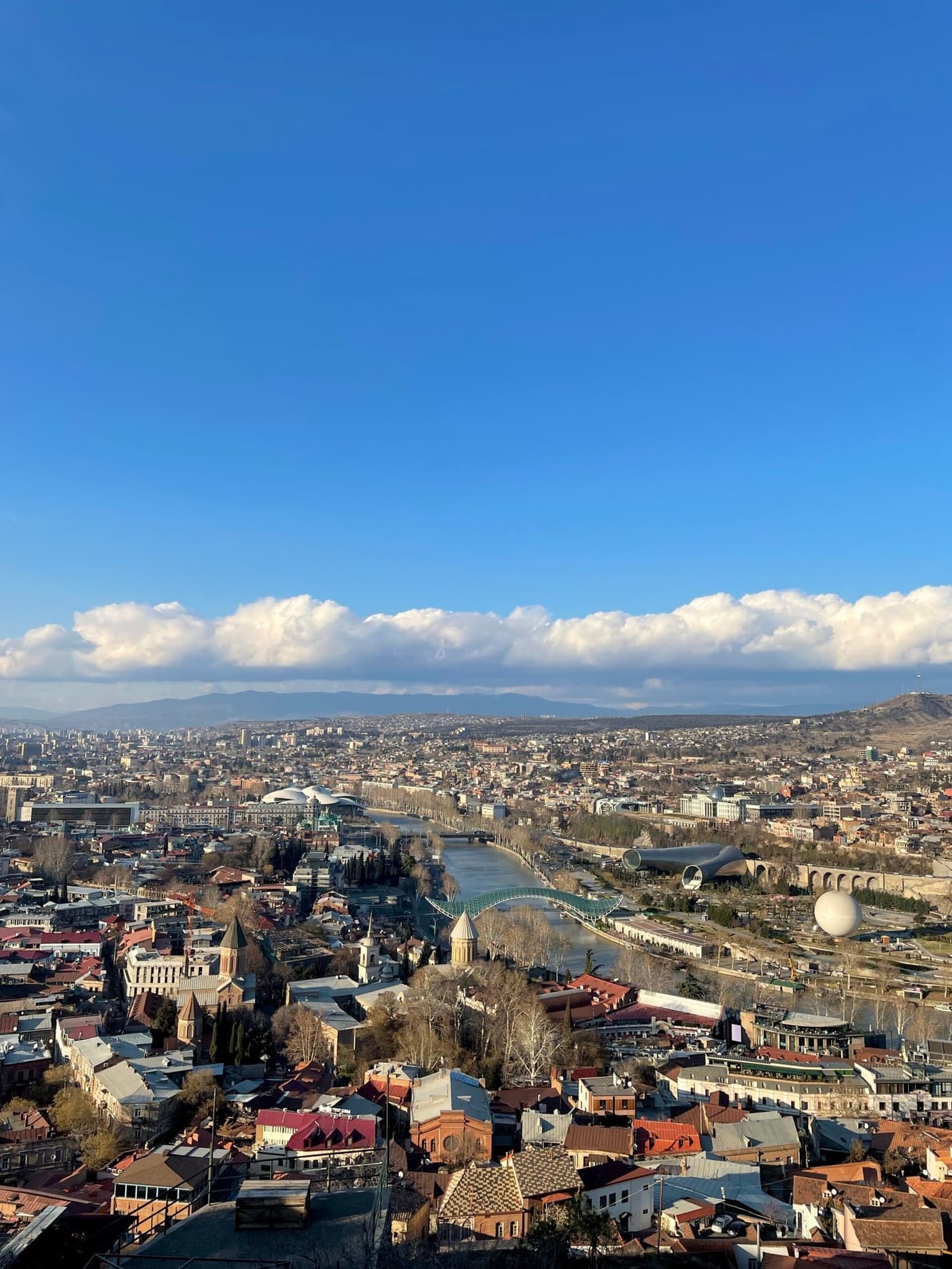
Everything seems to slow down in Mtskheta. It is not a tourist attraction and not just "an ancient town near the capital" — it is a place where you can feel the real history of Georgia. This is where the country adopted Christianity, where the first Christian kings are buried, and where, from the hill above the confluence of the Kura and Aragvi rivers, you get a view you will not forget.
Mtskheta is only 25 km from Tbilisi. Half a day is enough, but it is better to arrive in the morning and not rush. Mtskheta is one of those places that does not tolerate haste.
A Short History: Why Mtskheta Matters
Mtskheta is more than two and a half thousand years old. From the 3rd century BC to the 5th century AD it was the capital of the Kingdom of Kartli (Iberia). Trade routes from Persia to Rome ran through here, diplomatic negotiations took place, and fortresses and palaces were built. Before Tbilisi even existed, Mtskheta was already a major political center of the Caucasus.
In 319 a young nun named Nino, a Christian from Cappadocia who had fled Rome, entered the city. She settled in a blackberry thicket by the river and began to preach. First she healed Queen Nana, who was seriously ill and did not respond to treatment. Then King Mirian III followed. According to tradition, he came to believe at the moment when darkness suddenly covered him during a hunt, he cried out to Nino's God, and he saw the light again.
Mirian accepted Christianity himself and declared it the state religion. This happened around 337, and Georgia became one of the first countries in the world where Christianity received the status of an official faith. Only Armenia had done so earlier.
In the 5th century the capital was moved to Tbilisi, but Mtskheta did not lose its importance. It remained the spiritual center of the country: patriarchs are crowned and buried here, and the residence of the Catholicos-Patriarch of All Georgia is here. Georgians call Mtskheta the "Second Jerusalem," and these are not just pretty words.
In 1994 Mtskheta was added to the UNESCO World Heritage List together with Jvari Monastery. It was one of the first two Georgian sites to receive that status.
What to See: Four Key Spots
There are four places in Mtskheta you need to see. They are close together, and in half a day you can visit all four without rushing. The only thing that matters is getting the order right.
Jvari Monastery: Start Here
If you have a car, start with Jvari before you drive into town. The monastery stands on a high rock 1.5 km from Mtskheta, on a separate road with signposts. A taxi from Mtskheta to Jvari costs 10–15 lari round trip with waiting.
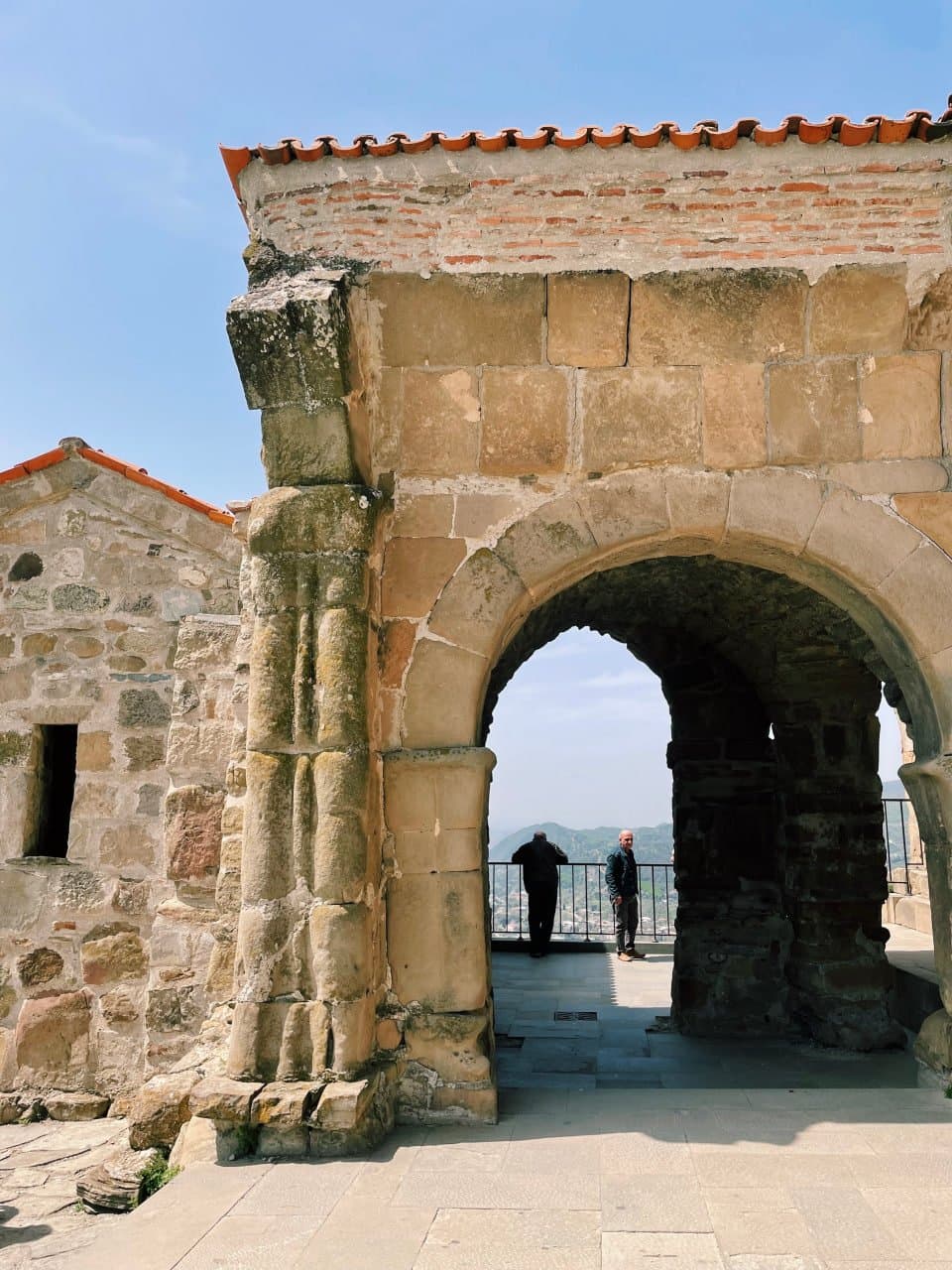
The monastery was built at the end of the 6th and the start of the 7th century, between 590 and 605. The place was not chosen by chance: according to tradition, this is where Saint Nino set up the first cross on Georgian soil. She made the cross from grapevine, tying the branches together with her own hair. A small chapel was first built on that spot, and its ruins still survive by the monastery walls. Later, under King Stepanoz I, the main church was built.
The architecture of Jvari is the early Georgian cross-dome style at its best. The church is small: 25 meters high, 22 by 19 meters in area. It has a dome on an octagonal drum and facades with relief images of the donors and scenes from Scripture. Strict, well proportioned, and set into the mountain as if it had grown out of it. This very style became the model for hundreds of Caucasian churches built later.
The main thing at Jvari is still what is outside.
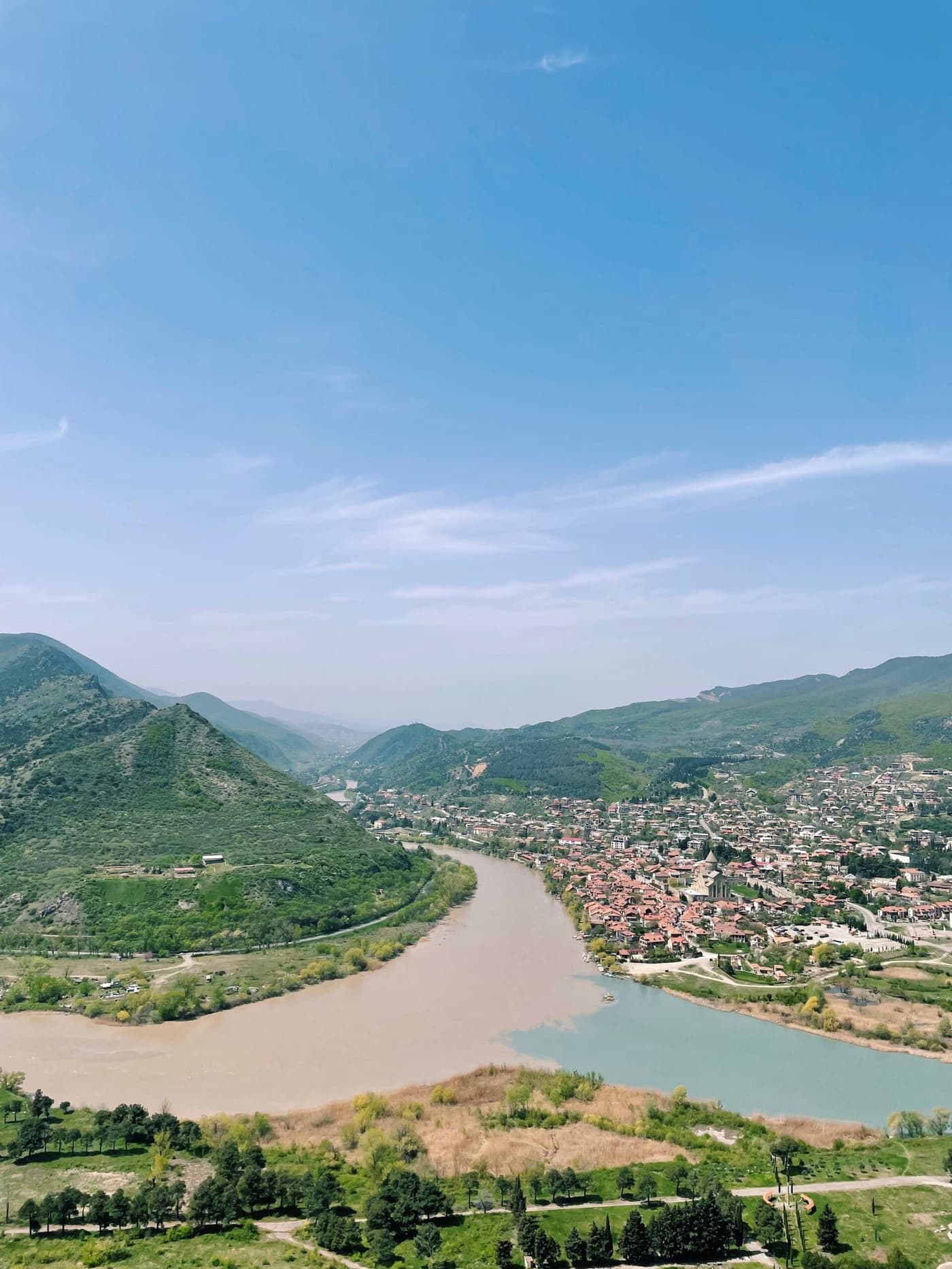
From the viewing platform by the monastery you get one of the most famous views in Georgia, the confluence of the Kura and Aragvi. Two rivers of different colors meet right below you: the muddy, yellowish Kura and the lighter Aragvi. Below are the red roofs of Mtskheta, green hills, and mountains on the horizon. This view inspired Mikhail Lermontov: in 1837 he passed through Mtskheta on his way to the Caucasus, stopped here, and two years later wrote the poem "Mtsyri." The famous lines about the streams of the Aragvi and the Kura that merge and murmur, embracing like two sisters, are about exactly this view from the hill of Jvari.
Entry to the monastery is free. It is open from 09:00 to 18:00–19:00.
Svetitskhoveli Cathedral
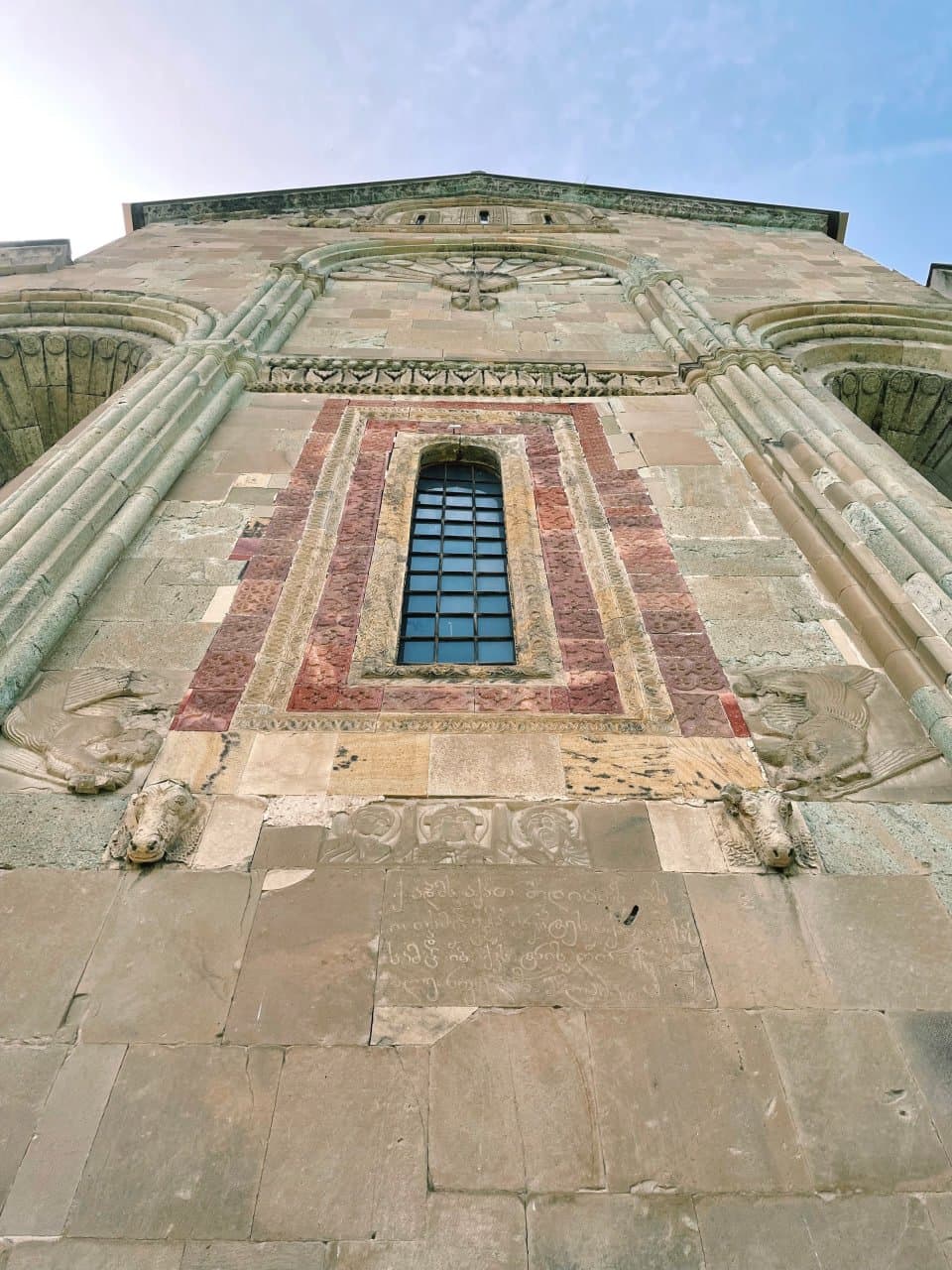
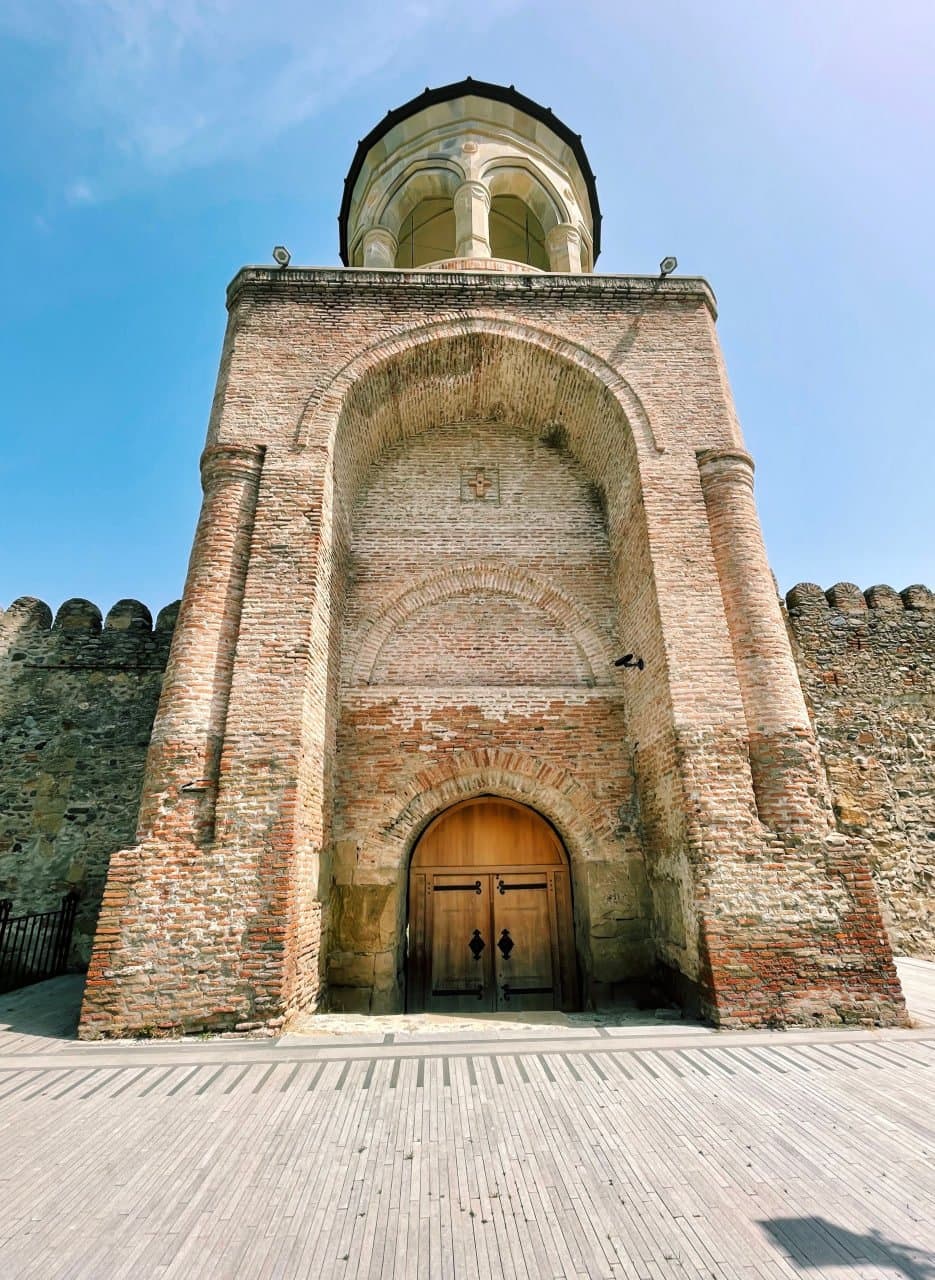
The main church of Georgia. It was built in 1010–1029 under King Giorgi I, by the architect Konstantine Arsukisdze. It is the largest historic building in the country. The walls reach 17 meters in height, and the bell tower can be seen from anywhere in Mtskheta.
The name translates as "Life-Giving Pillar," and behind it is a legend that Georgians regard as historical fact. According to tradition, the tunic of Jesus Christ after the crucifixion was brought to Mtskheta by local Jews, the rabbi Elioz and his brother, who had been in Jerusalem. A woman named Sidonia took the tunic and would not give it up; she died at the moment she pressed it to her chest. The tunic was buried with her. A cedar grew on that spot. When the first church was built in the 4th century, the cedar was cut down and made into a load-bearing pillar. According to tradition, the pillar rose by itself and stood in place after a night of prayer. Since then it has been called the Life-Giving Svetitskhoveli. Over the supposed burial place of the tunic there is now a separate chapel inside the cathedral.
Besides the tunic, Svetitskhoveli holds other relics: part of the remains of the Apostle Andrew the First-Called, who according to tradition visited Georgia, and the mantle of the Prophet Elijah, kept behind the central iconostasis.
The cathedral was the place of coronation and burial of Georgian kings for many centuries. Tombstones survive on the floor and along the walls. The frescoes have partly survived: some were destroyed in different centuries, and some were restored. On the walls you can make out scenes from the Gospels, Georgian saints, and portraits of the donors.
Outside, the cathedral is surrounded by a fortress wall of the 18th century with corner towers, which gives the whole complex the look of a fortified monastery. The entrance is through the main gate on the east side.
Entry to the cathedral is by donation. Women need a headscarf and covered shoulders; men need covered shoulders. At the gate there are wraps and scarves that are given out free or for a symbolic fee. It is open from 09:00 to 18:00.
Samtavro Monastery
A 10-minute walk from Svetitskhoveli, in the northern part of the town, stands Samtavro Monastery. The name translates as "royal territory," and that is exactly what it is.
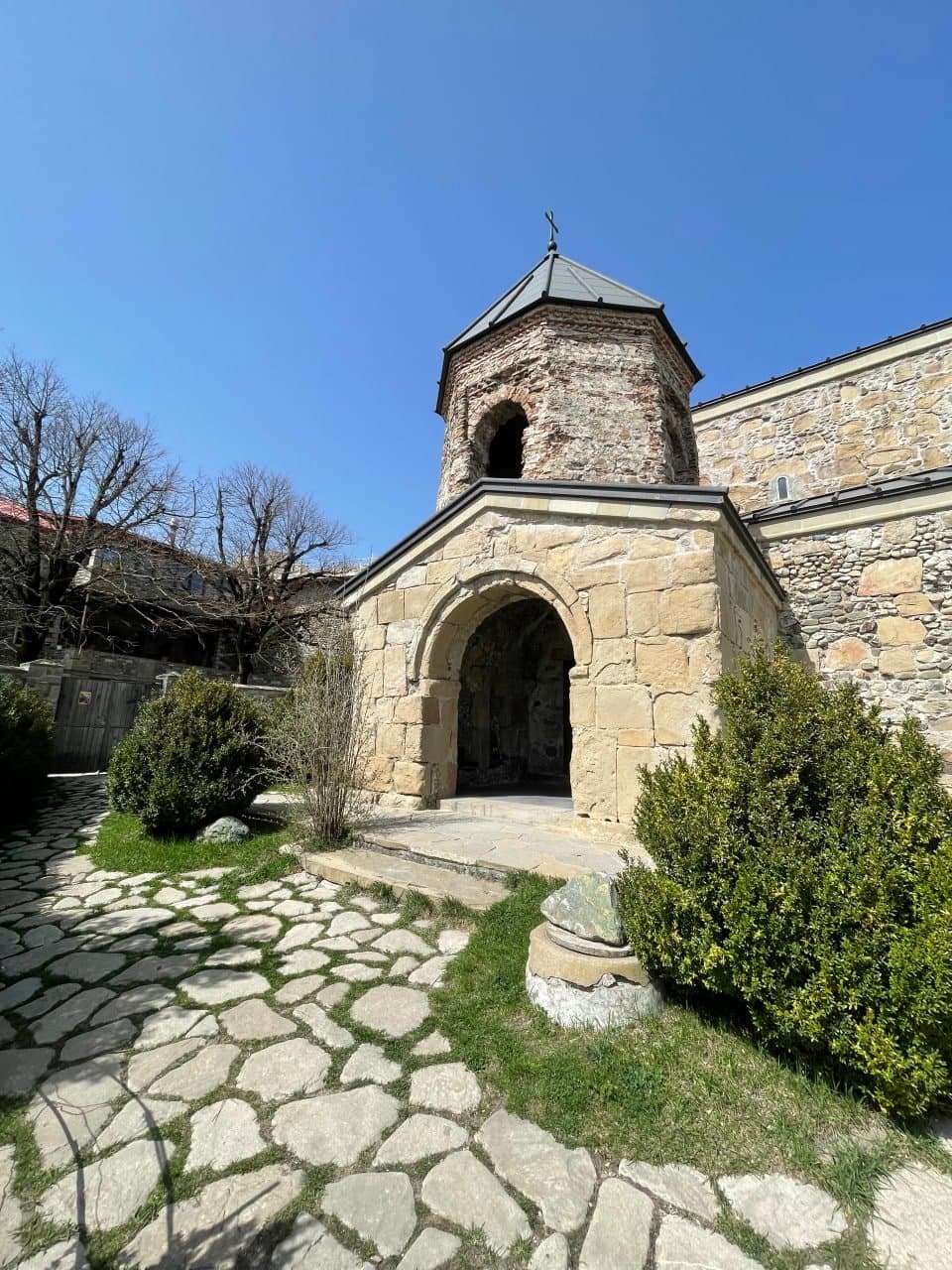
The history of this place goes back to the 4th century. This is where Saint Nino lived in the blackberry thicket by the walls of Mtskheta after she arrived in the city. After her death and the baptism of Georgia, King Mirian III built the Church of the Transfiguration on this spot. He himself and his wife Nana, the first Christian monarchs of the country, were buried here. Their tombs have been preserved in the main church of the monastery.
In the 11th century a large cathedral was built on the grounds, and it still stands. Next to it, in the small chapel of Nino, is the very blackberry bush under which, according to tradition, the saint prayed. The spring near the chapel is considered healing.
Samtavro is a working convent. The atmosphere here is noticeably quieter and more focused than at tourist-heavy Svetitskhoveli. The nuns hold services, and there are few tourists, especially on weekdays.
The monastery also holds the grave of Elder Gabriel Urgebadze, one of the most revered Georgian ascetics of the 20th century. He was canonized in 2012. People come to his grave from all over the country. If you see a line, it is for him.
Entry is free.
Bebristsikhe Fortress
The ruins of a medieval fortress on a hill above the town are the fourth stop on the route, one that is easy to skip but worth including. Bebristsikhe translates as "Grandfather's Fortress" or "Elder's Fortress." Only fragments of walls and towers remain of the fortress itself. But the view is worth the climb.
From the hill you can see everything at once: the town of Mtskheta, both churches, Jvari Monastery on its rock across the way, and the confluence of the rivers. It is the best viewpoint for panoramic photos.
The climb is on foot and takes about 20 minutes. The path is a bit steep, and shoes with non-slip soles are a good idea. There can be snakes in the tall grass, so do not leave the path. Entry is free.
One-Day Route From Tbilisi
If you leave at 09:00, you can be back in Tbilisi by evening with the feeling of a day well spent. If you are only heading to the Georgian capital, my Tbilisi city guide will come in handy.
What a One-Day Route Around Mtskheta Looks Like
09:30 — Jvari Monastery. An hour for photos and the view of the rivers. Let the view sink in, and do not rush.
10:30 — Drive down to Mtskheta, Svetitskhoveli Cathedral. Forty minutes inside to look at the frescoes, the chapel over the tunic, and the tombs of the kings.
11:30 — Samtavro Monastery. Thirty minutes. Look into the small chapel of Nino by the blackberry bush.
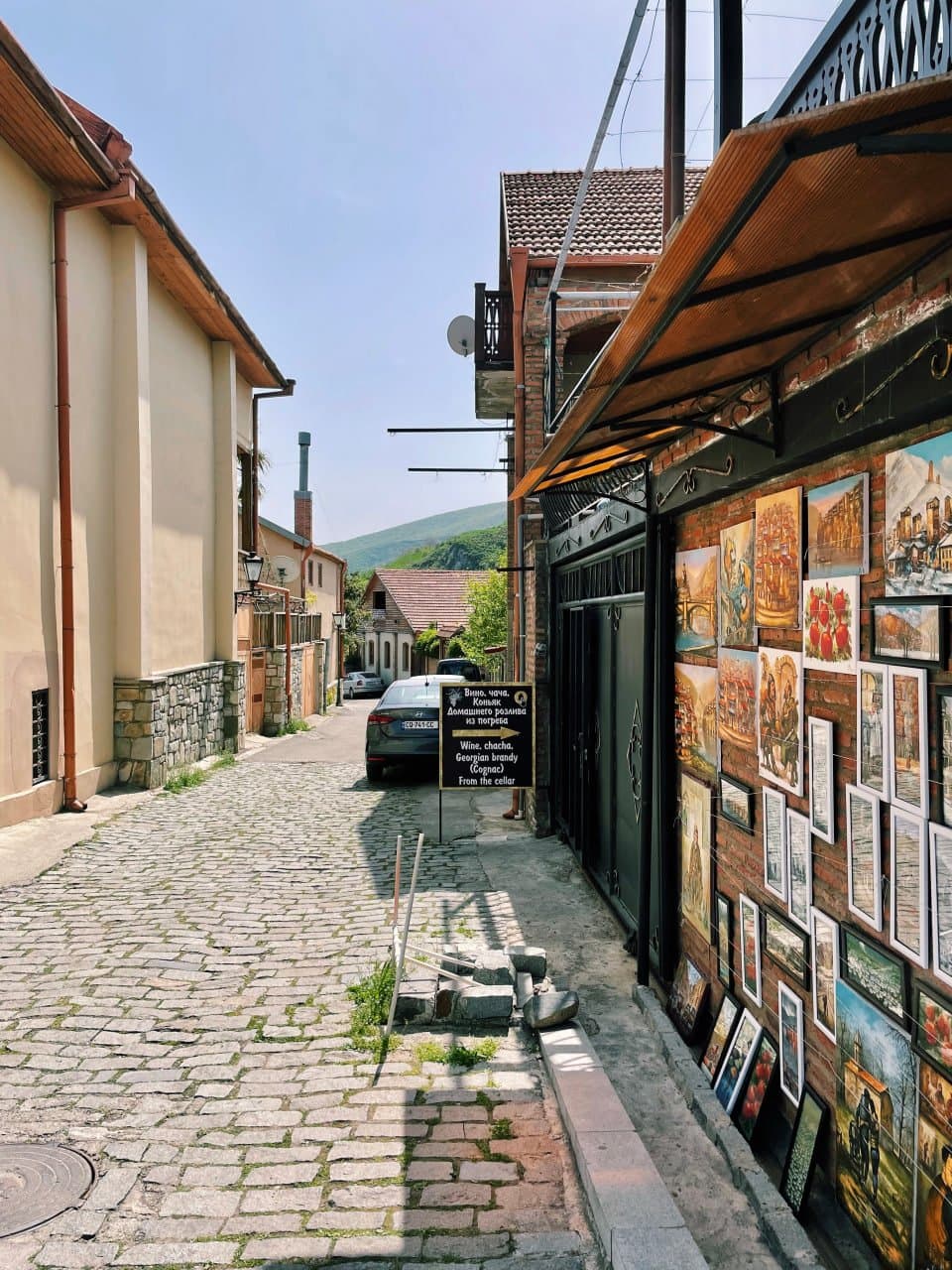
12:15 — A walk through the old town of Mtskheta. The main street leads from Samtavro to Svetitskhoveli, and along it are bakeries with tone ovens, shops selling churchkhela and wine, and souvenir stores.
13:00 — Lunch. It is nice to have a leisurely meal.
14:30 — Return to Tbilisi or continue along your route.
If you want to add Bebristsikhe, allow an extra hour and wear comfortable shoes.
Where to Eat in Mtskheta
The flow of tourists in Mtskheta has turned several cafes into consistently good places. Here is what works reliably.
Tatin Cafe & Hotel stands right next to Svetitskhoveli, surrounded by a garden. The menu is varied: Georgian cuisine with vegetarian options, breakfasts, and coffee. It is a pleasant, cozy place even in high season.
Ornament Express is behind Svetitskhoveli, a little away from the main tourist flow. A good choice for lunch: local dishes, decent portions, and a view of the church from the terrace.
Adacafe stands on the riverbank. It is quiet there, especially on weekdays. The menu is mixed, with Georgian and Turkish dishes, and the fish is good. If you want to eat by the water, come here.
Along the main street there are several bakeries with tone ovens. A clay oven, hot shoti bread for 1–1.5 lari, and the smell of bread that carries half a block. It is a must: bread straight from the oven is one of the best experiences in Georgia.
An average lunch for two in a Mtskheta cafe is 40–80 lari. Prices are slightly lower than in Tbilisi.
How to Get From Tbilisi to Mtskheta
Mtskheta is the nearest major sight to Tbilisi, only 25 km away. There are several ways to get there.
Minibus (marshrutka) is the cheapest and most convenient way. It leaves from the Didube bus station in Tbilisi, with minibuses running every 15–20 minutes from early morning. A ticket costs 1.5–2 lari. The trip takes about 30 minutes. Get off at the central stop in Mtskheta, near Svetitskhoveli. The return is the same. The only downside: Jvari is on a separate road, and the minibus does not go there.
Taxi is 35–50 lari from central Tbilisi. It is convenient for a group of two or three people. You can agree with the driver to stop at Jvari, which adds 15–20 lari to the price. Some drivers are willing to wait at the monastery while you look around.
By car it takes about 25 minutes along the E60 highway. Parking at Svetitskhoveli is paid, about 2 lari. Jvari has its own road with signposts, and the turnoff is visible from the highway before you enter Mtskheta. Parking at Jvari is free.
Combining with other routes — Mtskheta sits right at the start of the Georgian Military Road. If you are heading to Kazbegi or Gudauri, it is convenient to stop in the morning: see Jvari and Svetitskhoveli in an hour and a half, then continue north. It is a classic route, and it works.
What to Combine With a Trip to Mtskheta
Mtskheta is a natural hub for several directions.
Uplistsikhe is an ancient cave town in the rock above the Kura River, about 55–60 km from Mtskheta toward Gori. If you want to devote a day to history, do Mtskheta in the morning and Uplistsikhe after lunch. It is a packed itinerary, but a realistic one.
Gori is about 60–65 km from Mtskheta. It is Stalin's birthplace, with a museum of his personal belongings and his railway car, and the Goris Tsikhe fortress. If you are interested in Soviet history, it is a good addition.
The Georgian Military Road — the road to Kazbegi starts here. Mtskheta → Ananuri → Gudauri → Stepantsminda is a classic day trip, where you set out early in the morning and come back late in the evening.
Borjomi is 150 km in the other direction. If you want mineral springs and mountain air, you can combine Borjomi with Mtskheta on a two-day trip.
When Is the Best Time to Visit Mtskheta
Mtskheta is good at any time of year; it is not tied to a beach season and does not depend on mountain weather. But there are nuances.
April and May are the best time for nature: the greenery is bright, the gardens are in bloom, and it is warm but not hot. There are few tourists compared with summer.
June and July are high season. Visitors from Tbilisi come to Mtskheta for half a day, and the area around Svetitskhoveli can get crowded. Arrive before 10 a.m., before the tour buses show up.
September and October are my favorite option. It is warm, the grapes are ripening, and the hills around turn russet. The light in September is special, soft and golden. Mtskheta is very photogenic at this time.
In winter there are almost no people, and it is quiet and atmospheric. If you are lucky with fog, Jvari Monastery above the clouds looks like an illustration from a book. Sometimes there is snow, rarely, but the winter shots turn out stunning.
Budget for a Trip to Mtskheta
Mtskheta is one of the most affordable destinations near Tbilisi. If you go by minibus and do not spend on souvenirs, the whole day costs very little.
A round-trip minibus ride is 3–4 lari. Entry to Jvari and Samtavro is free. Svetitskhoveli is by donation, usually 2–5 lari. Lunch in a cafe is 20–40 lari per person. Coffee and hot bread from a tone oven are 5–8 lari. In total it comes to 30–60 lari per person, which is about $10–20.
By taxi, add 70–100 lari round trip if there are two of you and you want to get to Jvari in comfort.
Mtskheta FAQ
How far is Mtskheta from Tbilisi and how do I get there?
The town is about 20–25 km north of Tbilisi. You can get there by minibus, bus, taxi, or car. The trip takes about 25–40 minutes.
Can you see all the sights of Mtskheta in one day?
Yes. Because the town is compact and close to Tbilisi, you can realistically visit the main places in one day.
Is entry to the churches and monasteries of Mtskheta paid or free?
Many churches are free to enter, but a voluntary donation is welcome.
What is the best season to visit Mtskheta?
The best time is spring (April–May) and autumn (September–October), when the weather is comfortable and there are fewer tourists. Summer can be hot and winter cold.
Is it worth hiring a guide?
You can manage on your own: there are signs, and the route is obvious. A guide gives context: legends, architectural details, the story of particular frescoes. If you are interested in history, a guide gives you more depth. Guided tours from Tbilisi start at 50 lari per person.
What is Svetitskhoveli and why is it called the Life-Giving Pillar?
It is the main cathedral of Georgia, built in 1010–1029. The name comes from a legend: the tunic of Jesus Christ, brought from Jerusalem, is buried here, and one of the church's pillars, according to tradition, miraculously rose by itself and began to stream myrrh. That pillar was called the Life-Giving one.
Where is Saint Nino buried?
Saint Nino is buried not in Mtskheta but in Bodbe Monastery in Kakheti, near the town of Sighnaghi. A piece of the stone from her grave is kept at Samtavro, and she also lived there during her preaching. Mirian III and Nana are buried in Samtavro.