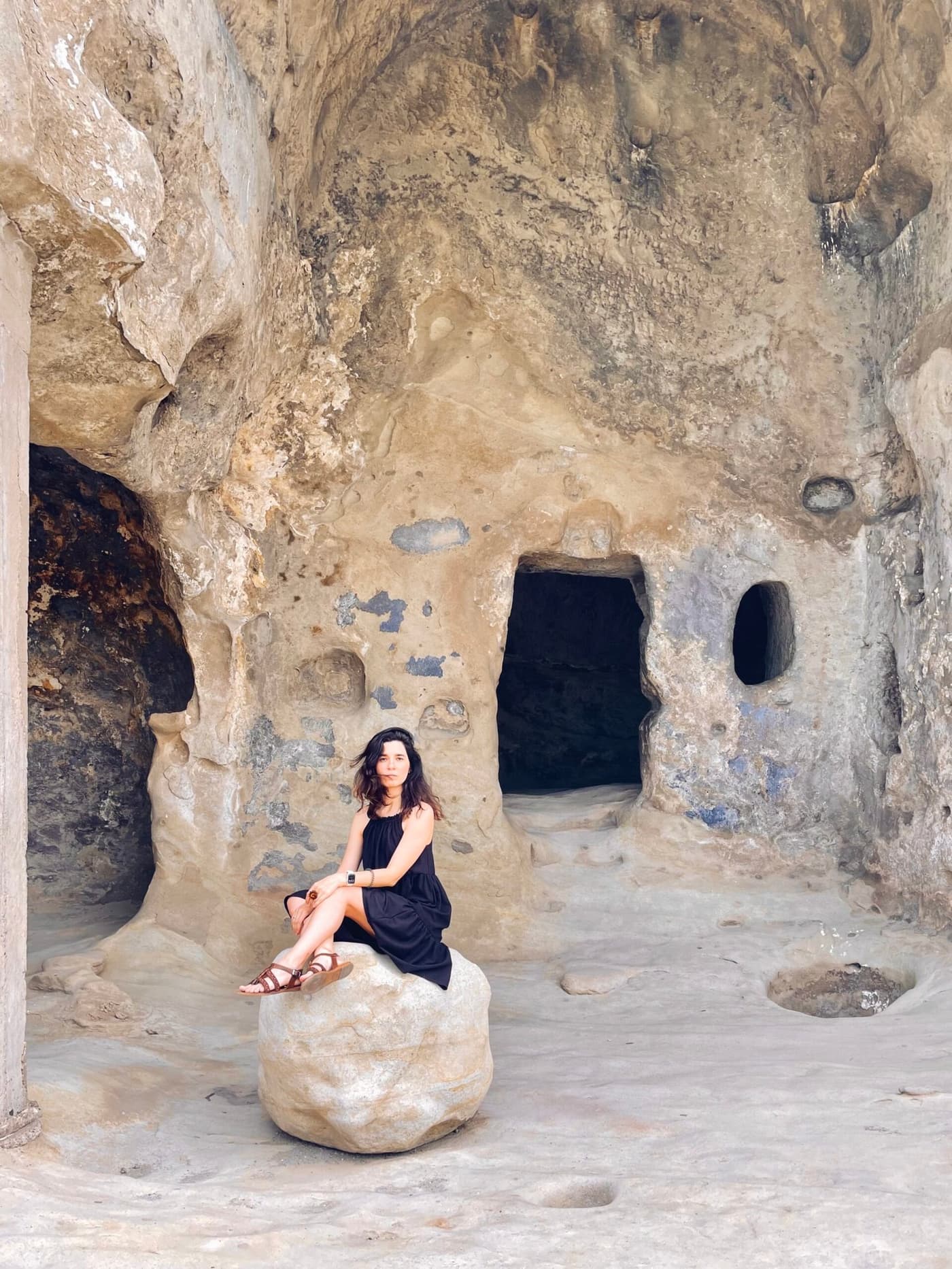
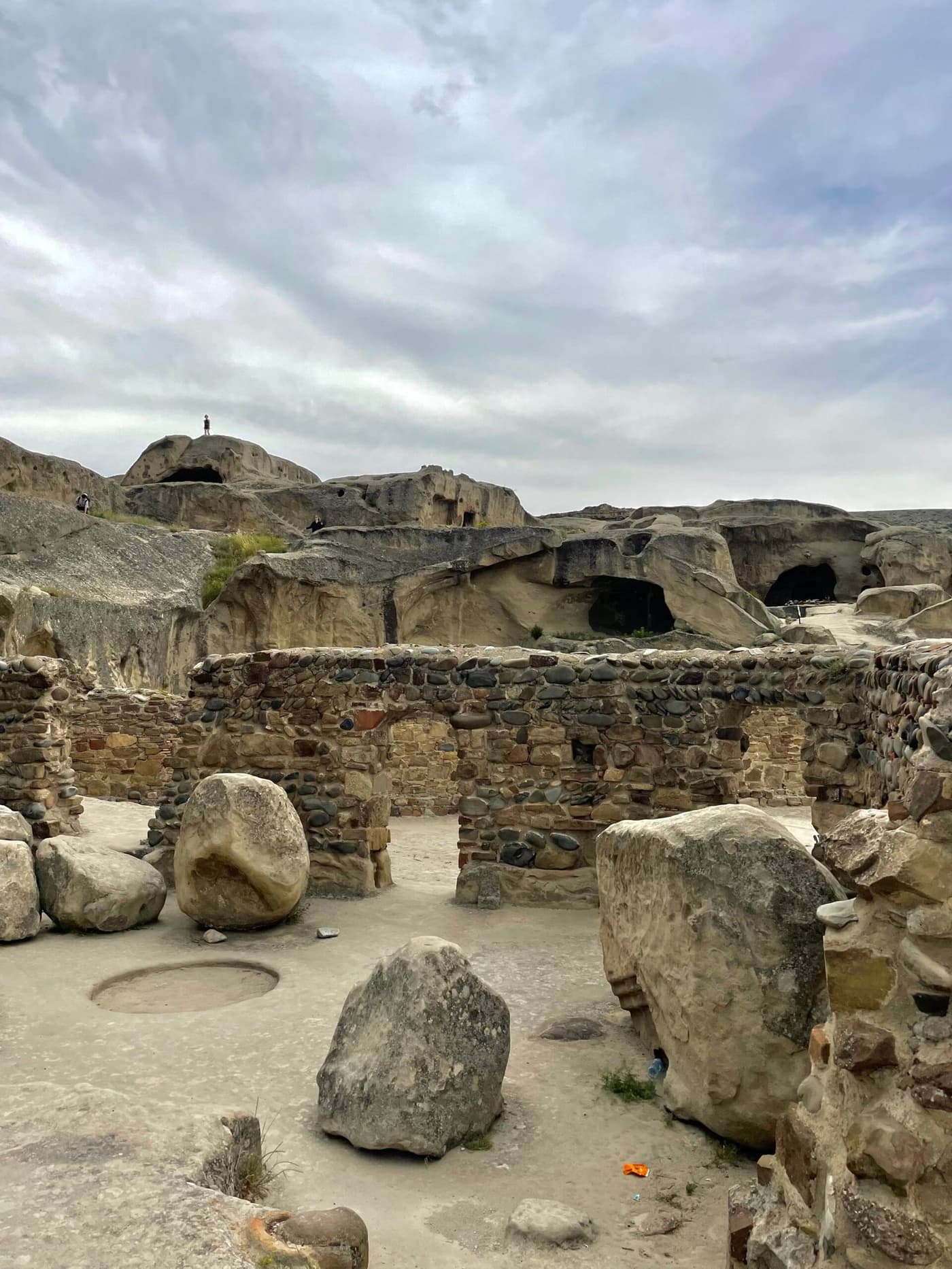
Uplistsikhe is an ancient cave town carved into a rock above the Kura River. It is more than three thousand years old, and it was a major political and religious center long before Tbilisi became the capital. Today it is an open-air archaeological complex where you can literally walk along streets, pharmacies, halls and a theater cut into the stone.
It is not the most hyped spot on Georgia's tourist map, and that is its advantage. There are fewer visitors than at Gergeti, it feels calmer than Tbilisi's Old Town, and the atmosphere of the place is genuine.
History of Uplistsikhe
The name translates from Georgian as "the Lord's fortress." The town appeared in the late 2nd to early 1st millennium BC and reached its peak between the 1st century BC and the 6th century AD. At different times it was home to 20,000 to 30,000 people, which made it a large city by the standards of the ancient Caucasus.
Uplistsikhe was an important center of pagan cults: people worshipped the sun, the moon, fire and other gods here. The architecture of the caves reflects these cults, from the orientation of the space to the placement of the niches and the shape of the halls. When Georgia adopted Christianity in the 4th century, the pagan temples were partly rebuilt as Christian churches, and this layering is easy to see.
At its height, in the 1st to 3rd centuries AD, the town was part of the trade routes between Persia, Rome and the Caucasus. Merchants from the Silk Road passed through it.
In the 7th century, the Arab conquest of Kartli struck the town hard. In the 10th and 11th centuries, Uplistsikhe briefly revived under the Georgian kings. In the 13th century, the Mongol invasion devastated it for good. The last residents left, and the town began to sink into dust.
Excavations began in the 19th century. About 700 cave rooms have been explored so far.
What to See in Uplistsikhe
Several dozen sites have survived in Uplistsikhe, from dwelling caves to temples and a theater. Here are the main ones.
The Main Street
A wide tunnel cut into the rock, the central artery of the town. As you walk along it, you feel the scale: this is not a small cave but a real city avenue, only made of stone. Entrances to dwellings and trading rooms line both sides.
The Pagan Temples
Several halls with columns and niches for idols. The architecture shows the high skill of the builders: the stone carving is precise and the proportions are carefully worked out. The niches were made so that on certain days of the year sunlight falls exactly there, which was a kind of architectural astronomy.
The "Pharmacy"
A room with stone shelves cut right into the rock. The shelves vary in height and width, clearly meant for storing vessels of different sizes. It is presumed to have been a place for storing medicines or raw materials, although its exact purpose is still debated by scholars.
The Theater Hall (Tamar's Hall)
A large room with acoustics designed on purpose. According to legend, this is where Queen Tamar the Great, the ruler of the 12th and 13th centuries, under whom Georgia reached the peak of its power, received guests. The mystery of this hall is its acoustics, which still work. If you stand in a certain spot and say something quietly, the sound carries surprisingly far. You can test it yourself.
The Christian Basilica (9th–10th Century)
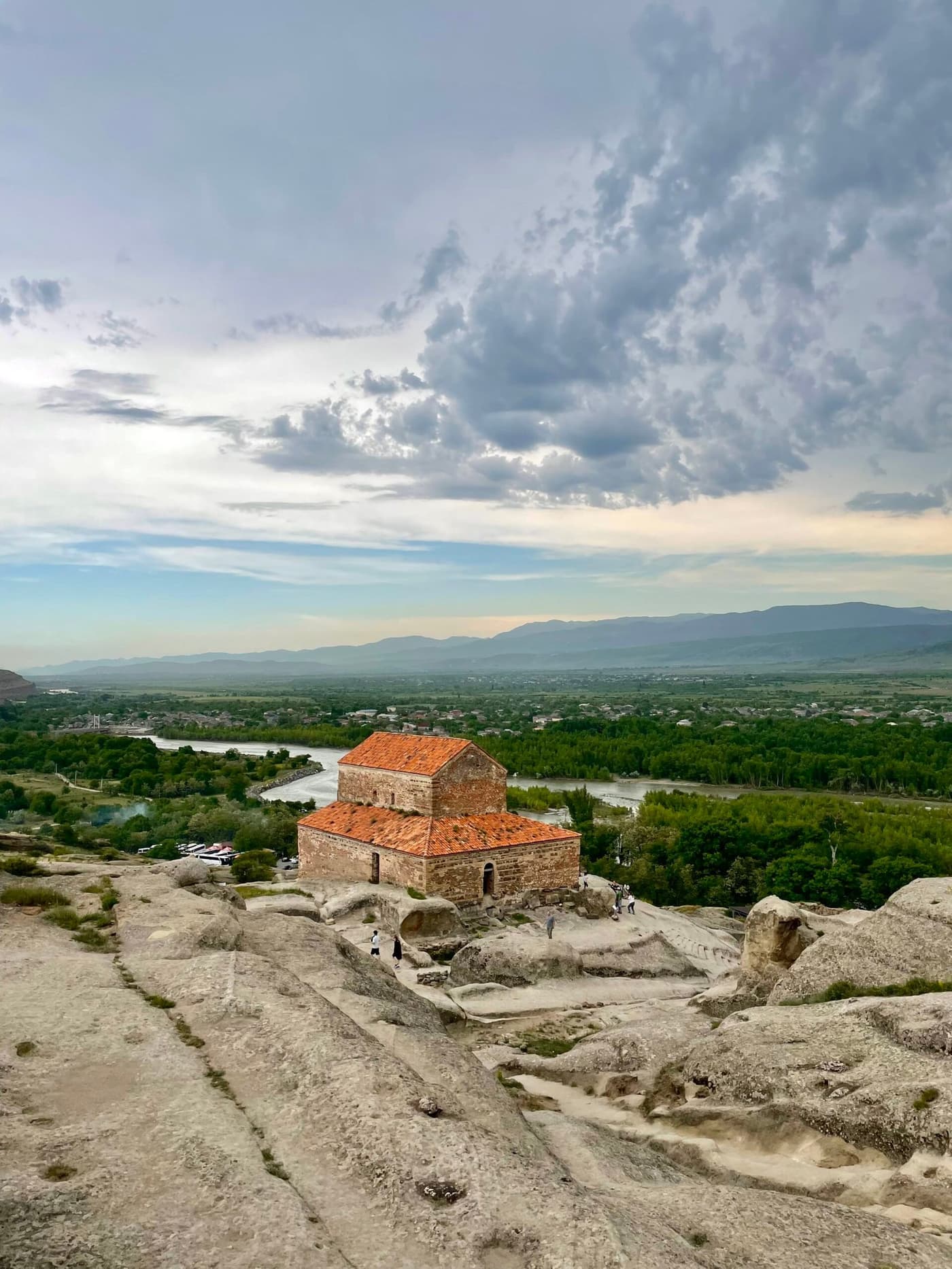
A church built on top of a pagan temple. You can literally see it in the stone: new masonry laid over pagan carvings, and a changed layout. It is the best preserved of all the sites in the complex.
Rocky Paths and Views of the Kura
Paths run between the caves across open areas of rock. From several points there are great views of the Kura River below, the surrounding valleys and the horizon. These are the best spots for photos.
The Stone Bridge Over the Kura
At the foot of the rock is an old stone bridge over the river, one of the few that have survived in this area. You can reach it on foot from the parking lot.
Uplistsikhe Route: 2 Hours
I recommend walking from the bottom up, from the entrance to the basilica and the viewpoint at the top. The trail is well marked, so getting lost is impossible. At the top there is a viewpoint over the Kura valley. The descent goes down the other side.
What to bring: water (there are no shops inside), comfortable shoes with non-slip soles (the surfaces are stone and slippery in the rain), a hat (it is hot in summer and there is little shade), and sunscreen.
How to Get to Uplistsikhe From Tbilisi
Uplistsikhe is 100 km from Tbilisi and 10 km from the town of Gori. If you are only planning your trip to Georgia's capital, my Tbilisi city guide will be useful.
By car: along the E60 highway (Tbilisi–Gori), about 1.5 hours. Parking at the entrance costs 3 GEL, and GPS leads exactly to the address.
By minibus: Tbilisi (Didube) → Gori. Minibuses run often, take about 1.5 hours and cost 5–7 GEL. From Gori to Uplistsikhe it is 15 minutes by taxi (about 10 GEL) or by an infrequent local minibus.
Organized tour: "Tbilisi–Uplistsikhe–Gori" or "Uplistsikhe–Borjomi" tours are available from Tbilisi travel agencies. With a guide, the price is 50–100 GEL per person.
What to Combine It With
Uplistsikhe is easy to combine with other places in the region: Gori is only about 15 minutes away, while Mtskheta and Borjomi are farther, so plan them as separate stops on your route.
Gori and the Stalin Museum
Gori is Stalin's hometown. It has a large museum dedicated to the dictator: personal belongings, books, maps, and the railway car in which he traveled to the Yalta Conference. It is a hard place to make up your mind about, with Soviet kitsch and real history all mixed together. It is unexpectedly interesting even if you are indifferent to Stalin. Entry is about 15 GEL. Nearby is the Goristsikhe fortress above the town.
Mtskheta
On the way from Tbilisi lies the ancient town of Mtskheta, the former capital and spiritual heart of Georgia. It has Svetitskhoveli Cathedral and Jvari Monastery. It is convenient to combine in one day: Mtskheta in the morning (1.5–2 hours), then Uplistsikhe.
Borjomi
A little farther, 80 km from Gori, is the town of Borjomi, a famous resort town with mineral springs and a national park. It is a packed but realistic route: Tbilisi → Mtskheta → Uplistsikhe → Borjomi (overnight) → Batumi.
Gori: Is It Worth Staying Longer
If Uplistsikhe is your main goal, you do not need to stay overnight in Gori. But if you came by car and have time, Gori offers what Tbilisi does not: a small Georgian provincial town without tourist polish.
The Goristsikhe fortress looms over the town from a hill. The Stalin Museum is a very controversial but memorable place. The local market is lively and not touristy.
Practical Information
- Entry ticket: 15 GEL (2024–2025 data). The audio guide costs extra, so check on site.
- Opening hours: 10:00–18:00 daily.
- Parking: at the entrance, 3 GEL.
- Cafe: a small eatery at the entrance. There is no food inside the complex. Bring water.
- Restrooms: at the entrance.
Uplistsikhe FAQ
Where is Uplistsikhe?
Uplistsikhe is in the Gori municipality, about 90 kilometers from Tbilisi. You can get there by car in 1.5–2 hours.
How do I get to Uplistsikhe from Tbilisi?
You can go by car, taxi or on a tour. The most convenient route is along the Tbilisi–Gori highway. Guided tours are also available, for example through the Georgia4Travel service.
How much is the Uplistsikhe entry ticket?
The basic ticket price is 15 GEL. A ticket with a wine tasting costs 20 GEL. Parking costs 3 GEL.
How long does it take to see Uplistsikhe?
The average visit takes 1.5 to 2 hours. If you want to explore every corner of the complex thoughtfully, set aside 3 hours.
When is the best time to visit Uplistsikhe?
The ideal time is spring (April–May) and fall (September–October). Summer can be hot, especially around midday, so keep that in mind when planning your trip.
Is it suitable for children?
Yes, but with caveats. The surfaces are rocky and uneven, so for little ones it is better to use baby carriers rather than strollers. A hat and water are also a must.
Are there guided tours of Uplistsikhe?
Yes, many agencies offer guided tours. Private guides who focus on history and archaeology are especially recommended.