Patong is the best-known and most touristy beach in Phuket, and also the most divisive. Some people come here specifically for the action and stay for years, others run away after two days. I have been to Patong and ended up in the second camp: for me it is too loud, too crowded and too much like downtown Pattaya. That does not mean the place is bad, it is just very specific. Below I'll sort out what is true and what is marketing, what kind of beach you actually get, and who Patong really suits and who would be better off choosing nearby Karon, Kata or other Phuket beaches.
Where Patong Beach is and how to get there
Patong Beach is on the west coast of Phuket, in a large bay of the Andaman Sea. It is the central resort area of the island, with the most developed infrastructure. Distances from Patong to the key points:
- Phuket International Airport: about 40 km, 45-60 minutes by car
- Phuket Town: 15 km
- Karon Beach: 8 km
- Kata Beach: 10 km
- Kamala Beach: 12 km
- Freedom Beach: 5 km
How to get from Phuket Airport to Patong
There are four options, listed by price. Choose based on your budget and how much luggage you have.
Phuket Smart Bus: 100-170 baht, 1-1.5 hours on the road. The white-and-blue bus runs from the domestic terminal along the west coast to Rawai. It does not take you to your hotel, so you get off at the nearest stop. It is the cheapest option, but with a suitcase and after a long flight it is not for everyone.
Minivan from the airport counter: 180 baht per person, about 1.5 hours. It drops passengers at their hotels and leaves when it fills up. On the way it may stop at its own travel agency, which is a standard routine and takes 15-30 minutes.
Prepaid taxi: 800-1,000 baht per car. The counters are in the arrivals area, the price is fixed and includes the airport fee. You get there in 45-60 minutes without stops.
Bolt or Grab: 650-800 baht in 2026. I usually take Grab.
Getting around Patong and to nearby beaches
Within the area, the easiest way is a motorbike taxi (from 150 baht) or a tuk-tuk (from 300 baht). A taxi to Karon starts at 450 baht, to Kata from 550, to Surin from 650. A scooter rental is 250-350 baht a day, a car from 800-1,000 baht. If you plan to move around the island a lot, a scooter pays for itself in a couple of days.
What Patong Beach is like
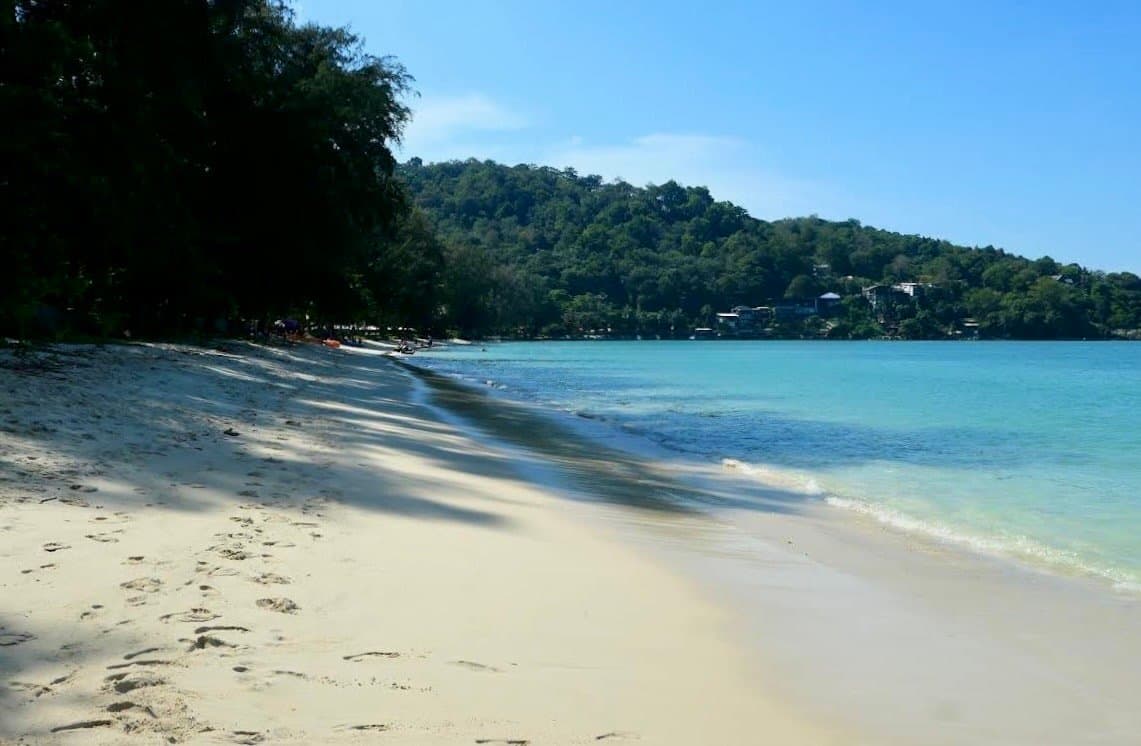
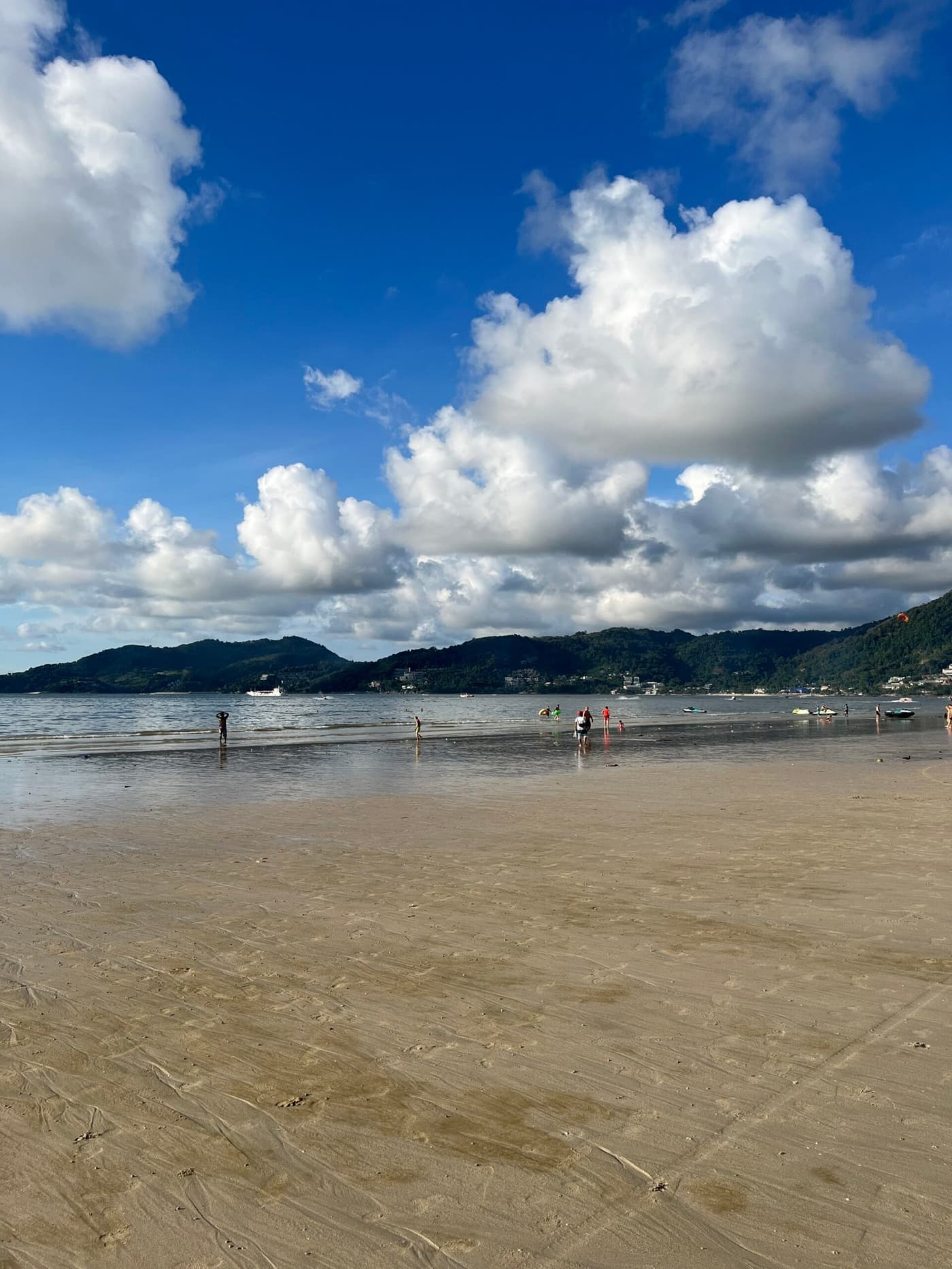
It is a strip of sand about three kilometers long, wide, with soft light-colored sand. The water is shallow at the entrance, with no rocks or corals, so you can walk in barefoot. The bay is closed off by headlands on both sides: in the north near Kalim there are picturesque rocks, in the south there is a pier and a river mouth. There is little natural shade, trees appear only here and there, so most people rent an umbrella.
As a beach, it is decent: wide, with an easy entry into the water. But it is not the most scenic. A flat strip of sand, then right behind it a road with a stream of bikes, massage stalls, and mango and coconut sellers. The scenery people come to Phuket for, with emerald cliffs, coves and jungle, barely registers here. Kamala or Mai Khao Beach have it, Patong does not.
Patong Beach zones: north, center, south
The beach is roughly divided into three parts, and each one works for its own purpose.
North Patong is the calmest part, past Sawatdirak Street. A park with casuarina trees starts here, so there is always shade and free spots. There are fewer people, the water is cleaner, and the Kalim rocks are close. If you are going to stay in Patong, stay here.
The central part is the most crowded zone, right by Bangla Road. This is where you find the most sun loungers, jet skis, vendors and noise. All the main water activities start from here. Swimming with kids in the center is not comfortable: bikes, parasailing boats and a dense crowd.
South Patong is by the pier and the river mouth. Accommodation is cheaper here, but the water is sometimes murkier, and near the canal you can occasionally smell something unpleasant. I do not recommend this zone.
If you do end up in Patong, I would go only to the far north. I could not relax in the center: in an hour so many vendors and touts walk along the beach that the place feels more like a fair than a beach resort.
The sea and swimming at Patong
Patong sits in a bay, so in high season the sea here is calmer than at the open Phuket beaches, where waves are more frequent at Kamala or Surin. But the character of the sea changes a lot with the seasons, and that decides whether you can swim at all. Below I describe how the water behaves in each period and what to watch for.
High season (December-February)
From December to February the sea at Patong Beach is almost always warm and calm, with a water temperature of 28-30°C, a gentle entry and almost no waves. In the morning, before the crowds arrive, the water is clear, and this is the best time for swimming with the family. December-January is the peak of the season; February has the same weather but without the New Year crowds and price tags. November and March are the shoulder season, and the sea in those months is a matter of luck, but you are usually lucky.
Low season (May-October)
The main problem is not the rain but the sea. The southwest monsoon drives waves up to 2-3 meters high, and dangerous rip currents appear. Lifeguards regularly put up red flags and ban swimming, and tourists drown here every season, this is not a scare story. Rain is usually short, 30-40 minutes, more often at night. But if there is a red flag on the beach, you must not go into the water, and that rule is not up for discussion.
Lifeguard flags and hazards
There are lifeguards at Patong, and the towers have first-aid kits and vinegar for jellyfish stings. The flag system is simple: green means you can swim, yellow means be careful, red means no swimming. In low season red is common. Dangerous box jellyfish appear rarely, ordinary ones show up after storms in the rainy season.
Is Patong worth visiting with kids
Short answer: yes, but with caveats.
The pluses: a gentle entry into the water without rocks, soft sand, a 7-Eleven, pharmacies and cafes with kids' menus nearby, the Jungceylon mall with a kids' zone and a cinema, and water parks and a mini zoo within easy reach.
The minuses: noise until 2-3 a.m., jet skis and parasailing boats near the shore in the center, crowds in high season, and Bangla Road running right down to the beach, so walking past it with a child in the evening is not a great idea.
If you go to Patong with kids, book a hotel only in the northern part, at least 500-700 meters from Bangla Road. In my experience, Karon, Kamala or Nai Harn work much better for a family vacation: the beach is cleaner, the atmosphere is calmer, and you do not feel like you are leading your child through a fair full of touts.
Patong nightlife and Bangla Road
This is the reason most people come here. The concentration of bars, clubs, shows and neon in Patong is a record for Phuket: the other beaches on the island have nothing like this scale of nightlife. If this is the format you are flying to Thailand for, here is what to see and where, when to go, and what to avoid falling for.
What Bangla Road is
Soi Bangla is a pedestrian street about 400 meters long that comes out right onto Patong Beach. Every evening around 6 p.m. it is closed to cars, and until 2-4 a.m. it is the epicenter of the island's nightlife. Bars, clubs, go-go bars, Thai shows, street vendors, fire shows, neon, and music from ten venues at once. Peak activity is from 10 p.m. to 1 a.m.
What to do in the evening
Big clubs: Illuzion (in the DJMag top 100 clubs in the world), Hollywood, White Room, Tiger Disco, Sugar Club. The Simon Cabaret show, tickets 800-1,500 baht, is one of the best-known drag shows in Thailand. Thai boxing: Bangla Boxing Stadium and Patong Boxing Stadium, with fights on Mondays, Thursdays and Saturdays. Beach clubs: Kudo, Fuga, Yona (floating, open in high season). Live music: Red Hot Bar, Monsoon Bar, Hard Rock Café.
Safety at night
The area is well lit and tourist police walk the streets. The basic rules are simple: do not leave drinks unattended, do not fall for the "ping-pong show" touts (a classic scam: they promise 800 baht, and at the exit they demand 1,800-2,000 for "mandatory drinks"), use only Bolt or Grab taxis, and do not get on a bike after drinking. Ask about prices before you order.
Bangla is, in essence, downtown Pattaya in miniature. If that format is yours, you will be delighted. I went there once, had a look for the sake of it and left after twenty minutes. All of it weighs on me at once: drunk crowds, pushy touts, music blasting from every door at the same time, poles in every window. After Bangla Road you want a shower and some silence.
Where to stay in Patong: north, center or south
Patong has more than 500 hotels, and the area you stay in determines the whole feel of your trip. The same Patong can be calm and relaxed or unbearably loud, and it all comes down to the distance from Bangla Road and how close you are to the sea. I roughly divide the area into three zones: north, center and south. Each has its own character, its own price level and its own crowd.
North Patong is for those who want quiet. It is farther from Bangla, the sea is cleaner and the streets are calmer. Good options: The Nap Patong, Avista Hideaway Phuket Patong, Amari Phuket, Kalima Resort & Spa.
Central Patong is for those who are here for the action. A minute to Bangla, a minute to the beach, noise 24/7. Burasari Phuket, Grand Mercure Phuket Patong, The Kee Resort & Spa, Holiday Inn Express Phuket Patong Beach Central.
South Patong is for budget stays. Prices are lower and it is farther from the nightlife, but also farther from the beach. Patong Lodge Hotel, Duangjitt Resort & Spa.
How much accommodation costs in Patong in 2026
Prices depend heavily on the star rating: 3-star, 4-star and 5-star hotels sit at clearly different price levels, with 5-star the most expensive. In low season prices drop by 30-50%. At New Year and Christmas the price doubles, so it is worth booking 3-4 months ahead.
If I had to stay in Patong, I would take a hotel in the northern part, at least 500 meters from Bangla. Sleeping in the epicenter only makes sense if you are into it yourself and are not sleeping until morning either.
Prices in Patong
Prices in Patong are about the same as in Phuket Town, but because of the heavy competition there is plenty of choice: there is an hour-long massage for 300 baht and one for 500, there is tom yum for 80 and for 250. For a couple, a day without alcohol or excursions comes to about 1,500-2,500 baht. Basic benchmarks:
| Service | Price in baht |
|---|---|
| Sun lounger + umbrella | 150-200 |
| Thai massage, 60 minutes | 300-500 |
| Parasailing (5-10 minutes) | 1,500-2,000 |
| Jet ski (30 minutes) | 1,200-2,000 |
| Tom yum at a street stall / at a restaurant | 80 / 250 |
| Mango shake | 60-80 |
| Coconut on the beach | 60-80 |
| Large bottle of water | 20-30 |
| Scooter rental per day | 250-350 |
| Taxi from the airport | 800-1,000 |
| Simon Cabaret ticket | 800-1,500 |
What to see in Patong and nearby
The beach itself is only part of a vacation program. Patong has dense infrastructure for shopping and entertainment, there are several less touristy beaches nearby, and it is a convenient starting point for most sea excursions around Phuket.
In the area
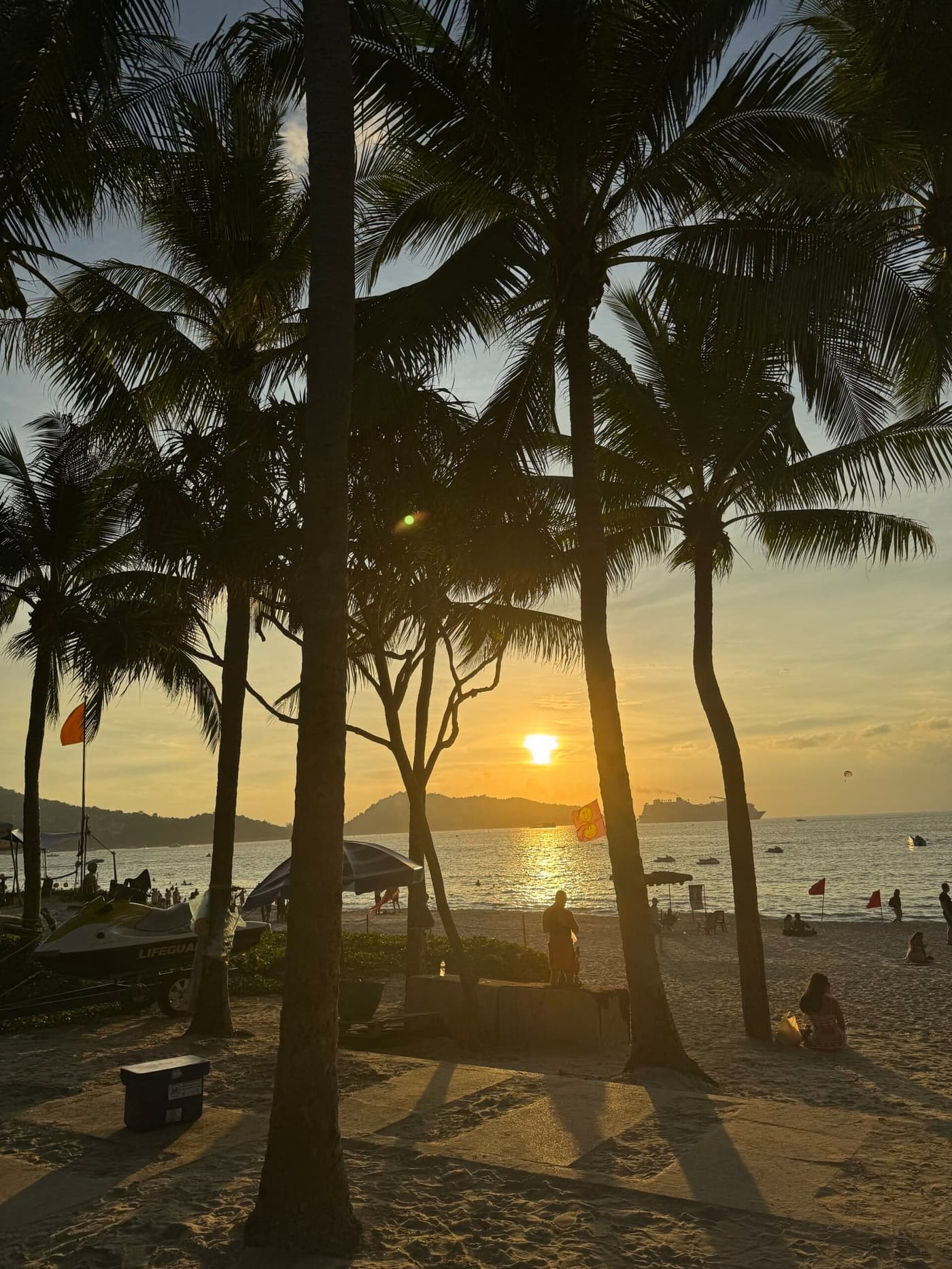
Jungceylon is the largest mall in Phuket, with a Big C supermarket, a food court, a cinema and shops. Central Patong is more modern, with boutiques. The Banzaan night market is the best place for fresh seafood and Thai food for dinner. Malin Plaza and the OTOP Market have street food and souvenirs. Wat Suwan Khiri Wong is a working Buddhist temple in the northern part, a quiet place that tourists rarely visit. The Patong Viewpoint is on the road between Karon and Patong and is the best spot for sunset photos.
Nearby beaches
- Kalim Beach is right past the northern edge of Patong, rocky, good for walks and sunsets. Swimming is not convenient, but the views are great.
- Tri Trang, the emerald beach, is 3 km to the south over the hill, quieter and greener.
- Freedom Beach is 5 km away, reached by longtail boat (1,500 baht round trip). A secluded cove with white sand and turquoise water. Entry to the area with sun loungers costs 200 baht.
- Paradise Beach is a small, intimate beach, reached by longtail boat or on foot over the hill.
If you have a day, I recommend going to Mai Khao Beach in the north of the island, where planes land right over your head. Or to Yanui Beach in the south, a tiny cove with clear water that is the complete opposite of Patong.
Day trips from Patong
Patong is a convenient starting point for most sea excursions: the Phi Phi Islands and Maya Bay, James Bond Island in Phang Nga Bay, the Similan Islands (November-May only), the Big Buddha, Promthep Cape and Old Phuket Town. It is better to book in advance through Klook, Getyourguide or Viator, because at street agencies on the spot prices are higher and there are no reviews.
For a full overview of the island and its routes, see my Phuket guide.
When to go to Patong: weather and seasons
Phuket has no familiar winter and summer, but it has two clear seasons: dry and monsoon. Which one you land in decides everything: whether you will swim or look at red flags, how much you will pay for a hotel, and whether you will get to the location you want at all. Below I describe what to expect in each period and when it is best to plan a trip to Patong specifically.
High season (December-February)
Dry, +30-32°C, calm sea, rare rain. December-January: peak prices and tourists, especially over the New Year holidays. February: the best compromise, the same weather, lower prices, fewer people.
Low season (May-October)
The season of monsoons, waves and downpours. The rain is not around the clock, usually a downpour of 30-40 minutes, more often at night. The main problem is not the water from the sky but the sea: red flags, rip currents, murky water. On the other hand, hotel prices fall by half, fruit is at its peak, and the island comes alive with greenery. If you choose June-September, consider beaches in sheltered bays: Mai Khao, Ao Yon, Yanui.
Shoulder season (November and March)
A transitional period: the weather is a matter of luck, but you are usually lucky, and prices are moderate. Separately, on April 13th-15th comes Songkran, the Thai New Year. The whole street douses each other with water from buckets and water guns. It is fun, but you need waterproof bags for electronics and documents.
Who Patong is for and who it is not for
Patong is for you if you:
- are going for the nightlife, bars and clubs and want to party until morning
- value well-developed infrastructure and like having everything within walking distance
- are traveling solo or with a group of friends without kids
- want to try Phuket in its brightest and most concentrated form
- are on a limited budget: it is easier to find cheap street food, budget hostels and inexpensive massage here
Patong is definitely not for you if you:
- are going for quiet, clear water and a relaxed atmosphere
- are traveling with small children and want a calm beach
- cannot stand noise, crowds, pushy touts and spontaneous tourist chaos
- are looking for authentic Thailand, because there is almost none here
- want scenic views, in which case it is better to go to Kamala, Surin or Nai Harn
To be honest, Patong is not my story. Too loud, too many drunk and pushy people, dirty, and no tropical paradise of the kind people come to Phuket for. The atmosphere is exactly like downtown Pattaya, only on a slightly smaller scale. At the same time, I understand why millions of people come back: for partying, shopping, plenty of choice at any budget and everything within reach, Patong works perfectly. If you recognized yourself in the "not for you" list, go straight to Karon, Kata or Nai Harn and do not waste time.
Patong vs Karon vs Kata: which to choose
These are the three most popular beaches on the west coast of Phuket. The main difference is the atmosphere, not the beach.
| Parameter | Patong | Karon | Kata |
|---|---|---|---|
| Atmosphere | loud, party | calm, family | relaxed, cozy |
| Beach length | ~3 km | ~5 km | ~1.5 km |
| Sea in high season | calm | calm | calm |
| Sea in low season | waves, rip currents | waves, rip currents | waves (surfing is possible) |
| Infrastructure | maximum | medium | medium |
| Nightlife | yes, Bangla Road | minimal | minimal |
| Good for kids | conditionally | yes | yes |
| Accommodation prices | medium, large selection | medium | higher than Patong |
In short: Patong for partying and shopping. Karon for a wide beach and a family vacation without chaos. Kata for a cozy atmosphere and surfing in low season.
Safety in Patong: what you should know
Patong is considered one of the safest tourist areas of Phuket, with police, lifeguards and round-the-clock cameras. Serious problems rarely happen here, but small ones certainly do: scams, thefts on the beach, pushy "guides". Below are three risk zones and the basic rules I follow myself anywhere.
On the beach
Lifeguards work all day, so always go by the flags. Do not leave valuables unattended on the sand: a waterproof bag that you take into the water with you is better than a backpack on a lounger. Keep documents and most of your cash in the hotel safe.
On the streets at night
The area is touristy and patrolled. The basics: do not fall for the "ping-pong show" touts, watch your drinks, and use only Bolt or Grab. Never get on a bike after drinking. The police catch scooter riders, and the fine for riding without a category A license is 1,000 baht on the spot.
Typical scams
Inflated prices for shows aimed at tourists: at the start they promise 800 baht, at the exit they demand 1,800-2,000 for "mandatory cocktails". Bike rental with fake scratches on return, so always photograph the motorbike from all sides when you pick it up. Street "guides" with excursions at half price are usually fake or a seriously cut-down program.
Patong is the most divisive beach in Phuket, and it is not for everyone. If you are going for nightlife, shopping and maximum activity, it is your option. If you are going for clear water, quiet and nature, choose Karon, Kata, Nai Harn or other Phuket beaches. I chose the second group and do not regret it. But even if Patong is not your format, it is worth stopping by for one evening just out of curiosity, because without it Phuket is not Phuket.
You can find a full overview of the island's beaches on my YouTube channel
Frequently asked questions about Patong
Below are the most common questions about Patong Beach.
Where is Patong Beach?
Patong Beach is on the west coast of Phuket island, in a bay of the Andaman Sea. It is the central tourist area of the island, 40 km from Phuket International Airport and 15 km from Phuket Town.
How long does it take to get from Phuket Airport to Patong?
The distance is about 40 km, and the trip takes 45-60 minutes by taxi without traffic. By Smart Bus or minivan the trip takes 1-1.5 hours. At rush hour in high season, traffic can stretch the trip to 1.5 hours on any transport.
How much does a taxi from Phuket Airport to Patong cost?
A fixed-price prepaid taxi from the airport counters is 800-1,000 baht per car. Grab is 650-800 baht and is usually cheaper. A minivan from the airport counter is 180 baht per person. The Smart Bus is 100-170 baht.
Is the sea clean at Patong?
In high season, from December to February, the sea at Patong is clean and clear, especially in the northern part and in the morning hours, while in November and March it is a matter of luck. In low season, from May to October, the water gets murky after storms, and in the southern part near the canal it is sometimes dirty all year round. The cleanest zone is the north, near the Kalim rocks.
Can you swim at Patong with kids?
Yes, but with caveats. The entry into the water is gentle and the sand has no rocks, which is convenient for children. The minuses: noise, jet skis near the shore in the center, and crowds in high season. With small children it is better to choose the northern part of the beach and a hotel far from Bangla Road. For a family vacation, Karon, Kamala or Nai Harn are more comfortable.
When is the best time to go to Patong?
The best time is from December to February. December-January brings peak tourist numbers and the highest prices, while in February the weather is the same but there are fewer people. November and March are the shoulder season: the weather is a matter of luck, but you are usually lucky, and prices are moderate. From May to October is the season of waves and rain, and swimming is often banned.
When is the rainy season in Patong?
The rainy season lasts from May to October, peaking from July to September. Rain is usually short, 30-40 minutes, and mostly falls at night or toward morning. The main problem is not the downpours but the monsoon waves and dangerous rip currents, which is why red flags are regularly raised on the beach.
Which is better: Patong or Karon?
Patong is for nightlife, shopping and the maximum of entertainment. Karon is for a family vacation, walks and cleaner sea. If your priority is quiet and space, choose Karon. If it matters that everything is at hand and the bars are within walking distance, then Patong. With kids, Karon is more comfortable.
Which is better: Patong or Kata?
Kata is a cozy small bay with a relaxed atmosphere, suited to couples, families and surfers in low season. Patong is the most active beach in Phuket, with nightlife and large infrastructure. If you want a balance between entertainment and calm, choose Kata, and if you want to party, choose Patong.
Where is the best place to stay in Patong?
North Patong is for a quiet vacation, with cleaner sea and calmer streets. The center is for those who come to party and want to stay near Bangla Road. The south is the most budget option, but farther from the beach and sometimes dirtier. With kids, only the north, at least 500 meters from Bangla.
What is there to see in Patong?
The main things: the Jungceylon mall with a Big C supermarket, the Banzaan night market, the Simon Cabaret show, the Patong Viewpoint at sunset, and Thai boxing at Patong Boxing Stadium or Bangla Boxing Stadium. Nearby are the beaches of Kalim, Tri Trang, Freedom and Paradise.
What time is Bangla Road closed to traffic?
Soi Bangla is closed to cars every evening around 6 p.m. and becomes pedestrian-only until 2-4 a.m. The venues come alive from about 9 p.m., with peak activity from 10 p.m. to 1 a.m. If you want to see the real Bangla, come no earlier than 9 p.m.; during the day it is an ordinary street with shops.
How much do a sun lounger and a massage cost in Patong?
A sun lounger with an umbrella is 150-200 baht per day. A 60-minute Thai massage is 300-500 baht on the street, 600-1,000 in a hotel spa, and from 1,500 for premium. A foot massage is from 250 baht for 30 minutes. Prices vary by beach zone, and in the north and center they are higher than in the south.
Is it safe to walk around Patong at night?
Generally yes, the area is touristy and patrolled by police. Bangla Road is well lit. The basic rules: watch your drinks, do not fall for pushy show offers, use Bolt or Grab instead of random tuk-tuks, and keep valuables close to your body. Never get on a bike after drinking.
Are jellyfish dangerous in Patong?
Usually not. Dangerous box jellyfish are found extremely rarely, and ordinary ones appear after storms in low season. The lifeguard towers have vinegar and first-aid kits in case of a sting. If you feel a burning sensation, get out of the water, rinse the spot with sea water and go to a lifeguard.