Phuket's airplane beach is the southern end of Mai Khao, where jets come in to land just a few dozen meters above your head. The spot is free and open all year, but the "famous" photo with a plane overhead doesn't work every day: it all depends on the wind direction. Below you'll find the coordinates, how to get there from anywhere on the island, when planes approach from the sea, which app to install, where to park and whether it's worth the trip at all. If you're planning the whole island, I recommend reading my Phuket guide.
Mai Khao or Nai Yang: Where Exactly to Watch the Planes
This spot is called "Mai Khao" in some places and "Nai Yang" in others, which is confusing. In fact, the viewing point sits where two beaches meet: the southern tip of Mai Khao and the northern tip of Nai Yang, right at the western end of runway 09/27 at Phuket Airport (HKT). On Google Maps it's marked as Airplane Viewpoint at Maikhao Beach or Plane Spotting Point, and the coordinates are 8.111991, 98.301942.
You can reach the spot from the north, through Mai Khao, or from the south, through Nai Yang. Both ways work, and the only difference is which direction you're coming from. Mai Khao itself stretches another 11 kilometers to the north, and that's a completely different story, more about long, empty walks than about planes.
What Mai Khao Beach Is Like
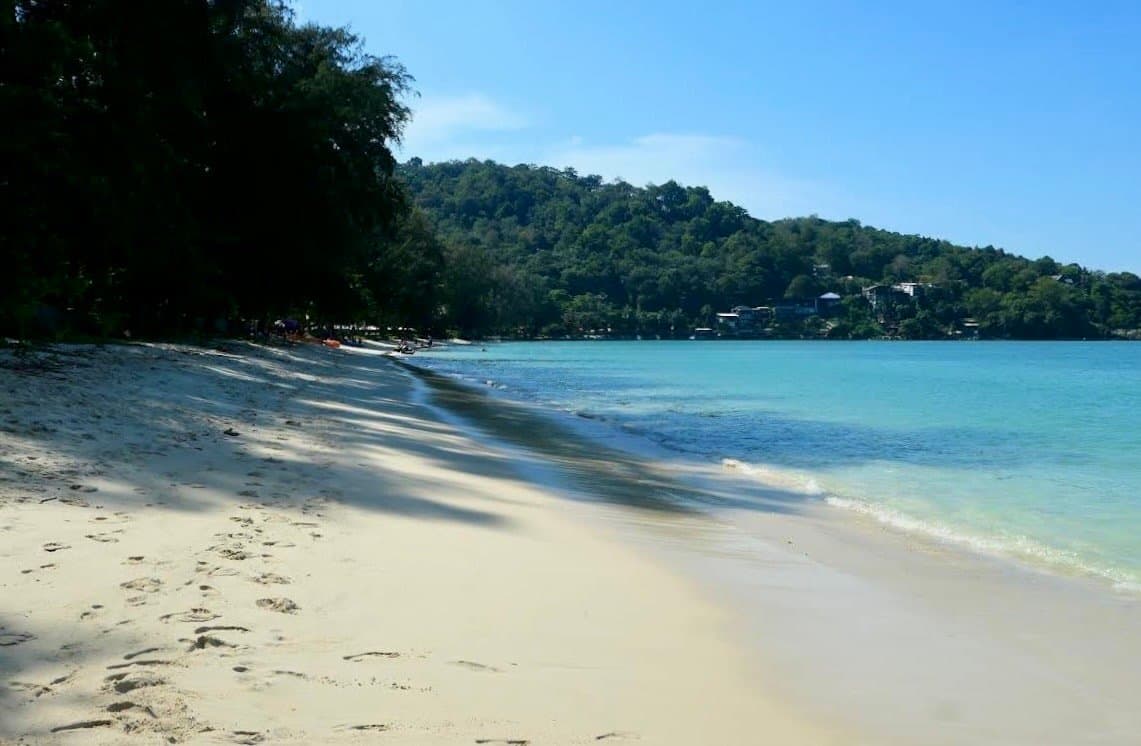
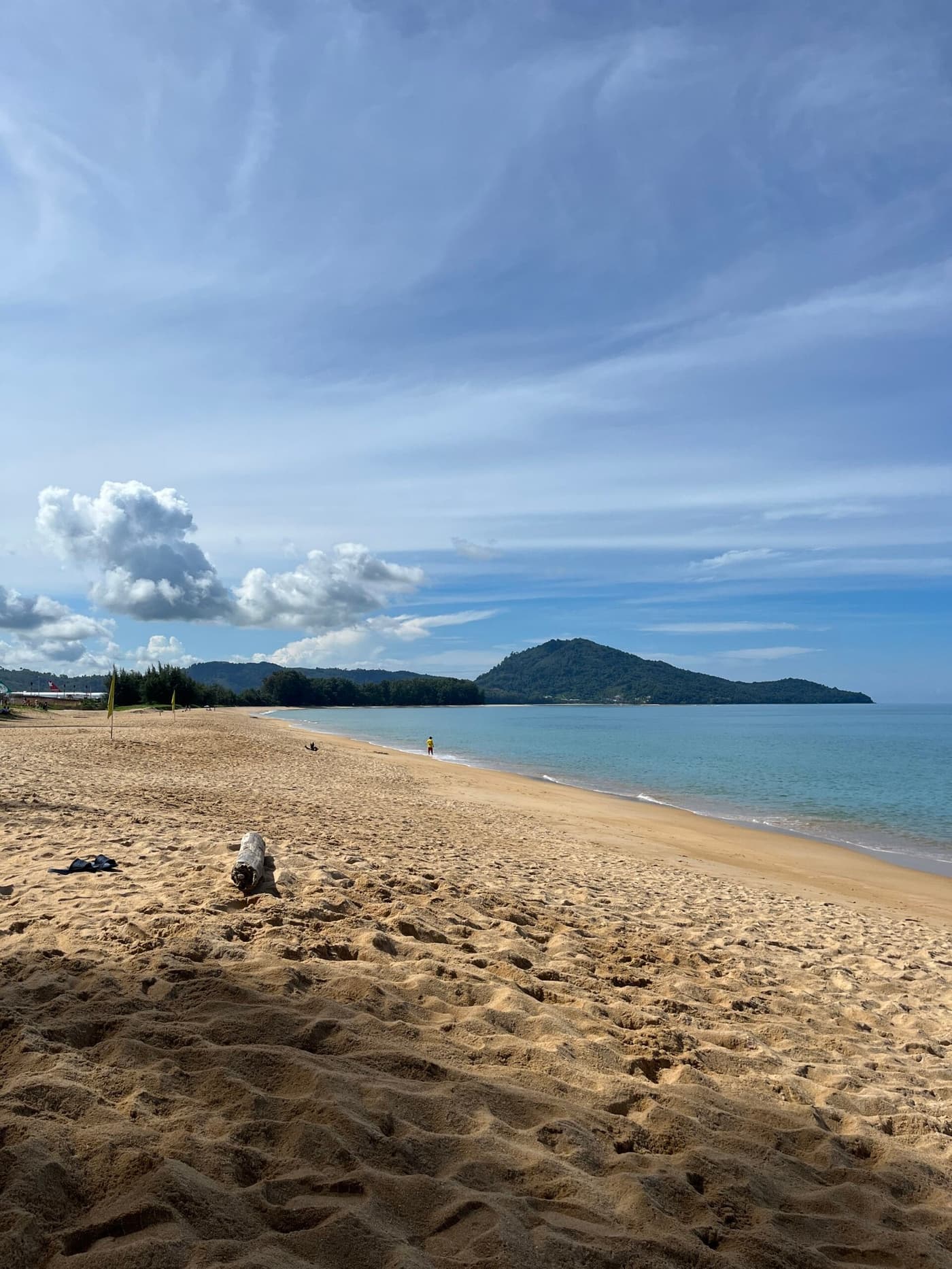
Mai Khao is on Phuket's northwest coast, in Thalang district, and it's the last beach before the Sarasin Bridge that links the island to the mainland. It's 11 km long, the longest beach in Phuket. The whole area is part of Sirinat National Park, so there's almost no development here: just premium resorts that, under local law, have to be set back 50+ meters from the water. The sand is coarse and honey-colored, and the seabed drops off steeply, so it's not the best choice for a beach day with small children.
The plane-spotting point is at the very southern end of the beach. The other 10 kilometers are emptiness, silence and a casuarina grove behind the strip of sand.
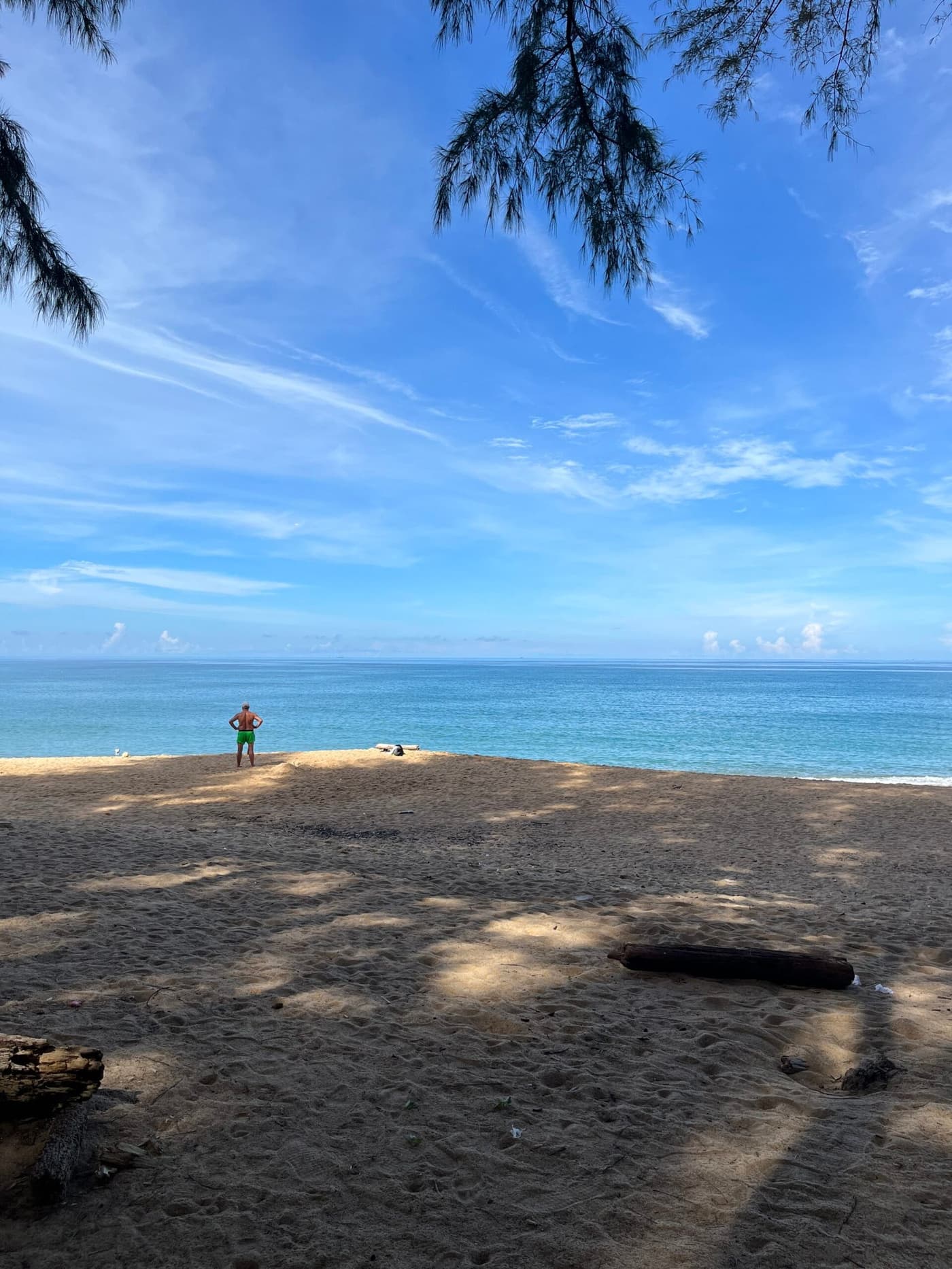
When I visited the longest stretch of Mai Khao, not the spotting zone but farther north, the beach looked almost empty: wide, clean and very beautiful. No sunbeds, umbrellas or cafes on the sand, just the sea, the sand and the pine-like trees. The contrast with noisy Patong is huge.
How to Get to the Plane-Spotting Beach in Phuket
Mai Khao is in the north of the island, and it's about an hour's drive from the southern tourist beaches. Public transport hardly runs here, so most tourists get there by taxi, by Bolt or Grab, or in a rented car or on a scooter. Below are all the options in order, with prices and travel times.
From Phuket Airport (HKT)
This is the fastest and cheapest option. A taxi from the Taxi Meter kiosk costs 250–350 THB and takes 5–10 minutes. You can also walk: after leaving the terminal, take the main road to the right, turn right at the first junction and follow Soi Naiyang 16 for about a kilometer. A little life hack: if you have a late flight, spending 2–3 hours here is nicer than sitting in the airport lounge.
From Patong, Karon and Kata
It's about 40 km and an hour's drive without traffic. A street taxi costs 900–1,000 THB one way, or 1,400–1,500 THB round trip with an hour's wait at the beach. Bolt and Grab usually come out 30–40% cheaper, and I'd choose them.
From Phuket Town
It's 35 km, and a taxi is about 700–800 THB. The alternative is the orange Phuket Airport Bus, route 8411: as of October 2026, a fixed fare of 100 THB and one to one and a half hours on the road, depending on traffic. You can ride to the airport and walk from there along Soi Naiyang 16.
By Scooter or Rental Car
Head north on Highway 402, after the airport turn toward the sea onto Road 3033 (check the exact turn on your navigation app and the signs with a plane on them), and keep going to the sea. There are two access points to the beach:
- Soi Mai Khao 6 — from the Mai Khao side, past Coriacea Boutique Resort and Grand West Sands. From there a dirt track runs along the beach for about a kilometer to the viewing point, and you can ride it on a scooter.
- Soi Naiyang 16 — from the Nai Yang side. After that it's about 1 km on foot along the northern part of Nai Yang beach.
The first time, I drove in through the grounds of one of the beachfront hotels. I don't remember which one, we simply turned in at the nearest entrance. The parking lots at the beach resorts are huge and security didn't stop us. I left the car and walked to the sea in 5–10 minutes through the well-kept resort grounds. If you're in a rental car and don't want to look for public parking, this works. On a scooter it's easier: I left it at any small turnoff from Road 3033 and walked.
Where to Park
There's free parking at the entrance to Sirinat Park on the Nai Yang side, at Coriacea Boutique Resort and Grand West Sands on the Mai Khao side, and at Splash Beach Resort. If you don't feel like walking, tuk-tuks wait in the parking lot to take you to the spotting point for 100–200 THB, depending on the distance.
When Planes Come In From the Sea: Season and Wind
This is the main factor in whether the trip pays off. Phuket Airport has a single runway (09/27), and planes always land into the wind.
In high season (December–April) the wind blows from the northeast, and jets approach from the west, meaning from the sea, right over the beach. That's the postcard picture.
In low season (May–October) the wind is from the southwest, and planes approach from the land side, so over the beach they only take off and climb. The shot is weaker: the plane is already high up rather than ten meters above your head.
At peak times the airport handles up to 30 flights an hour. There are usually 5–15 minutes between aircraft, and sometimes two or three planes come in a row.
How to Know Exactly When the Next Flight Lands
Install FlightRadar24 or FlightAware. In FlightRadar24, find Phuket International Airport (HKT), open the Arrivals tab and you'll see a map with the paths of all the incoming planes. When a flight shows 3–5 minutes from landing and is coming from the west, you have a couple of minutes to get your camera out.
The Best Time to Come: Time of Day
Early morning (7:00–9:00) brings soft light and the fewest people, and the first flights start around 7:00. It's the best time if you want peace and good shots without a crowd in the background.
The 10:00–14:00 window is when the sea turns bright turquoise and the photos come out rich in color. The downsides: the sun is harsh, there are more people and there's no shade.
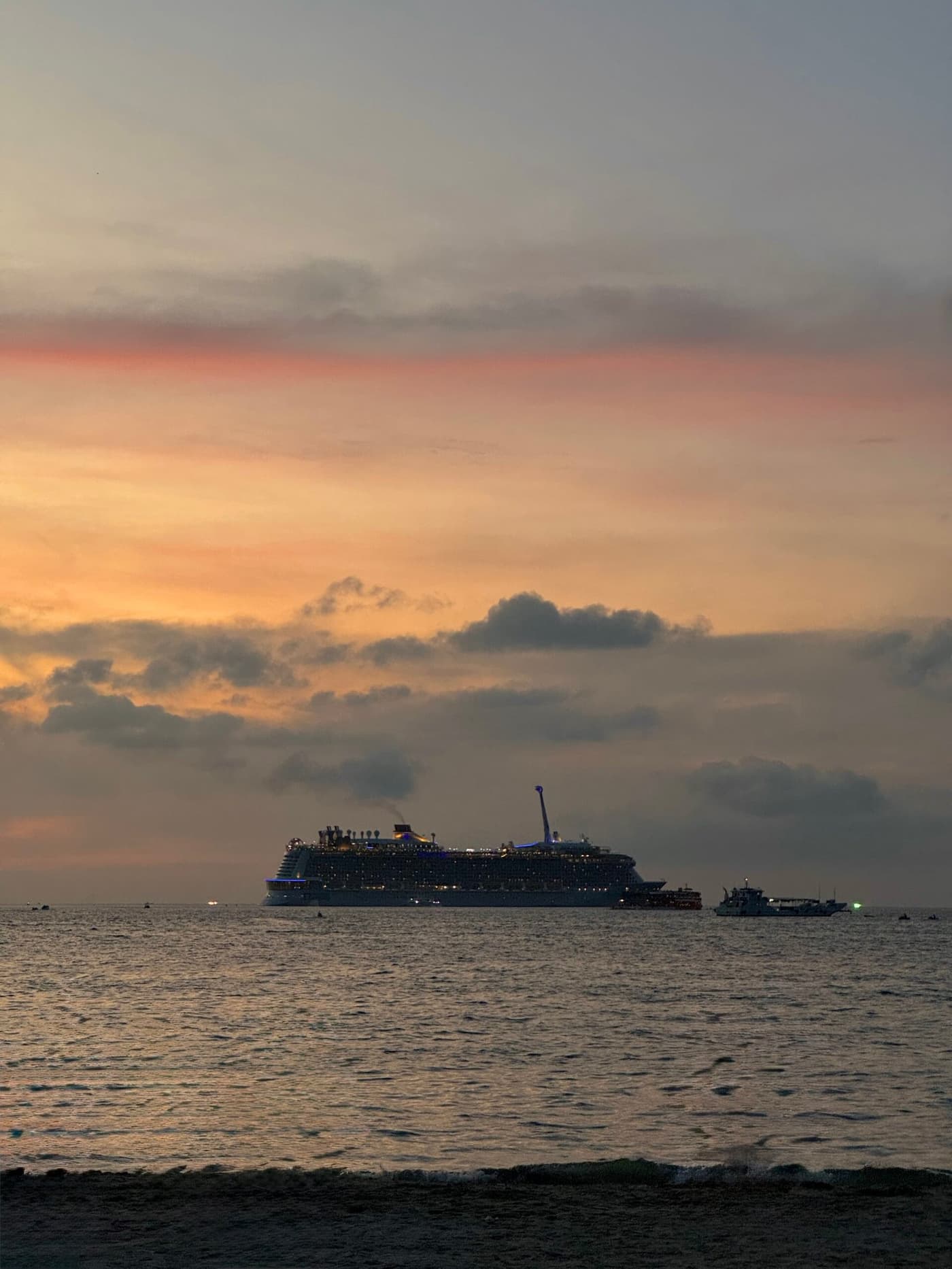
Sunset (17:00–18:30) gives you silhouettes of planes against an orange sky, which looks great. But it's backlit: to get a good shot you need proper gear and an understanding of how to use it. On a phone it will come out so-so.
The quietest time is before 9 a.m. The most photogenic sea is closer to noon.
How to Take Great Photos With a Plane
Where to stand. By the airport's boundary fence, in a small dip between the beach and the barrier: from there the plane passes exactly overhead, and the upward angle is the most striking. You can also shoot from the waterline, but the plane looks smaller.
Lenses. Use a wide-angle lens so the plane fills the sky. A 70–200 mm telephoto is good for details: landing gear, logos, windows. On a phone, be sure to turn on HDR, otherwise the sky will blow out and the fuselage will fall into shadow. Burst mode is a must: the plane passes overhead in 2–3 seconds.
Protecting your gear. The jet blast kicks up a cloud of sand from the beach that flies horizontally and stings your face. Put your camera and phone in a bag or cover them with a cloth as soon as you hear the roar of the turbines at close range. Put your belongings in a bag too, or they'll be blown away.
Drones: no. Absolutely not. It's an airport zone, with fines and confiscation. The ban applies at all times.
Is It Dangerous to Stand Right Under a Plane?
The plane itself is safe: it's on the glide path and flies a steady course. The real danger is jet blast, the exhaust stream on takeoff. As a plane accelerates, it throws out a flow of hot air that can knock you off your feet and hurl sand at the speed of a sandblaster. On landing there's no blast, but the noise of the turbines at close range is loud enough to make your ears ring for a while.
About fines. In 2016 the Thai authorities declared the zone under the glide path off limits, and the news even carried phrases about "the death penalty under the 1978 Aviation Act." In practice nobody is fined, the beach remains public, and the spot is busy every day. Still, standing right in the path of a departing plane is foolish. The standard viewing point is by the fence, to the side of the glide path, and it's safe there.
Entering Sirinat National Park: Where You Pay
Mai Khao beach itself is public and free. If you enter from the Mai Khao side via Soi Mai Khao 6, nobody will charge you. If you come from the Nai Yang side through the Sirinat Park office, you may be asked for 200 THB per adult and 100 THB per child for entering the protected area. According to reviews, they don't check every day, and sometimes the ticket booth simply isn't working. Through hotel and resort grounds it's always free, if they let you in.
What's on the Beach: Facilities and Swimming
In the part of Mai Khao where I was, there are no facilities on the sand at all, no sunbeds or umbrellas for rent unless you're a guest of a beach resort. Cafes, showers and foot-rinse taps are on hotel grounds, not on the public beach. The beach itself is huge and clean with very few people, a contrast to noisy Patong or Karon. It's great for a couple of hours of photos and a walk. Spending a whole beach day there when you're not a hotel guest is almost impossible: there's nowhere even to sit in the shade.
You can swim, but the seabed drops off sharply: within 2–3 meters it's already deep. The beach isn't suitable for small children. From May to November, rip currents run along the shore and red flags are up, so going in the water is dangerous. The calmest water is in January–March.
The nearest cafes are on resort grounds: M Beach Club at the JW Marriott and the bars at Splash Beach Resort. On the sand at the viewing point there are sometimes a couple of mobile stalls selling drinks and snacks, but not every day.
What to bring: water (at least a liter per person, there's nothing to buy on the beach), SPF 50+ sunscreen, a hat or umbrella (there's almost no shade), a thick towel or mat (the sand gets scorching), flip-flops and a swimsuit.
What's Nearby: Where Else to Go
Splash Jungle Water Park is one of Phuket's two big water parks (the other, Andamanda, is in Kathu) and the one closest to the airport, 5 minutes from the plane-spotting point. It combines well with a half-day trip. A ticket costs 1,295 THB for adults and 650 THB for children.
Turtle Village is a small open-air mall with cafes, shops and a pharmacy. It's a handy place to stop for lunch.
Wat Mai Khao is a local temple with a pond and a small park, free to enter. It's not the main reason to come, but if you have 20 minutes, it's worth a look.
Baan Ar Jor is an old house museum from 1936, a restaurant and a museum in one building, 200 THB.
Mai Khao Marine Turtle Foundation is a turtle conservation center at the JW Marriott. Nesting season runs from November to February, and in April, during Songkran, the resorts release grown hatchlings into the sea, which kids love.
Sarasin Bridge is the northernmost point of Phuket, linking the island to the mainland. It's a good spot for photos and a quiet walk.
Where to Stay Nearby
JW Marriott Phuket Resort & Spa (5★) is a large family resort with its own turtle farm, 15 minutes from the spotting point.
Anantara Mai Khao Villas (5★) offers villas with private pools, for couples.
Sala Phuket Resort (5★) has minimalist design in a boutique format.
Holiday Inn Resort Mai Khao (4★) is the most affordable of the beachfront hotels.
Splash Beach Resort (4★) is a 10-minute walk to the viewing point, and the hotel has its own water park.
Coriacea Boutique Resort (3★) is the closest to the spotting point, inexpensive and no-frills.
Staying at Mai Khao for your whole vacation only makes sense if you want peace and quiet and your budget allows it: there are no cafes, markets or nightlife nearby. But for the last night before an early flight, it's an ideal location.
Is Mai Khao Worth a Special Trip?
For half a day, for photos and the water park, yes, definitely. Especially in high season, when the wind lets jets approach from the sea: it really is a sight worth crossing the whole island for.
For a whole beach day, no, unless you're a guest at a beach resort. Mai Khao has no sunbeds, no cheap cafes and no facilities. For a beach day, Karon, Kata, Surin and Nai Harn are better, and they have everything you need. I put together a full overview of all the island's beaches in a separate guide to Phuket's beaches.
I shared my trip experience and more vivid footage on my YouTube channel. Subscribe, I talk about traveling the world and life in different countries.
Mai Khao Beach FAQ
Where exactly in Phuket should I watch the planes: Mai Khao or Nai Yang?
The viewing point is where the two beaches meet, at the western end of the airport runway. On Google Maps, search for it as Plane Spotting Point or Airplane Viewpoint at Maikhao Beach.
How much does a trip to the airplane beach from Patong cost?
A street taxi costs 900–1,000 THB one way, or 1,400–1,500 THB round trip with an hour's wait. Through Grab it comes out 30–40% cheaper.
How do I find out when the next plane will land?
Install FlightRadar24, find HKT airport and open the Arrivals tab. When a flight is 3–5 minutes from landing and approaching from the west, it will be overhead in about a minute.
Do the planes come in from the sea in winter or summer?
In winter, from December to April. In summer the wind changes and jets approach from the land side, so over the beach they only take off.
Is there an entrance fee for Mai Khao?
The beach itself is free. If you enter through the Sirinat National Park office on the Nai Yang side, you may be asked for 200 THB per adult and 100 THB per child. Through the hotels and Soi Mai Khao 6 it's always free, if security lets you through.
Can I fly a drone at the airplane beach?
No. It's an airport zone, the ban is permanent, and the penalty is a fine and confiscation of the equipment.
Can I swim at Mai Khao with kids?
I don't recommend it. The seabed drops off sharply, with deep water within 2–3 meters, and from May to November there are rip currents. For families with small children, Kamala, Nai Harn or Ao Yon are better.
Can I stay near Mai Khao the night before an early flight?
Yes, it's one of the best locations for a last night. The airport is 5–10 minutes away by taxi. Convenient budget options are Maya Phuket Airport Hotel, Coriacea Boutique Resort and Splash Beach Resort.
Is Mai Khao worth visiting in the rainy season?
Only if you want to photograph takeoffs rather than landings, and keep in mind the red flags, because swimming is dangerous. For the most striking picture, come between December and April.