There are about 60 beaches on the map of Phuket, but only around a third of them are really good for swimming. The rest lose their water at low tide, are crowded with boats, or are open to the monsoon swell. The most common mistake tourists make is to pick a hotel first and only then look into the beach. In Phuket, two kilometers in either direction can change the whole character of your vacation: from party to family-friendly, from upscale resort to fishing village. Below you will find a short map of the coastline, a breakdown of the main beaches and a guide to matching a beach to the kind of trip you want. If you are looking for the big picture of the island, it is in the Phuket island guide.
How many beaches are there in Phuket and how is the coastline laid out
The island stretches about 50 km from north to south, and the character of the shoreline is completely different from one side to the other. Tourist life is concentrated in the west, which faces the Andaman Sea, with white sand, restaurants, hotels and almost all the names you have heard. The east is boat piers, mangroves and a muddy seabed. The north is quieter and greener, and the south is rocky and more intimate. For a detailed breakdown by area from the "where to stay" point of view, see the separate article on Phuket's areas.
West coast: the main resort beaches
This group includes Patong, Karon, Kata, Kata Noi, Surin, Kamala, Bang Tao and Layan. It is one long tourist corridor where most of the hotels and services are concentrated. The sea is open, calm in the high season, and catches the southwest monsoon in the low season.
North: quiet, turtles and a national park
Mai Khao, Nai Yang, Nai Thon. The shore is part of Sirinat National Park: from November to February sea turtles come onto the sand to lay their eggs. There are few people, the hotels are mostly expensive, and the airport is 5-15 minutes away.
South: coves, rocks and surf
Nai Harn, Yanui, Ao Sane, Promthep Cape. Here you find short beaches in coves framed by granite boulders, and some of the best sunsets on the island. The atmosphere is different: more of a "European expat neighborhood" than a resort.
East: boats, sunsets, no swimming
Chalong, Rawai, Panwa, Ao Yon. There is not much swimming here, but the logistics and the cafes are excellent. The paradox is that the east is also home to Phuket beaches where the sea is calm all year round.
When to go: seasons, waves and red flags
The high season runs from November to March: it is dry and calm, underwater visibility is 5-7 meters, and the air and water temperature stays around 86 °F (30 °C). This is both the beach peak and the price peak. The low season runs from May to October, when the southwest monsoon brings downpours (short, usually at night) and waves. On the west coast in July-September the waves reach 2-3 meters, rip currents appear and lifeguards raise red flags. Ignoring them is dangerous: tourists drown in Phuket every season.
You can swim during the monsoon, but not everywhere. The sea stays flat all year round only at a few beaches:
- Ao Yon and Panwa are enclosed bays on the east side, protected by coral reefs and hills;
- Nai Yang is on the west coast, but its shallows are sheltered by a reef that dampens the waves.
If you are traveling with kids in the low season, choose the north or the east over a hotel in Patong or Karon. For more on the weather, see the article when to go to Phuket.
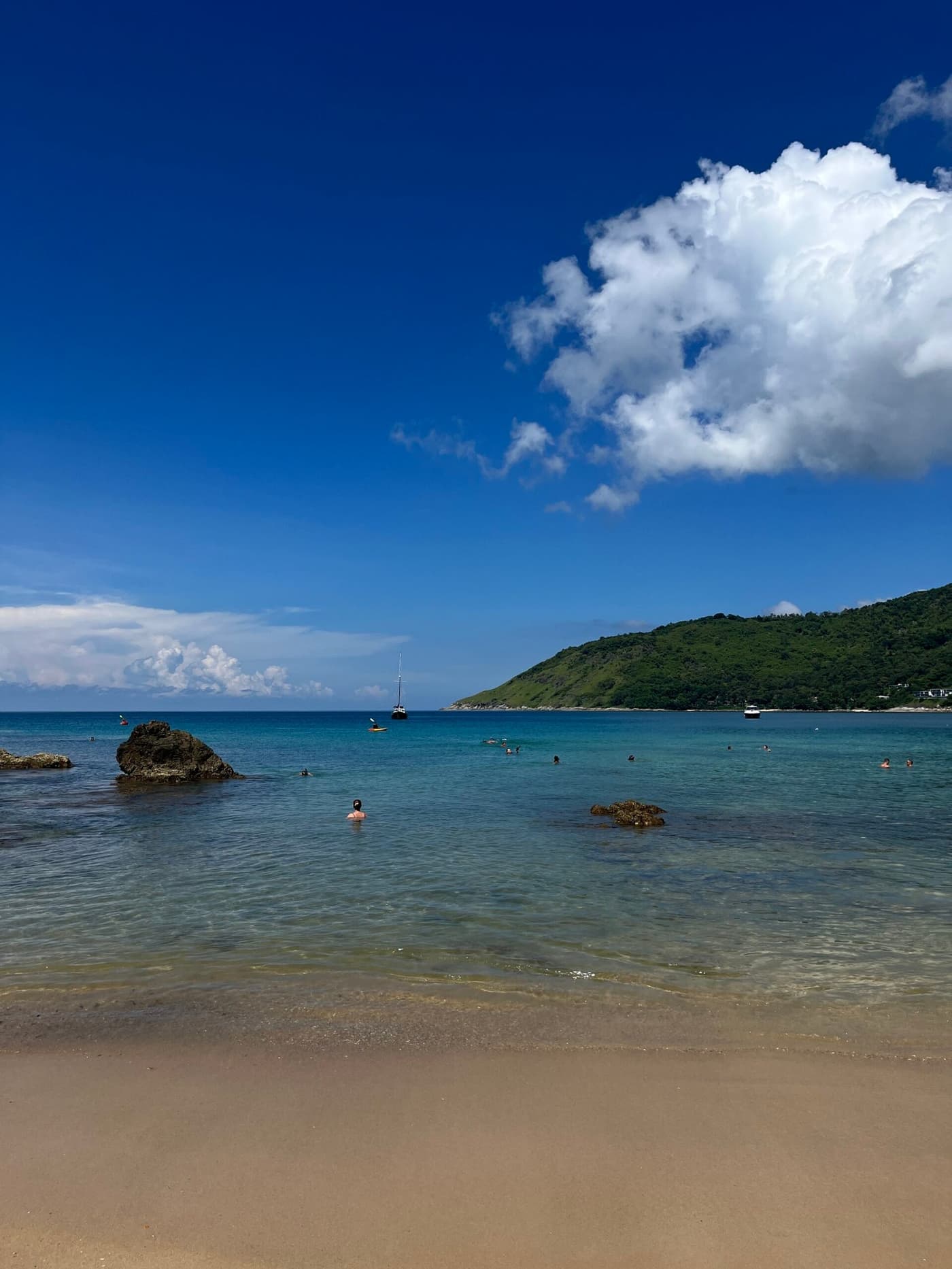
Phuket's main beaches: a quick look at each
There are many beaches on the island, and they are all different. Neighboring bays can differ more than entire resorts in Turkey: Patong is noisy around the clock, fifteen minutes away at Laem Singh there is nobody, and ten minutes after that there is a crowd again at Karon. That is why "a hotel in Phuket" without knowing which beach is next to it is almost always a lottery.
Patong: the noisiest beach on the island
It is about 3 km long, with a wide strip of yellow sand and a dense row of hotels across the road. People come here for the infrastructure and for Bangla Road, the island's main party street. A sunbed costs about 200 THB, but it is crowded all year round. The sea is calm with almost no waves, but the water near the shore is often a bit cloudy from stirred-up sand. Detailed review of Patong Beach.
Patong did not click with me. It is loud and cramped, there is noticeably more litter than on neighboring beaches, and the cafes along the promenade have no character or style. For evening entertainment, yes, it is the island's number one. I would not stay in Patong for a beach vacation. But if you do decide on Patong Beach, I recommend stopping by the emerald Tri Trang Beach, a beautiful spot not far from Patong.
Kalim: a surf spot at the northern edge of Patong
A narrow strip of rocks and sand north of Patong, effectively a continuation of the bay but without the crowd. The bottom is rocky and not suitable for swimming, but surfers come here during the monsoon. Restaurants with terraces overlook the beach. It is a place for watching the sunset, not for a sunbed.
Karon: a long beach with "singing" sand
Karon is the second most popular beach in Phuket and one of the longest on the west coast, at about 3 km. The sand is fine and white and squeaks underfoot, which is where the nickname "singing" comes from. In the high season the water is clear; in the low season red flags often go up, as the rip currents here are strong. Right across the road there are 7-Eleven stores, currency exchanges and inexpensive guesthouses. It is louder than Kata and calmer than Patong.
Kata and Kata Noi: a balance of comfort and infrastructure
Two bays in a row, separated by a small headland. Kata Beach (Kata Yai) is large, with a gentle entry into the water and a view of Koh Pu. Kata Noi is more compact and calmer, is considered one of the cleanest beaches in Phuket. Surf schools operate here (the waves come from June to October), and accommodation prices are noticeably higher than in Karon. It is a good choice for a first visit: clean, convenient and busy, but not like Patong.
Surin: a bay without mass tourism
A kilometer-long strip of white sand between rocks, upscale hotels and authentic cafes in the village behind the beach. A sunbed costs more than the island average, and there is no crowd even in December. In winter Surin is a decent place for snorkeling: around the rocks the water is home to barracuda and schools of small fish.
Kamala: a calm family beach
About 2 km long, with a shallow bay sheltered by headlands. There are few noisy bars and it is quiet at night. Nearby is the Phuket FantaSea park with its evening show. It is a good option for families who want infrastructure and a safe way into the water without the noise of Patong.
Laem Singh: a hidden cove between Kamala and Surin
A small beach among the rocks. You can reach the sand by a path or from the water by longtail boat. There are almost no sunbeds or infrastructure, but there is white sand, large boulders along the edges and decent snorkeling by the headland. There is not much space, and in the high season it is crowded by noon.
Bang Tao and Layan: the premium coast and Laguna
Bang Tao is one of the longest and most beautiful beaches on the island: a wide strip of sand, a casuarina grove behind the beach, turquoise water and a gradual entry. In the central part stands the gated Laguna complex with 5* hotels and villas, while the edges still have "wild" stretches with very few people.
There is one downside: it is expensive. Prices for food, coffee and accommodation in the area are noticeably higher than in Karon or Kata. Judging by the bill, I would say the local night market costs about twice as much as the markets in Phuket Town: it is tasty, clean and atmospheric, but you pay for that here. Going to Bang Tao for a beach day and dinner is great. Staying there only makes sense if your budget handles it comfortably.
Nai Harn: my favorite beach in Phuket
Nai Harn Beach is a bay in the south, about 700 meters long, framed by green hills. The entry into the water is gentle, the sand is clean, and there are many times fewer people than in Karon or Kata. Behind the beach there is a lagoon with a park and smooth paths: we go running there in the mornings.
After the beach, you can ride a scooter for 5-10 minutes to a couple of stylish cafes, and there are plenty of them in the area. To the south of the beach is Promthep Cape, the best sunset spot in Phuket. At the rocky northern and southern edges there is decent snorkeling from the shore.
If I had to choose between Nai Harn and, say, Kata on a comparable budget, the choice is obvious to me.
Ao Sane: a tiny beach for snorkeling
A beach about 200 meters long, just northwest of Nai Harn, beyond a rocky headland. It is not suitable for swimming, with a rocky bottom and sharp changes in depth, but it is one of the best places on the island for snorkeling from the shore: clownfish, parrotfish and eels right by the boulders. It makes sense to come here with a mask, not for a beach day.
Nai Yang, Nai Thon and Mai Khao: the north and the quiet
Three beaches within Sirinat Park. Mai Khao is the longest beach in Phuket (about 11 km); the water gets deep right by the shore, so it is not the best option for small children, but planes land right over your head here. Nai Yang is protected by a reef and is good for swimming even during the monsoon. Nai Thon is a compact beach south of Nai Yang, with fine white sand and a casuarina grove. There are few people and the hotels are expensive. The main audience is couples and winter long-stayers who want quiet near the airport.
Yanui, Freedom, Paradise, Banana: small coves for photos and snorkeling
These are postcard beaches: compact, with granite rocks and a good underwater world. Freedom and Paradise now charge an entrance fee (about 100-500 THB; prices change, so check on the spot). Banana is a "wild" cove about 100 meters long, and at high tide there is almost no water left.
Yanui is a beach the size of a big living room, and in the high season it is completely full by 11 a.m. I do not recommend it for a beach day alone, as there is little space and little shade. But for snorkeling from the shore it is one of the best places in Phuket: clownfish and parrotfish swim right by the boulders. Life hack: rent a SUP on the beach and paddle out to the small islet opposite. It is literally a few hundred meters away, and the corals and fish there are denser than at the beach itself.
Rawai, Chalong, Ao Yon, Panwa: eastern Phuket
Rawai is not a beach in the tourist sense. There is nothing to swim in: the bottom is murky, the water goes far out at low tide, and longtail boats line the shore. But along the promenade there is a fish market and dozens of inexpensive local cafes with seafood and Thai food. The atmosphere is pleasant and the prices are fair. Dashing over for lunch or a sunset is a great idea, especially if you live in Kata or Nai Harn.
Chalong is a transport hub: boats to the islands leave from here. Ao Yon and Panwa are those same "all-season" bays with calm sea, corals by the headlands and a view of hills that shelter them from the wind. In the low season they are a lifesaver for families. But getting onto the beach is not that easy: the shore is in fact taken up by hotels, and guards at the entrance turn you away or charge a fee to pass. Formally, beaches in Phuket are public, but arguing with a guard is often pointless, so count on bargaining or a small entrance fee.
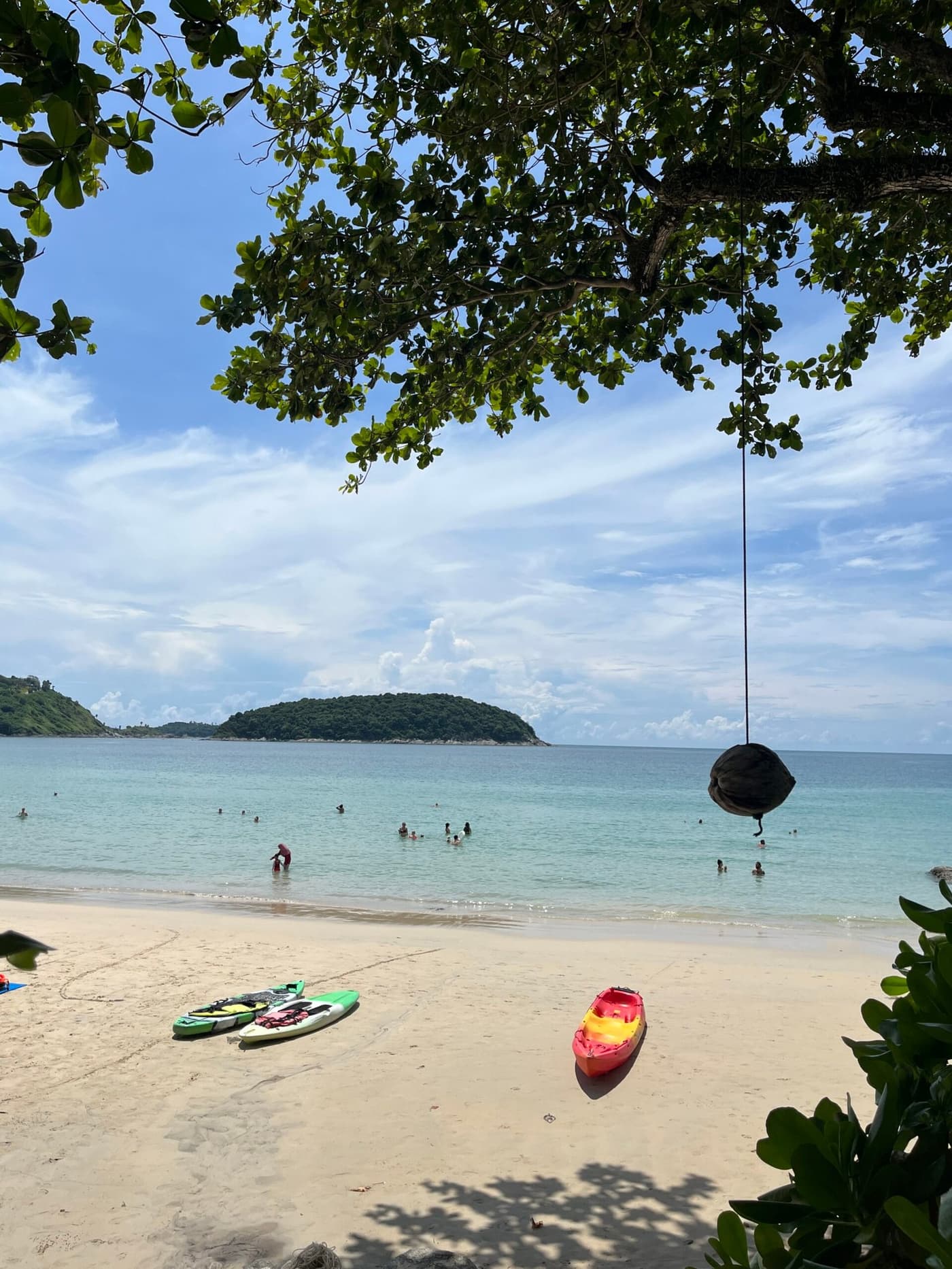
Which Phuket beach to choose
It is easy to pick a beach in Phuket from a pretty photo and then discover that in December Kata is crowded and Mai Khao gets deep from the first meters. It is best to work out what you want: quiet, a party, kids, snorkeling or surf.
Phuket beaches for vacations with kids
Kamala, Kata Noi, Nai Harn, Ao Yon, Panwa, Nai Yang. All of them have a gentle entry, soft sand and no noisy bars. At Karon, be careful with small children because of the rip currents.
Party beaches and nightlife
No alternatives here: Patong and Bangla Road. Kata has bars and a couple of clubs, but they close early.
Quiet, uncrowded beaches in Phuket
Mai Khao, Nai Thon, Layan, the northern "wild" stretches of Bang Tao, Nai Harn on weekdays. At Mai Khao, with luck, you will find yourself on the sand practically alone, especially in the morning.
The best beaches in Phuket for snorkeling
Yanui, Ao Sane, the southern edge of Kata Noi, Banana, the northern and southern rocky edges of Nai Harn. The best time is the morning in the high season, when the sea is clear.
Where to surf in Phuket
Kata, Karon and Kalim from June to October. Schools include Phuket Surf and Saltwater Dreaming. There are almost no waves in the high season, so going for surf makes sense from July to September.
Phuket beaches for couples and beautiful photos
Surin, Freedom, Laem Singh, Yanui, Promthep Cape at sunset. Turquoise water and boulders look great in photos without any filters.
Prices, sunbeds and rules on Phuket beaches
A sunbed usually costs 100-200 THB a day, a mask and snorkel 100-150 THB, a SUP from 300 THB an hour, and water activities (parasailing, jet skis) cost much more and depend heavily on the beach. You can bring your own umbrella and mat, as all beaches in Phuket are public. The law prohibits fencing off the shore for a hotel, so even if the area looks like it belongs to the hotel, formally you have the right to walk through.
The rules are strict. Smoking on the sand carries a fine of up to 100,000 THB, and separate smoking zones are usually set up behind the beach line. E-cigarettes (vapes) are officially banned by law in Thailand, and using them can also lead to a large fine or deportation.
Single-use bags and cups are fined. Since 2022, bringing single-use bags, plastic containers, cups and straws has been banned in national parks (including marine reserves and many islands).
Picking up or breaking corals is a criminal offense. Picking up, breaking or even trying to take away a dead shell or piece of coral found on the shore is a serious violation. Fines range from 20,000 to 100,000 baht, or a prison sentence. At airport customs, suitcases are scanned, and unprocessed souvenirs from the sea can lead to detention.
Alcohol is sold by the hour (11:00-14:00 and 17:00-24:00 in shops). Drinking on beaches is not banned as such, but drunk people are not allowed into the water and may be written up. Amendments came into force recently under which not only the seller but also the buyer can be fined if they drink at a prohibited time or in prohibited places (parks, temples, government buildings). The fine is about 10,000 baht.
The bottom line
If I had to choose, I would do it like this: live in Nai Harn, take a day trip to Bang Tao or Surin for the pretty pictures, have lunch in Rawai, snorkel at Yanui, see Bangla Road in Patong and come back. Karon and Kata are solid middle-of-the-road choices, and you will not go wrong with them on a first visit.
And in general, the beach is only a part of Phuket. What to see, how to get around, where to eat and which islands are nearby are all in the main island guide.
Phuket beaches: frequently asked questions
Which is the best beach in Phuket?
There is no single answer; it depends on the kind of vacation you want. For cleanliness and nature, people most often name Kata Noi and Nai Harn, for infrastructure Kata and Karon, and for beauty Bang Tao and Surin.
Which Phuket beach has the cleanest sea?
Kata Noi, Surin, Bang Tao and Nai Harn. These beaches are far from ports and boat moorings, and the water is clear.
Where in Phuket are there no waves in summer?
Ao Yon and Panwa on the east coast are calm all year round. Nai Yang on the west coast is protected by a reef and is also good for swimming during the monsoon.
Which Phuket beach should I choose for a first visit?
Kata or Karon. They are all-round beaches: clean, with infrastructure, simple logistics, not deafeningly loud, and with convenient transport to Patong.
How much does a sunbed on a Phuket beach cost?
On average 100-200 THB a day. It costs more at premium beaches such as Surin and Bang Tao. You can sit for free on your own mat.
Can you swim in Phuket in July?
On the west coast, be careful: waves, rip currents and red flags. On the east coast (Ao Yon, Panwa) and at Nai Yang you can swim all year round.
Is it true that Patong is dirty?
The beach is now cleaned every morning, and there is noticeably less litter than 5 years ago. The water near the shore can be cloudy from stirred-up sand, which is not pollution.