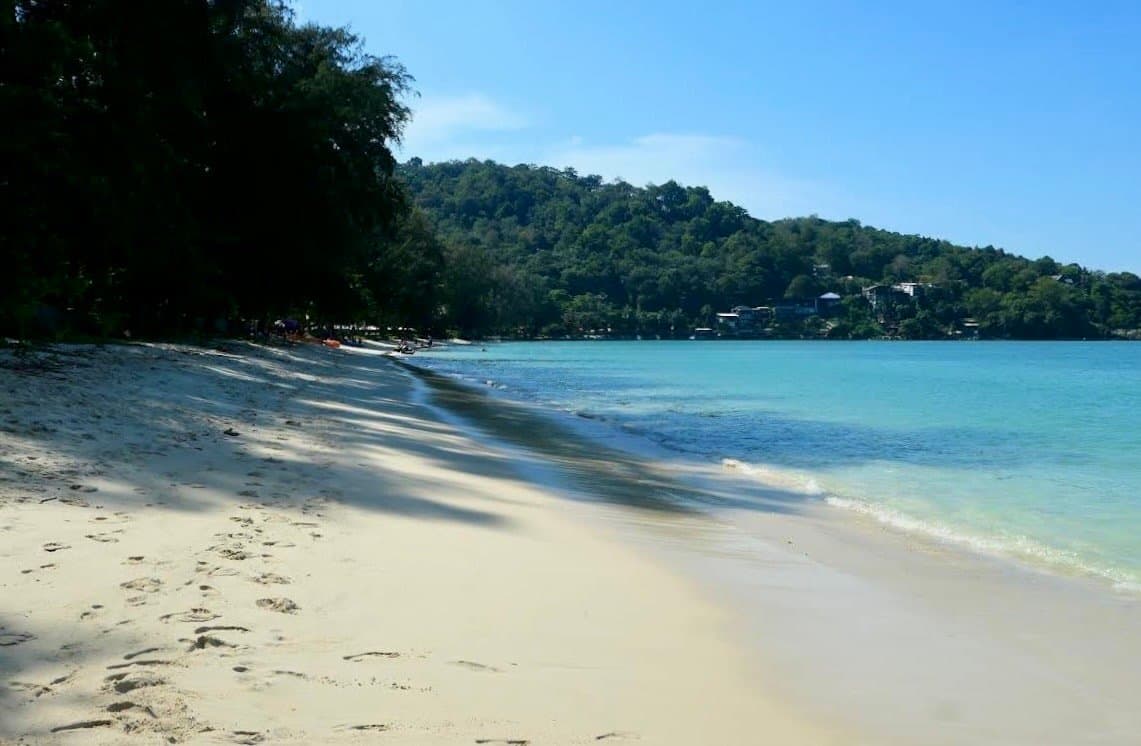
Nai Harn Beach sits in a bay between two green hills at the very south of Phuket, in the Rawai area. It is about 660–700 meters long, with fine, light-beige sand and a gentle entry into the water, with no rocks or coral underfoot. Of all of Phuket's beaches this is my favorite, and I keep coming back to it, so I'll explain why. Below you'll find prices, how to get here from anywhere on the island, what to expect from the waves and red flags in the rainy season, what to do nearby, and whether it makes sense to base yourself here for the winter. If you are still choosing a destination, start with the overview of all the beaches of Phuket or the general island guide, which have a short comparison of areas and logistics.
Where Nai Harn Beach is and what it's like
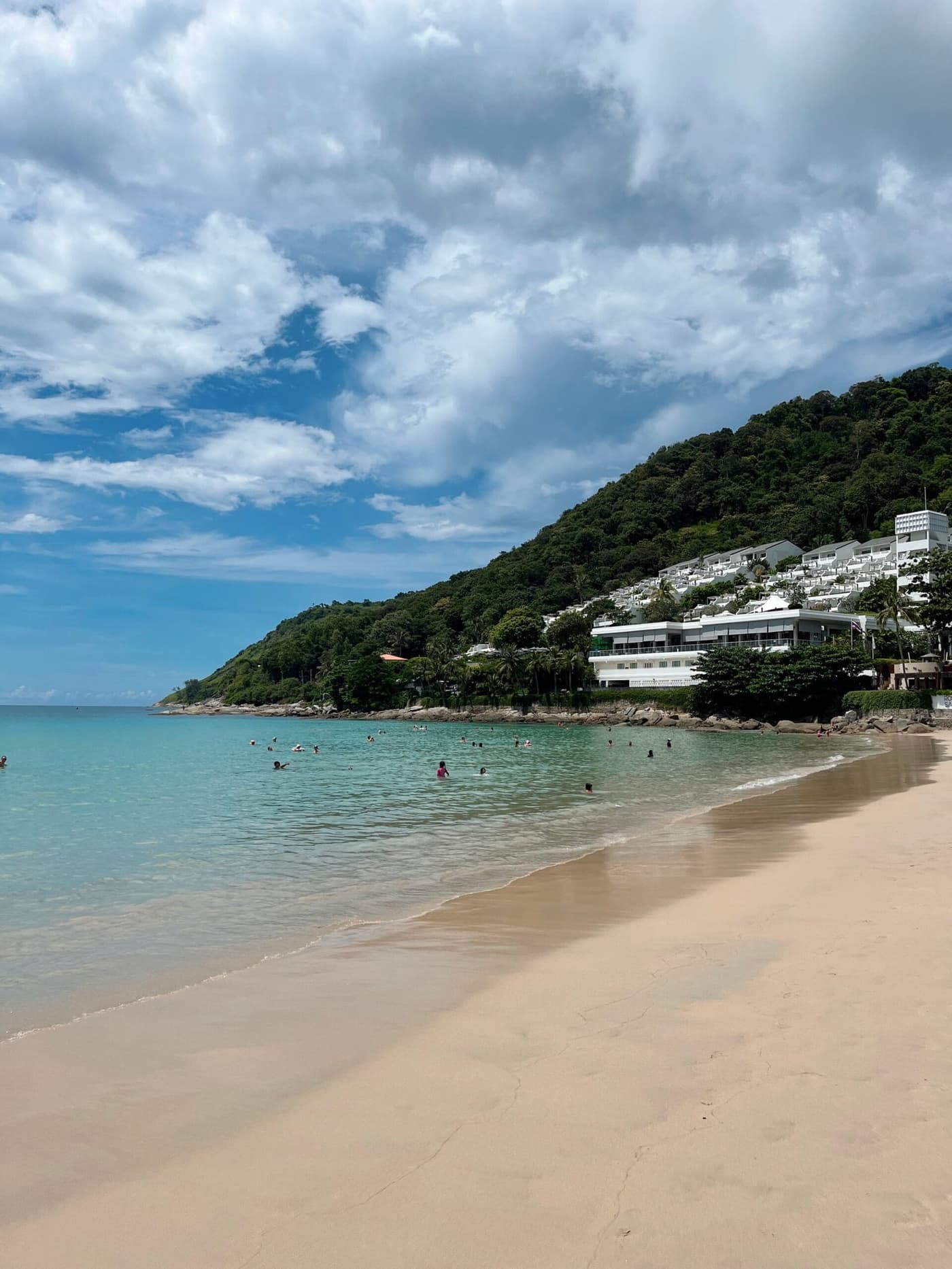
Nai Harn is on Phuket's southwest coast, in the Rawai area, between Promthep Cape and Ao Sane. It is 30 kilometers from the airport, about 20 from Patong and 7–8 from Kata. The bay is sheltered by hills on both sides, so in high season the wind rarely gets in the way and in winter the sea is truly calm; in summer, though, the bay is open to the southwest monsoon.
The beach is wide, with a strip of shore about 50 meters deep, and the sand is fine and firm, so it is pleasant to walk barefoot. The color is light beige with a slight yellow tint, not as dazzlingly white as at Bang Tao or Surin, but I like that. In high season the water is turquoise in the morning and darkens toward evening, with visibility of 5–10 meters. The bottom is sand with no rocks or coral, and the entry is gentle and gradual.
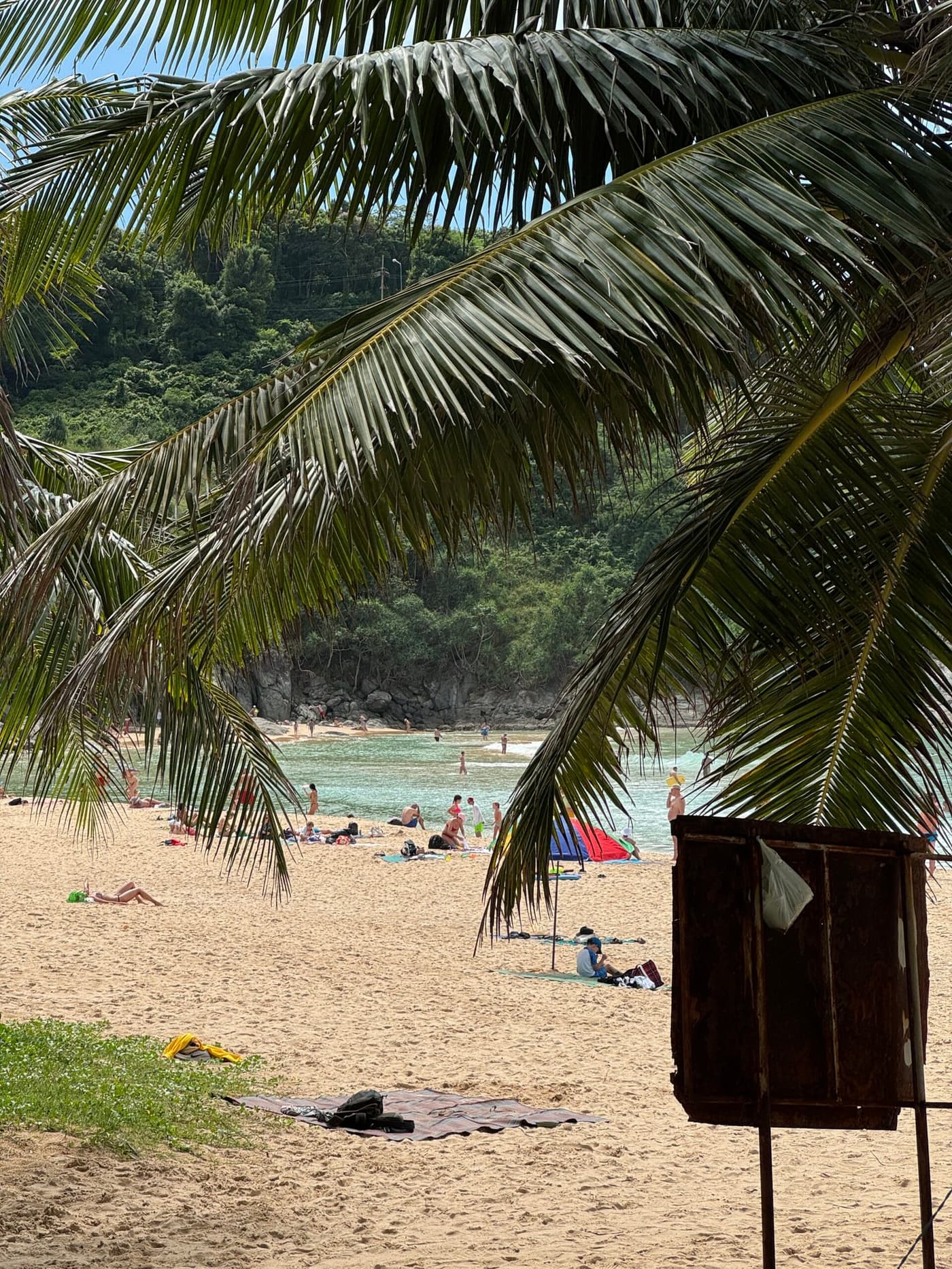
On the south side of the bay, a stream from Nai Harn Lake flows into the sea, forming a shallow freshwater pool where the water is always warmer than the sea. In the rainy season, when the main part of the beach is closed for swimming, families with children and Thai locals gather at this pool.
The land along the shoreline belongs to the Buddhist temple Wat Nai Harn, so behind you there are no rows of hotels and condos, just a casuarina grove (thin, pine-like trees that give light shade) and green slopes. The large buildings are the five-star The Nai Harn on the southern hill and, a little further back near the lake and the road, Sunsuri, Wyndham Grand Nai Harn Beach and All Seasons Naiharn. That is the main difference here: the shoreline has not been walled in by development the way it has at Karon or Patong.
In 2015, TripAdvisor (Travellers' Choice) ranked Nai Harn third among the best beaches in Asia, which helps explain why it consistently tops the advice on where to go in Phuket with a child.
How to get to Nai Harn Beach
There is no direct public transport from the airport to the beach, but there are still plenty of options, so choose based on your budget and how much luggage you have.
From Phuket Airport (HKT)
It is 30 km, and the trip takes 40–60 minutes depending on traffic. A taxi from the airport counter costs 800–1,000 baht per car. The Airport Minibus is from 200 baht per person if enough passengers gather, but you'll have to wait. The most predictable option is a pre-booked transfer through Klook or Kiwitaxi: a fixed price (usually 1,000–1,600 baht per car, depending on the class of vehicle), and the driver meets you with a name sign. With kids and luggage, I think this is the best option.
From Patong, Karon and Kata
From Patong it is about 20 km, and by scooter or car the trip takes 30–40 minutes. The route runs along the Karon and Kata seafronts, then turns uphill at Kata Beach Resort and climbs a 5 km winding road to Nai Harn village. It is one of the most scenic roads on the island, with several viewpoint pull-offs overlooking Kata and Karon along the way.
From Karon it is 12 km, 25 minutes. From Kata it is 7 km, 15–20 minutes. By Grab or Bolt, a ride from Patong costs 400–600 baht and from Kata 250–400 baht, with prices shifting by season and time of day. Mobile internet works well here, so you can order a car right from the beach.
By songthaew and bus
From Phuket Town, a bus runs to Nai Harn on the "Phuket-Rawai-Nai Harn" route. It departs from Ranong Road, at the entrance to the market of the same name, every 30 minutes from 7:00 to 18:00. The fare is 30–40 baht per person. Songthaews (blue open-air pickup buses) connect Nai Harn with Rawai and also stop at Karon and Kata beaches. This is the cheapest but also the slowest way, best without luggage and with time to spare. The Smart Bus (airport, Patong, Karon, Kata, Rawai; flat fare of 100 baht) does not stop at Nai Harn itself: you ride to Rawai and change to a songthaew or taxi to reach the beach.
Parking and renting a vehicle
The free parking lot by the beach is large, on the right of Wat Nai Harn. There are usually spaces even in high season. At the southern end there is informal parking under the trees. Scooters can be parked freely along the road, and nobody chases you away.
The most convenient way to get around southern Phuket is a rented scooter (from 200–250 baht a day) or a car (from 800 baht a day). Without your own transport you'll be tied to taxis, and they eat into your budget quickly.
Facilities and prices at Nai Harn Beach
Entry to the beach is free, with no ticket booths or barriers. After that, you pay for everything separately.
Sun loungers with an umbrella cost 200 baht for two loungers and an umbrella for the whole day, the standard price all over Phuket. There are not many loungers at Nai Harn, and they are concentrated in the central part of the beach. Most people spread out their own mats in the shade of the casuarina grove, which lasts until about 11 a.m., after which the sun reaches you. If you want shade in the afternoon, rent an umbrella.
A shower costs 20 baht and a toilet 10 baht. There are no free options, but by the stairs in the northern part there is a container of fresh water where you can rinse the sand off your feet. A few years ago there was talk of plans to install new free facilities, but the situation hasn't changed so far.
Massages are given right on the beach under awnings, at about 400 baht an hour for a Thai massage, and the same for an oil massage. Quality is hit or miss; it's better to go to the masseurs in the salons along the road, where 500–700 baht gets you a more consistent result.
Cafes and food stalls line the edge of the beach and the road leading uphill. The average bill on the beach is 250–350 baht per person: pad thai, tom yum, fried rice, fruit, shakes. There are also a couple of bars with cocktails and sunset views. The bigger concentration of more serious restaurants is already on the road up to the village.
Shops and stalls right on the beach sell towels, flip-flops, inflatable rings, masks and sunscreen, everything for the beach at slightly inflated prices. If you come for the day and forgot sunscreen, you have no choice.
Lifeguards at Nai Harn are on duty all year round, not only in high season. This matters because the main danger here is in the off-season: rip currents. It is best not to ignore their flags and whistles.
Season, weather and safety at Nai Harn
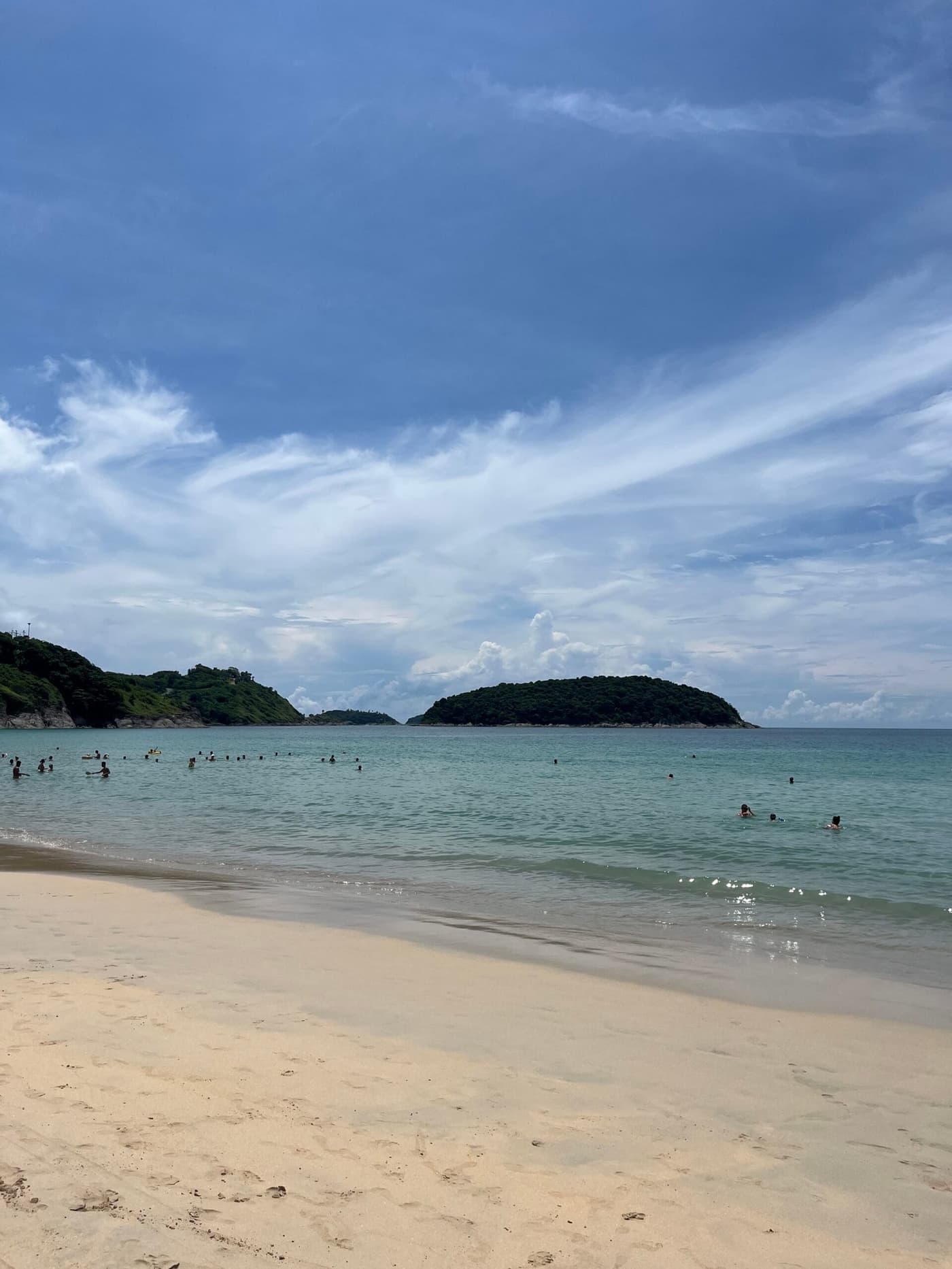
Phuket has two opposite modes: the calm winter sea and the monsoon summer with waves and rip currents. At Nai Harn the difference is felt more sharply than at many other beaches on the island, because the bay is open to the southwest and in summer, in the monsoon season, is the first to take the swell. Here is what that means in practice: which months to come, what to expect from the sea and how to read the flags on the beach.
When to go
High season runs from November to April. In these months the sea is flat, visibility is good and the water temperature is a steady 27–28 °C. The picture-perfect peak is December and January, but that is also the peak for prices and crowds.
Low season is May to October, the southwest monsoon. The sea becomes rough, with waves and rip currents. The harshest months are June, July and September. That doesn't mean you can't come: the rain is usually short and heavy, with hours of sunshine in between. Swimming just becomes a matter of flags and luck.
The shoulder periods, early November (before the peak of the season) and late April to early May, are my personal favorites for Nai Harn: the crowds have already left or haven't arrived yet, the weather is good and prices are lower than in December. For more on the weather month by month, see the article on Phuket's seasons and the best time to go.
Waves, rip currents and flags
From May to October is rip current season. Here the current is steady and strong, and there have been cases of tourists dying. Lifeguards on the beach put up flags:
red flag — swimming is prohibited yellow with a stripe — a swimming zone watched by lifeguards, swim between the flags, near the lifeguard post and the buoys two red flags — critical, do not go in even up to your ankles.
If you get carried out, don't swim against the current, because it is stronger than you. Swim parallel to the shore, sideways, until the current lets go, then head back.
Surfing at Nai Harn
Low season (May to October) turns Nai Harn into one of the surf spots of southern Phuket: the southwest swell arrives with the monsoon, but in July to September the quality is worse because of onshore wind. According to surf-forecast, the cleanest days (a west swell with an offshore northeast wind) most often come in November, at the turn of the seasons, but the spot is fickle and does not work every day.
At the northern end of the beach, in front of the yacht club, there is a beach-and-reef break that holds a big swell and works quite well in good conditions. At the southern end, in front of the lagoon, there is a permanent sandbar that catches even small waves, long and even, ideal for longboarding. For board rental and lessons, try Green Room Surf Shop, just past the beach on the road uphill. For experienced surfers Nai Harn is "average," but beginners with an instructor will do well here.
What's around: the lake, Promthep Cape and stylish coffee shops
Nai Harn's main advantage is not the beach itself but the combination of beach, lake, sunset and cafes within a few kilometers.
Nai Harn Lake and the park with outdoor gym equipment
A couple of steps from the beach is Nai Harn Lake, with a walking and running path around its perimeter of about 2.5 km. It is probably my favorite morning routine in Phuket. I run a lap around the lake, where there is a little park with natural shade from the casuarinas and free outdoor exercise equipment: parallel bars and pull-up bars. You can do some push-ups, sit in the shade on a bench, then head down to the sea for a dip.
The lake has a life of its own: mornings and evenings there are lots of local runners, Thai families and fighters from the neighboring Muay Thai gyms (there are several in the area, and athletes come here to train on purpose). Loi Krathong and other festivals are often held by the lake, and if you catch a festival, the floating lights on the water are worth it.
Wat Nai Harn: the Buddhist temple by the beach
About 500 meters from the beach is Wat Nai Harn. Inside there is a large Buddha statue and a prayer hall, and in the evening the monks hold a service. Visitors come without swimwear and without loud conversation, because this is not a tourist attraction. If you are interested in local Buddhist culture, it is worth stopping by, and it takes about twenty minutes.
Promthep Cape and Windmill Viewpoint
1.5 km to the south is Promthep Cape, the southernmost point of the island and Phuket's main sunset spot. Crowds gather here for sunset, and cars fill the parking lot from 5 p.m. If you are on a scooter, there's no problem, but if you come by car it's better to get there early.
A bit to the east is Windmill Viewpoint, with the very windmill you can see from Nai Harn Beach. From the windmill you get a view over the whole bay from above, and there are usually fewer people than at Promthep. A logical evening plan: the beach until five, dinner in the area, then sunset at one of the two viewpoints.
Nearby beaches: Ya Nui, Ao Sane, Rawai
700 meters to the south is Ya Nui Beach, a small bay with the best snorkeling in the area. By the rock in the middle there is a coral reef and schools of fish, and visibility is good. There is more about this beach in the separate article on Ya Nui Beach.
At the western edge of Nai Harn, over the hill, is Ao Sane Beach: even quieter, with divers, a small rocky bay. There are also a few cafes and a couple of dive centers.
4 km to the east is Rawai. You shouldn't swim there (shallow water, longtail boats, a muddy bottom), but there is a great Sea Gypsy fish market where the catch is unloaded in the morning, and dozens of seafood cafes with honest prices. I go to Rawai for lunch or dinner when I don't feel like cooking.
If you are planning a route around the south, also take a look at the guide to Mai Khao Beach in the north of the island: it's a contrast, and it helps to understand the difference between the "family-friendly south" and the "wild north."
Cafes and breakfast spots around Nai Harn
In the last couple of years, plenty of stylish coffee shops and breakfast places have opened around Nai Harn and on the road to Rawai. The coffee and food there are truly good, and I usually have breakfast and work on my laptop right there.
My favorites: KenKen Coffee, with a warm atmosphere and decent sandwiches; Coco's Nai Harn Cafe, a very pleasant breakfast cafe; and BOOST, with good coffee and tasty food, ideal for both breakfast and lunch.
The routine I love and recommend: a run around the lake at 7 a.m. → a swim in the sea while the beach is empty → breakfast at BOOST. After a morning like that you can head home and get on with your own things.
Where to stay near Nai Harn Beach
The big plus of Nai Harn is that there isn't much development, so there are few hotels and they don't blur into a tourist mush. The downside is that if you want to be right on the sea, the choice is limited.
The Nai Harn 5* — the only five-star hotel right on the beach, formerly Le Méridien. Prices start at 6,500 baht a night, higher in high season. Service at the level of Leading Hotels of the World, and the Rock Salt restaurant is one of the best in southern Phuket. It suits those who come for top-level service.
Sunsuri Phuket 5* — a little further inland, a 10-minute walk from the beach, by the lake. Quiet and new, with private pools in some rooms. It suits couples.
Wyndham Grand Nai Harn Beach Phuket — a large property with pools and swim-up bars, and there are all-inclusive options. It is geared toward families.
All Seasons Naiharn — mid-range budget, near the beach, no frills but a good location.
For a winter stay it makes more sense to look at villas and condos in Rawai and Nai Harn rather than hotels. A studio starts at 16,000 baht a month, a two-bedroom is 35,000–45,000, and a villa with a pool starts at 60,000.
If you are choosing between Nai Harn and other areas for a long trip, there is a short comparison in the general Phuket guide.
Is Nai Harn worth visiting: honest pros and cons
Pros. One of the cleanest and prettiest beaches in the south, a gentle entry that is safe for kids, a calm atmosphere with no bars or motorboats, and lots of activities nearby (running around the lake, outdoor gym equipment, snorkeling at Ya Nui, diving at Ao Sane, sunset at Promthep). Stylish coffee shops and restaurants within walking distance. Lifeguards who actually work. Free parking.
Cons. All toilets and showers are paid. There are few loungers and only in the center. In high season it can get crowded after noon. In the rainy season swimming is not safe and you need to watch the flags. Without a scooter or car, logistics are awkward, and public transport runs at long intervals and does not go directly from the airport. There is no nightlife; for that, go to Rawai or Patong.
Who it suits: families with kids, people on a long winter stay, fans of a calm beach rhythm with the chance to run and exercise, couples who come for the sunset, and freelancers with a laptop (the coffee shops in the area are good).
Who it doesn't suit: those who come for nightlife (that's only Patong), those who on principle are not ready for paid facilities on the beach, and those who come in June to September purely for swimming.
FAQ: Nai Harn Beach, frequently asked questions
Is entry to Nai Harn Beach paid?
No, entry is free, as at all beaches in Thailand, where beaches are public by law. You only pay for loungers (200 baht for two with an umbrella), the shower (20 baht) and the toilet (10 baht).
How long is the trip from Phuket Airport to Nai Harn?
It is 30 kilometers, 40–60 minutes depending on traffic. A taxi is 800–1,000 baht, a pre-booked transfer is usually 1,000–1,600 baht per car at a fixed price, and the minibus is from 200 baht per person.
Can you swim at Nai Harn in July?
Technically yes, but in practice with caution. July is monsoon season, rip currents regularly pick up and the lifeguards raise red flags. When the yellow flag is up you can swim in the marked zone, and when the red flag is up, absolutely not. The alternative is the shallow lagoon in the southern part of the beach, which stays calm.
What do the red flags at Nai Harn Beach mean?
A red flag means swimming is prohibited because of a strong rip current or big waves. Two red flags side by side mean critical danger. Yellow with a stripe marks a swimming zone watched by lifeguards: swim between the flags, near the lifeguard post and the buoys. Don't ignore them: the lifeguards at Nai Harn really do pull people out every season.
Is Nai Harn Beach good for a vacation with kids?
Yes, in high season it is one of the best beaches in Phuket for families with small children. The entry into the water is gentle and the bottom is sandy, with no coral or rocks. On the south side there is a shallow freshwater lagoon where the water is always warmer and there are no waves even in the monsoon. Lifeguards are on duty all year.
How is Nai Harn different from Karon and Kata?
Nai Harn is smaller and calmer, with no line of high-rises along the shore and fewer people. Kata is the most balanced beach, with children's facilities, but it is crowded. Karon is long and wide, also busy with people, and good for surfing in the off-season. Nai Harn wins thanks to its surroundings: a lake with exercise equipment, Promthep Cape and stylish cafes. Kata and Karon have nothing like that. There is a full comparison in the overview of all the beaches of Phuket.
Where is the best snorkeling near Nai Harn?
At Nai Harn itself the snorkeling is so-so, with no coral in the main part. It's better to go 5 minutes to the neighboring Ya Nui Beach, where the rock in the middle has a decent reef and schools of fish. Further away, Ao Sane also has snorkeling.
Is it worth staying at Nai Harn on a first trip to Phuket?
If nightlife and partying are your priority, no; choose Patong. If you are traveling with kids, for a long winter stay or for a calm beach vacation, Nai Harn is one of the best options on the island. For a first trip of a week to a week and a half, many people are more comfortable in Kata or Karon, thanks to the more developed tourist infrastructure and the number of cafes and bars. For a month or more, Nai Harn beats most areas.
When is the best time for sunset at Nai Harn Beach?
The beach itself faces west, so the sunset is good right from the sand; arrive 30–40 minutes before sunset. But the most postcard-worthy views are from Promthep Cape (1.5 km to the south) or from Windmill Viewpoint. At Promthep it is already crowded from 5 p.m., so it's better to arrive early.
Is there a running path at Nai Harn?
Yes, around Nai Harn Lake there is a paved walking and running path of about 2.5 km around the perimeter, mostly in the shade. Along the way there is free outdoor exercise equipment: parallel bars and pull-up bars. It is one of the best places for morning runs in Phuket.
I filmed a great video about this beach and other beaches in Phuket. Watch it, give it a like and of course subscribe!