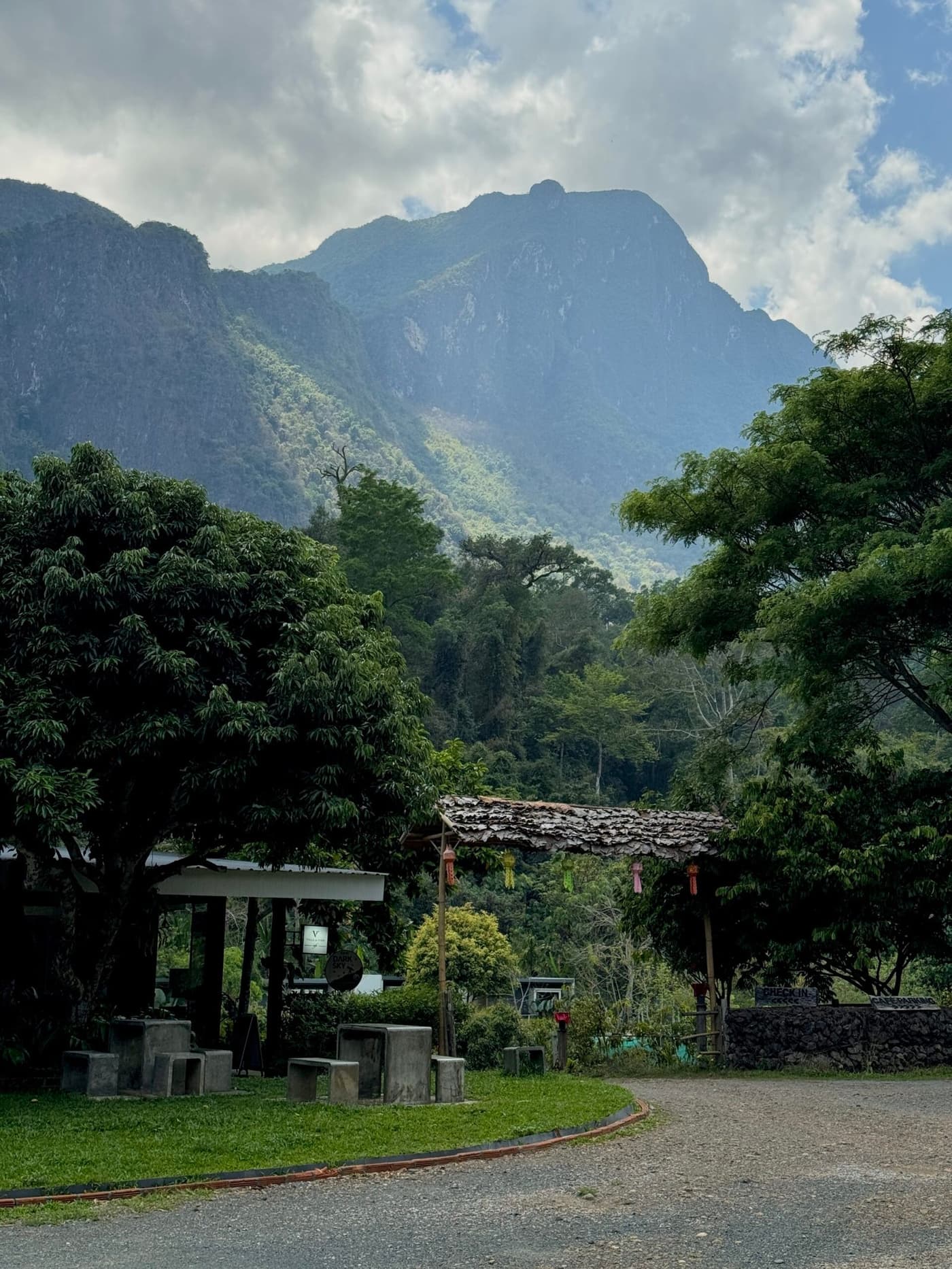
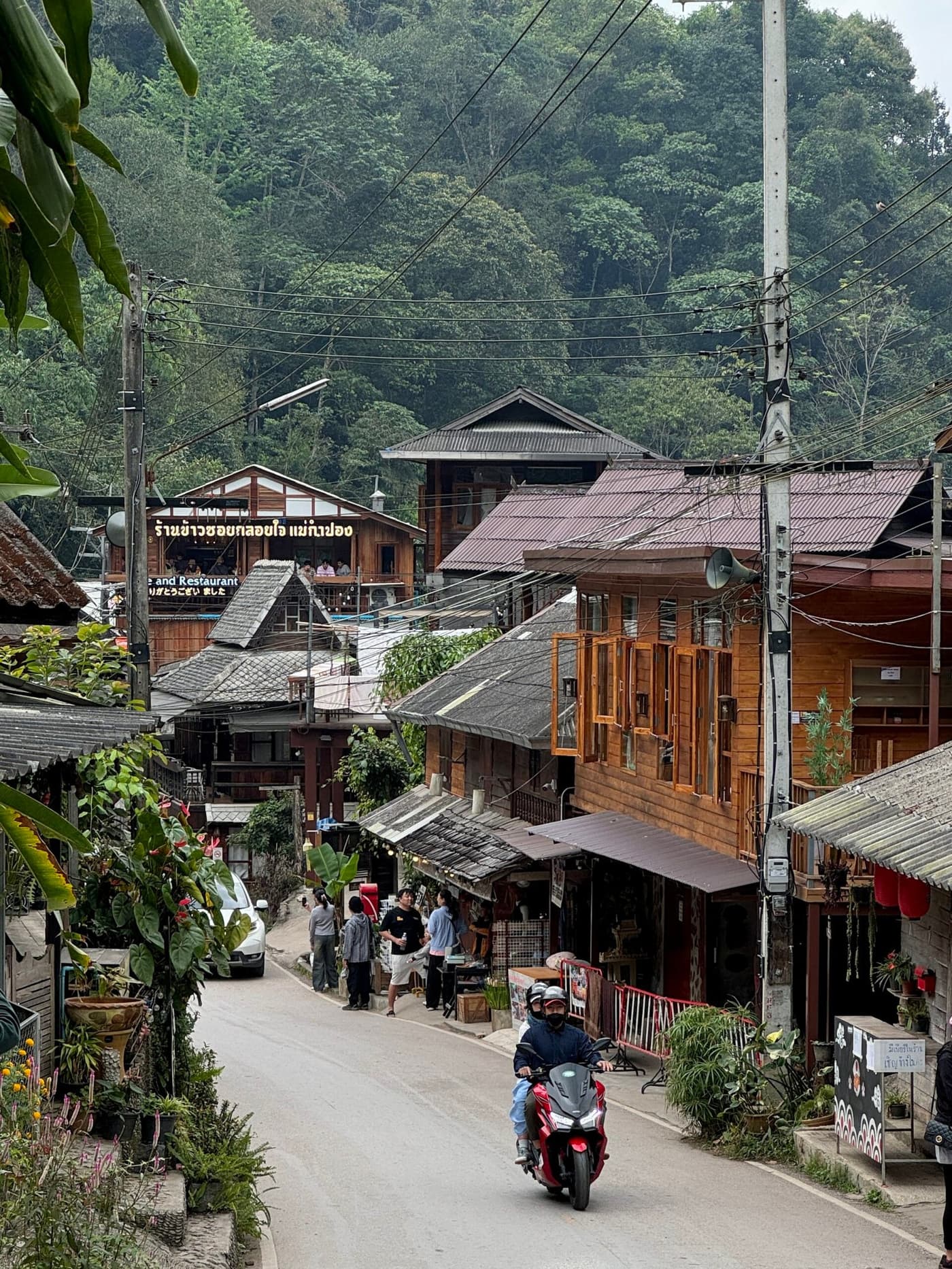
Mae Kampong is a mountain village 50 km from Chiang Mai that people describe as "straight out of a Miyazaki anime." Wooden houses over a river, thick jungle, local coffee and total quiet after the noisy city. Plenty of tourists come, but the place has not turned into an attraction. Everything is still real and unhurried.
We went there from Chiang Mai for a single day and did not regret it. If we had known how good it is, we would have stayed overnight. If you are only planning your trip to northern Thailand, I recommend the complete Chiang Mai guide.
The village's history and what makes it special
Mae Kampong is one of the first villages in Thailand to organize itself around a community-based tourism model. In the late 1990s the residents decided to develop tourism themselves, without outside investors or hotel chains. The money from visitors stays in the village: in the cafes, guesthouses and workshops run by local families.
The village has existed for more than a hundred years. Historically, people here grew tea trees, and fermented Miang tea is considered a local specialty that is still produced here today. Coffee plantations arrived in the 1980s under the Royal Project: Arabica is grown on the slopes around the village at an altitude of 1,000–1,200 m. At exactly this altitude Arabica gets its characteristic dense, slightly grassy flavor without bitterness.
All of this helps explain why the village feels alive. People here do not put on a show of village life for tourists. They simply live it and have opened it up to visitors.
How to get there from Chiang Mai
The distance is about 50 km, and the drive takes 1–1.5 hours.
By scooter or car is the best option. The road is scenic: first through the suburbs, then a climb into the mountains. The last 15 km are a serpentine road with sharp turns. Be especially careful on the way down: the road is narrow and there is oncoming traffic. When it rains the surface gets slippery, so slow down in advance.
Songthaew — you can find one at Warorot Market in Chiang Mai. There are few direct runs to Mae Kampong, and more often you will have to change at Bo Sang. The cost is about 50–80 baht.
Private transfer — convenient if you are traveling as a group. You can book it through Klook or directly with local tour operators, and the price is about 1,200–1,500 baht per car for a round trip.
On the way to the village you can stop at the San Kamphaeng Hot Springs, roughly halfway. Entry is about 100 baht, with several pools at different temperatures. It combines well into one day.
What to do in the village
Mae Kampong has no single "sight." The place works as an atmosphere. But if we break it down, here is what there is and what is worth doing.
Walking around the village
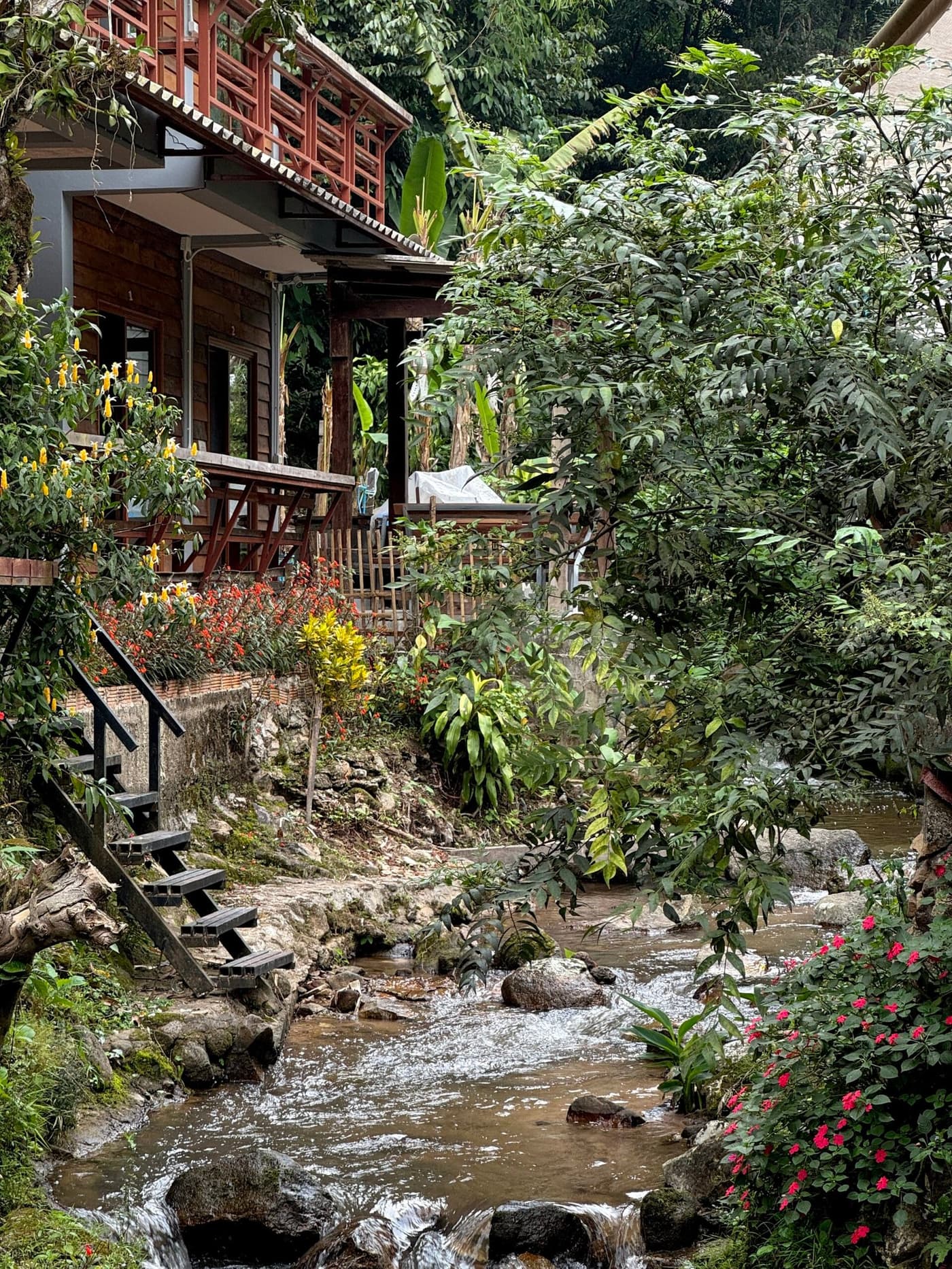
The village is small, with one main street and houses on stilts over a mountain river. You can walk all of it in 30–40 minutes. The atmosphere is relaxed: locals go about their business and vendors do not pester you. Just strolling here is already a pleasure.
The houses literally hang over the river, and the photos practically take themselves.
Mae Kampong waterfall
It is about a 15–20 minute walk uphill along a trail from the center of the village. There are several cascades, and the water is crystal clear and very cold, so it refreshes you seriously even on a hot day. You can swim in the pools beneath the lower cascades. Entry is free.
It is best in the rainy season (June–October) and right after it, when the waterfall is full and powerful. At other times the flow is smaller, but it is still beautiful.
Coffee shops with mountain views
Coffee is grown in the surrounding hills at 1,000–1,200 m, and the local Arabica has a characteristic grassy and nutty flavor without sourness. The Giant Chiangmai is a cafe literally in a tree with a view over the jungle. It is open roughly from 8:00 a.m. to 6:00 p.m. Coffee costs 80–120 baht and food 100–200 baht. The place is popular, and on weekends there can be a line.
Besides The Giant, there are several more cafes with verandas. I advise setting aside at least an hour for coffee, because there is no point in rushing here.
Tea plantations and fermented tea
Besides coffee, the area produces fermented Miang tea, made from the leaves of local trees processed with an old recipe. It has an unusual, slightly sour taste. You can buy it right in the village, a pack costs 50–80 baht.
Jungle trekking
There are several trekking routes of different difficulty around the village. The easy ones follow the river and go through bamboo thickets, and you can walk them on your own. The harder routes through the jungle (3–6 hours) are better done with a local guide: ask in the village, and the cost is about 500–800 baht per person.
Flight of the Gibbon (zipline)
A zipline over the jungle with mountain views. It is one of the best-known activities in the area, with platforms connected by cables and part of the route over a mountain river. The day program costs roughly 3,600–4,200 baht per person depending on the package and the seller (as of October 2026), so check the exact price when you book. Book in advance on the official website or on Klook, because spots sell out.
Mae Kampong coffee: what it tastes like
Arabica grown at 1,000–1,200 m differs from the plantation coffee of the lowlands. It has less sourness, more body and more grassy notes. Local farmers pick the cherries by hand, and the drying and roasting are done in small batches.
Several shops in the village sell ground coffee on the spot, in 100–200 g packs for 80–150 baht. The Giant Chiangmai serves the same coffee prepared as a drink: Americano, espresso, cold brew. It is a good way to try it before you buy.
If you are taking some home, buy ground coffee in a bag with a zip closure, and it will travel fine in carry-on luggage. On a plane you can carry up to 300 g of coffee per person.
Where to eat
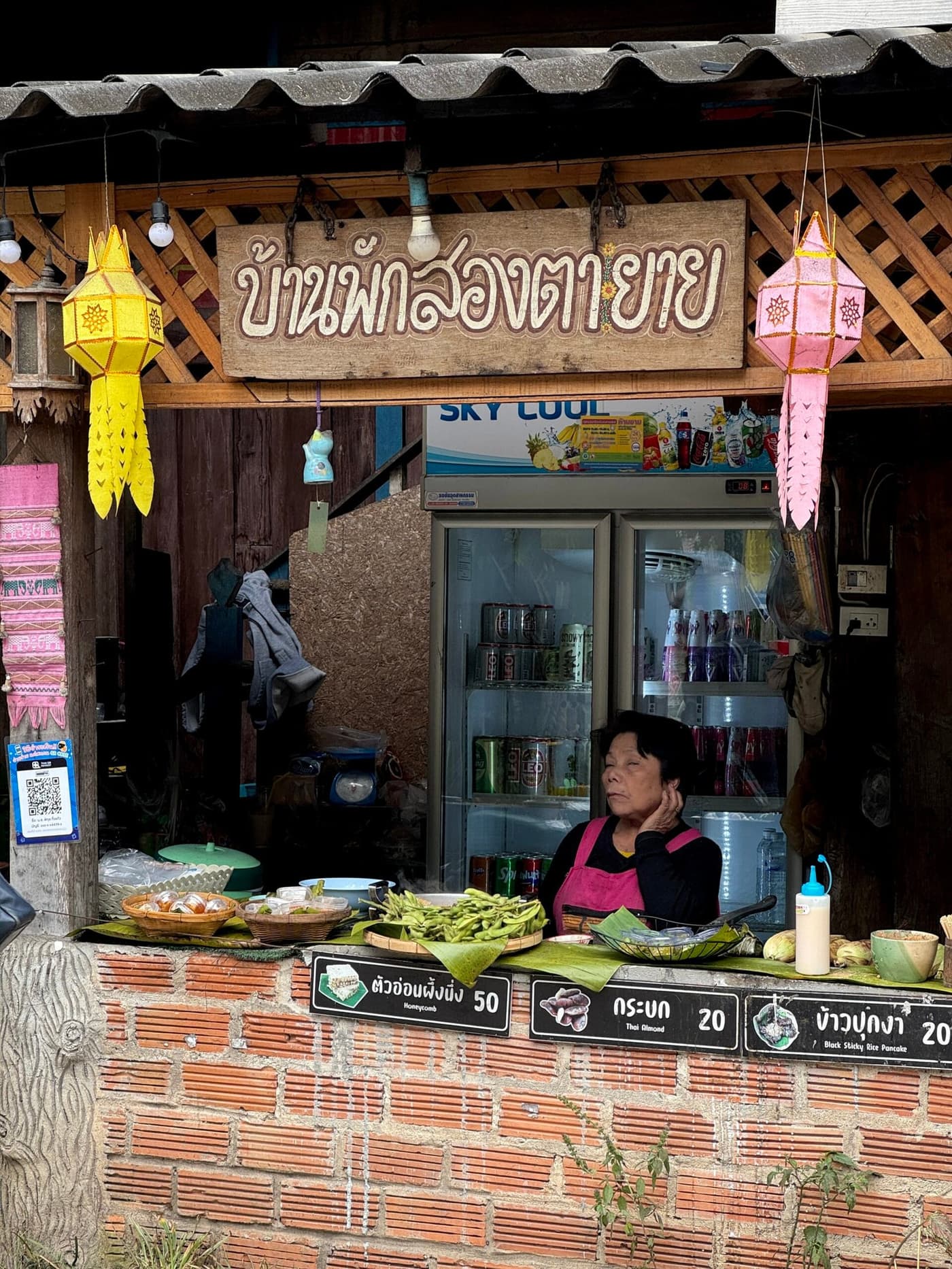
There are plenty of small cafes and shops in the village. Be sure to try Khao Soi — the famous northern noodle soup in a coconut broth with crispy fried noodles on top. It is especially good in a mountain village: a bowl costs 60–80 baht.
An average lunch costs 150–200 baht with a drink. Cash is a must, as there are no ATMs in the village.
Where to stay
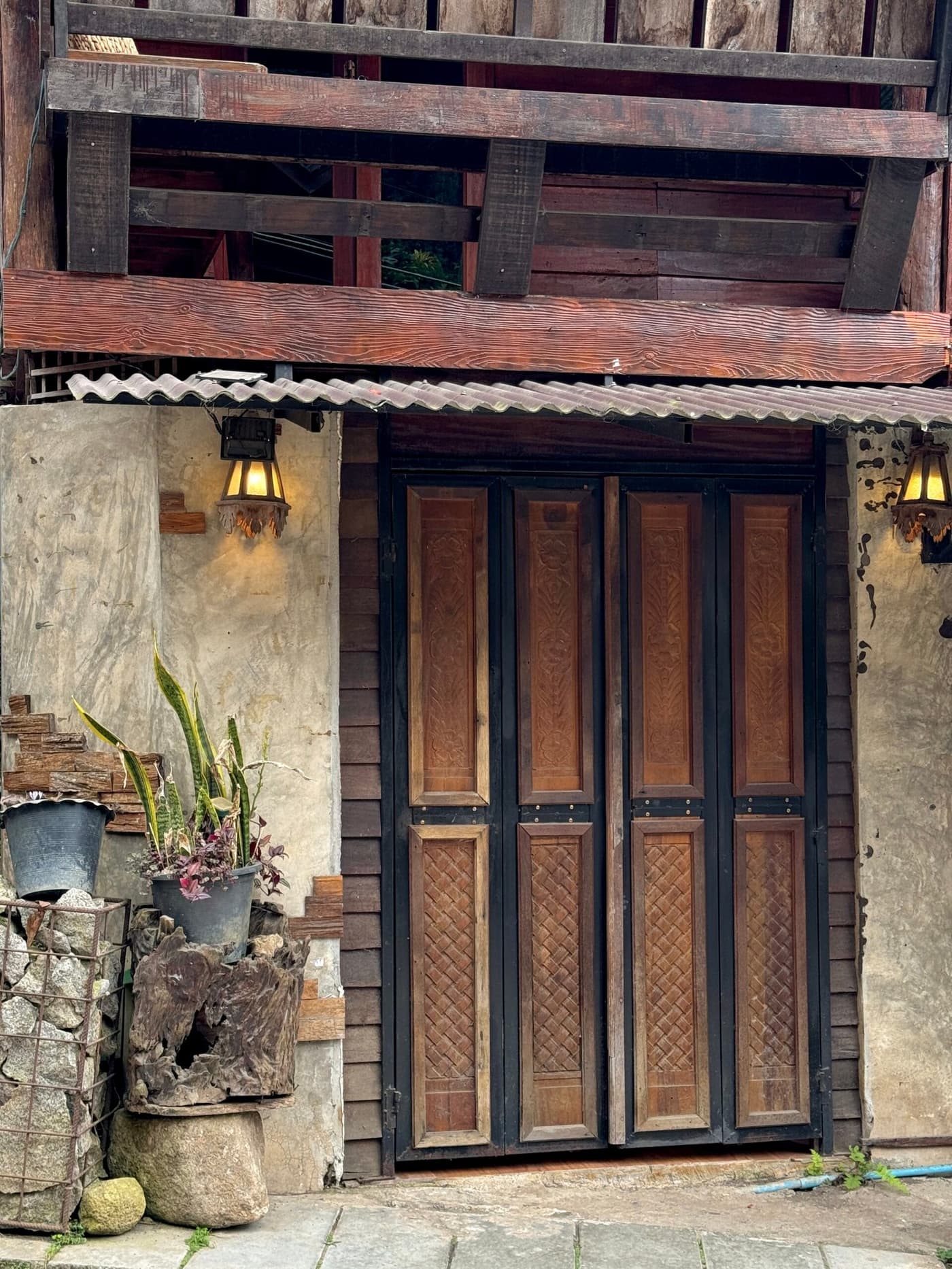
There are no big hotels. There are cozy guesthouses and homestays from 400–700 baht per night. Some houses literally stand on stilts over the river: at night you hear the sound of water, and in the morning there is mist over the river. This is exactly the experience people come here for.
Book in advance through Agoda or Booking, especially on weekends and in high season (November–February): the village is small and there are few rooms.
What to do if you stay overnight
If you decide to stay the night, it is a different experience. After the day visitors leave, the village goes quiet: only the river, the birds and the smell of mountain air. Morning mist over the water, your first coffee on the veranda, empty paths.
Guesthouse hosts often offer a home-cooked dinner: simple northern Thai food, what they cooked for the family. It is better than any restaurant. Ask in advance, since not everyone cooks, but many agree.
Before 8–9 a.m. is the best time to hike up to the waterfall: nobody is there, just you and the sound of water. On weekends after 10 a.m. the waterfall is already crowded.
The village after rain and other seasonal notes
In the rainy season (June–October) Mae Kampong is especially beautiful: the river is full, the jungle is deep green, and clouds often hang over the village. The romance of mountain mist is quite real. But the serpentine road in the rain on a scooter takes experience and is not for beginners.
Winter (November–February) is the most pleasant: it is dry, the air is clear, and the evenings are cool. The waterfall is noticeably smaller than after the rainy season, but still beautiful.
April–May is the quietest time: few tourists and the lowest prices. It is hot in the city, but cool specifically in the mountains, which is a plus.
What to buy in Mae Kampong
Ground coffee is the main souvenir from here. Locals sell it right in the village, in 100–200 g packs for 80–150 baht. The quality is noticeably better than in the souvenir shops of Chiang Mai.
Fermented Miang tea in packs, if you want to try something truly local. The taste is unfamiliar and sour, so it is for those who like it.
Honey from mountain apiaries is sold at a few houses. A small jar costs 100–200 baht.
Carrying all this on a plane is easy: coffee and tea are allowed in carry-on luggage, and honey goes in checked baggage.
Useful tips for travelers
It is noticeably cooler in the mountains in the evening than in Chiang Mai, so bring a light jacket. Cash is a must, as cards are not accepted anywhere in the village. On a scooter, be careful on the descents and in the rain: the serpentine road is narrow and there is oncoming traffic.
A charged phone matters: the navigation app will come in handy at the forks before the village, where there are no signs. Mobile coverage on the approach to the village is unreliable, so download an offline map in advance.
The best time for the trip is the cool season (November–February): no rain, clear air, and the waterfall is no longer as full as in the rainy season and right after it. In the rainy season (June–October) the village is especially green and the waterfall is more powerful, but the serpentine road in the rain demands caution.
Mae Kampong is a place worth visiting if you want to see a different Thailand and enjoy the beauty of nature. Here you can try local coffee and northern cuisine, see waterfalls and simply look at an unusual side of Thailand.
I wrote about where to go and what to see in Chiang Mai in another article.
I filmed how we explored the main sights of Chiang Mai in a YouTube video. A like and a subscription would be much appreciated 🙂
Frequently asked questions about Mae Kampong village
How do I get to Mae Kampong?
The best way is to rent a scooter or a car in Chiang Mai, but you can also get there by songthaew (a red shared pickup taxi) or by private transfer.
How much time do I need for a visit?
You can come for one day, but if you want to feel the atmosphere of the village, it is better to stay overnight.
When is the best time to go?
Year-round, but the best time is from November to February, when the weather is most comfortable.
Are there restaurants in Mae Kampong?
Yes, but the choice is small. It is better to try the local cuisine in small cafes and homestays.
Is this place suitable for families with kids?
Yes! The air is clean, the walking routes are safe and the scenery is beautiful.
Useful services for your Chiang Mai trip
Here is everything I use myself:
✈️ Flights: Trip.com — good prices and bonuses
📱 Mobile data (eSIM): Airalo
🌴 Tours and transfers: Klook | GetYourGuide | Viator | Tiqets
🏥 Insurance: Tripinsurance — travel insurance
🏨 Hotels: Agoda and Booking
🚌 Buses and trains: 12Go
🚙 Car and scooter rental: localrent | Discovercars | Getrentacar