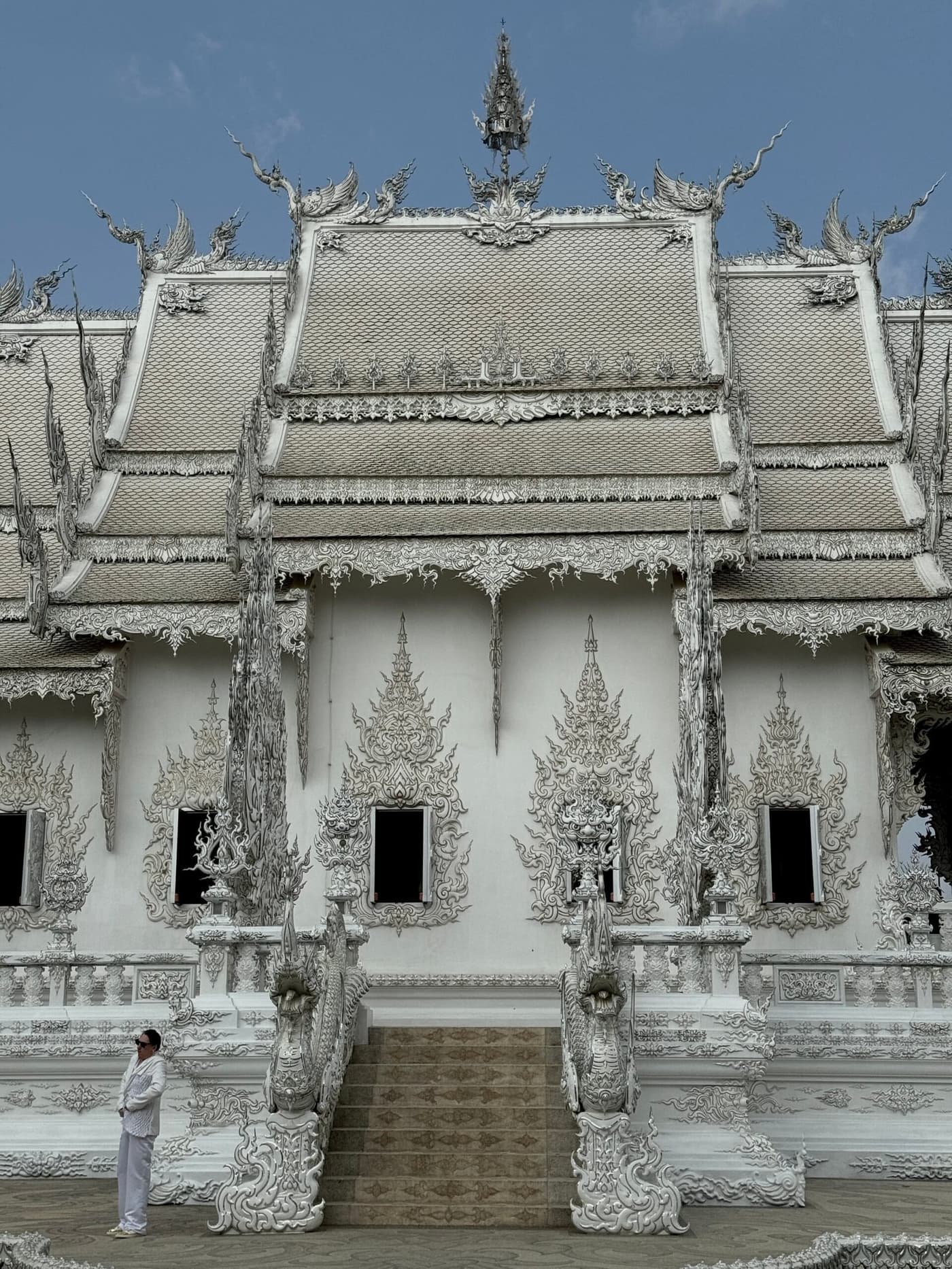
The White Temple, Wat Rong Khun, is not just a sightseeing stop. It is one artist's personal art project, which he has been building with his own money for almost 30 years and has no plans to stop. Outside are snow-white towers and mirror mosaics. Inside are Buddhist murals, Batman and rockets. We arrived skeptical and left impressed.
The Artist and His Vision
Wat Rong Khun was built, and is still being built, to a design by the Thai artist Chalermchai Kositpipat. He was born in Chiang Rai in 1955, studied painting in Bangkok and became one of the best-known Thai artists of the second half of the 20th century. His works have sold at international auctions, and he has painted Buddhist temples all over the country.
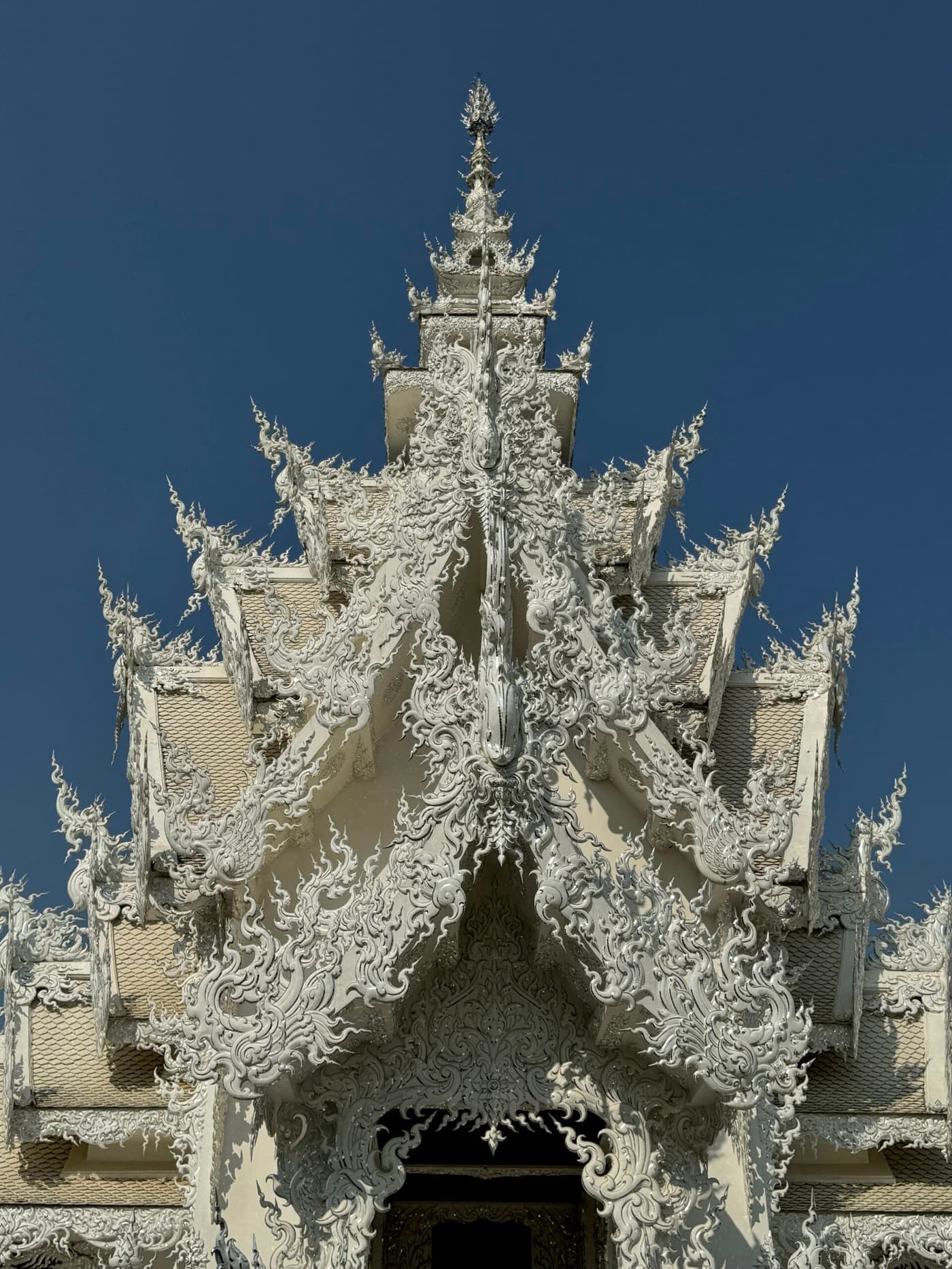
In 1990 Kositpipat bought a plot of land in his hometown of Chiang Rai, where an old, half-ruined temple once stood. In 1997 he began building a new one entirely at his own expense, deliberately refusing government funding: in his words, that is the only way he can control every detail. Construction is still going on. According to the plan, the complex will have nine buildings; some of them and the gate are still being finished. By the author's own estimate, the work will not be finished before 2070.
Kositpipat calls Wat Rong Khun a personal offering to the Buddha and, at the same time, a statement about Buddhist philosophy in a modern visual language. He explains the pop-culture references inside (Batman, Superman, characters from The Matrix and Transformers) as a comment that people's pull toward illusions and passions does not change over time. In this system, pop-culture characters are demons of desire just like the figures in classic Buddhist paintings.
In 2014 an earthquake damaged several of the buildings. Kositpipat declined foreign help with the restoration and rebuilt at his own expense.
The Temple Complex: What You'll See on the Grounds
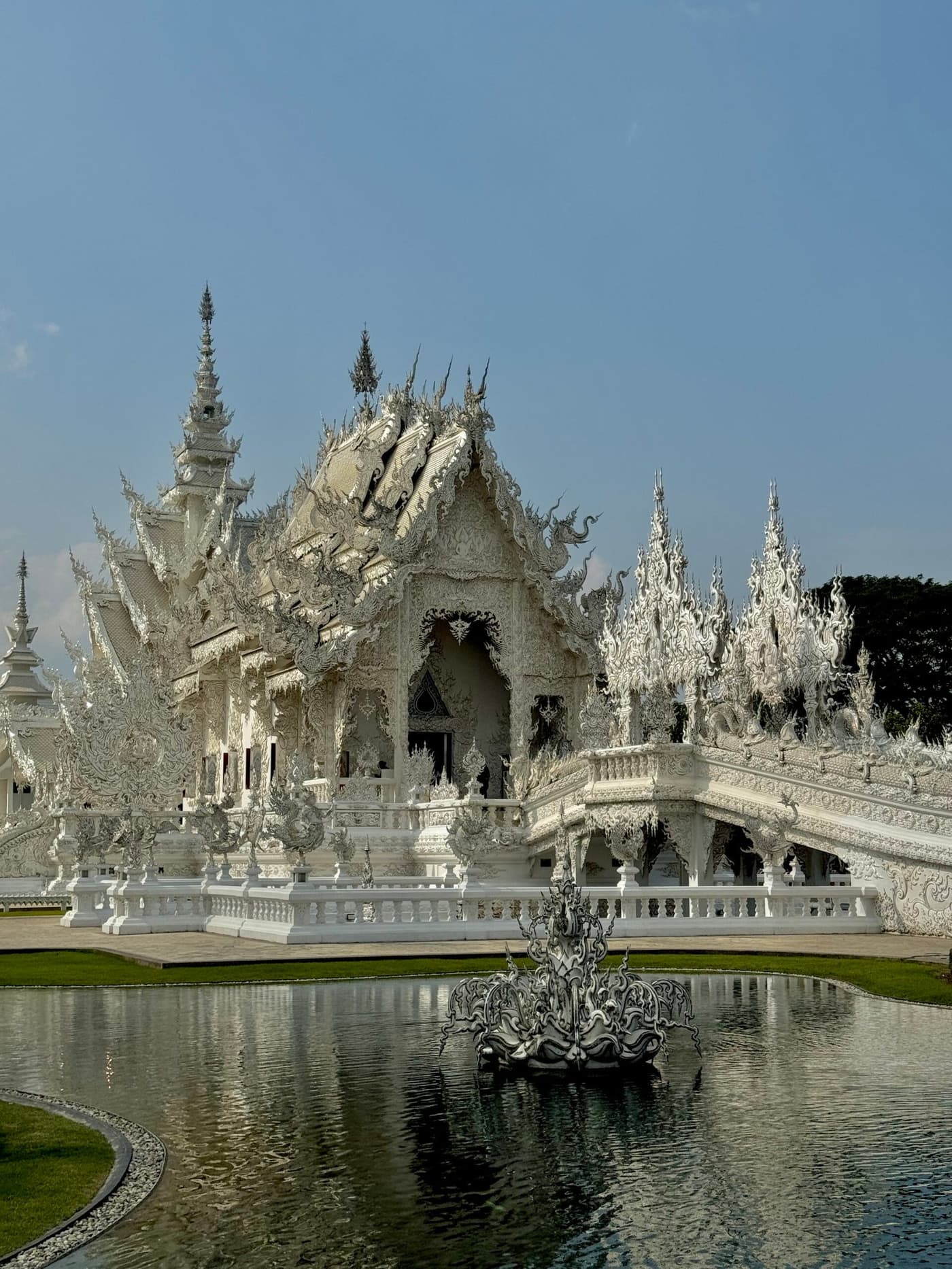
The grounds are fairly big, so allow 1.5-2 hours to walk around without rushing. The central building, the ubosot (ordination hall), is only one part of the complex.
At the entrance you are greeted by white gates with figures of mythological creatures. Small pavilions and sculptures line the main path. The grounds are neatly kept: white gravel, low bushes, flower beds. Nothing is accidental, and every element has been thought through.
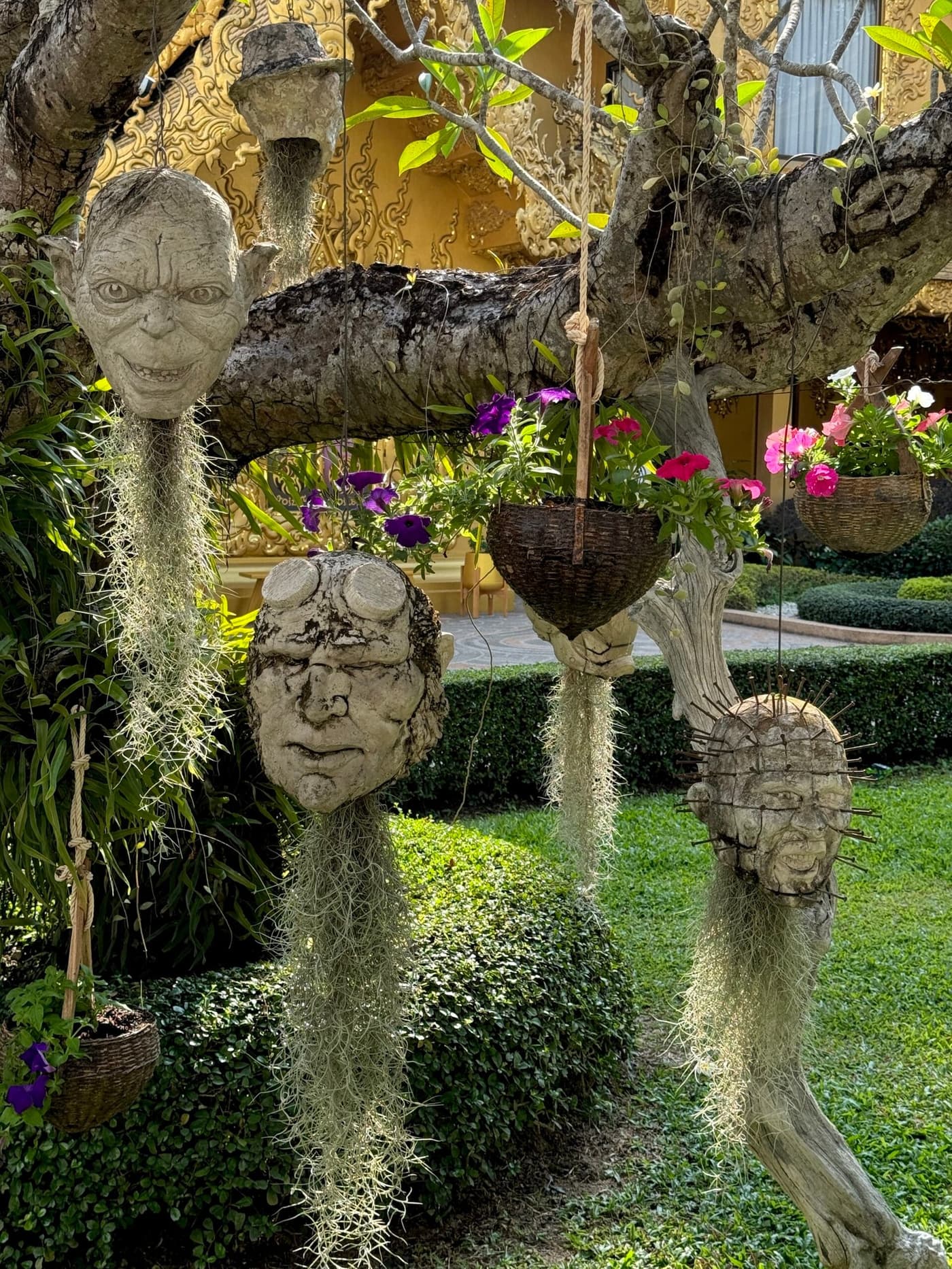
Besides the ubosot, there is a golden building on the grounds: the restroom. This is not a joke. Kositpipat deliberately made the restroom building gold to contrast with the white ubosot. White symbolizes purity and the Buddha, gold symbolizes wealth and money. In the author's concept it is a visual metaphor: spiritual purity and material cleanliness are different things.
There is also a gallery with Kositpipat's works, paintings in his signature style, with Thai mythology in rich colors. Separately, there is a small museum and a gift shop with reproductions and the artist's own publications.
The Bridge Over the Pond: Hands and Symbolism
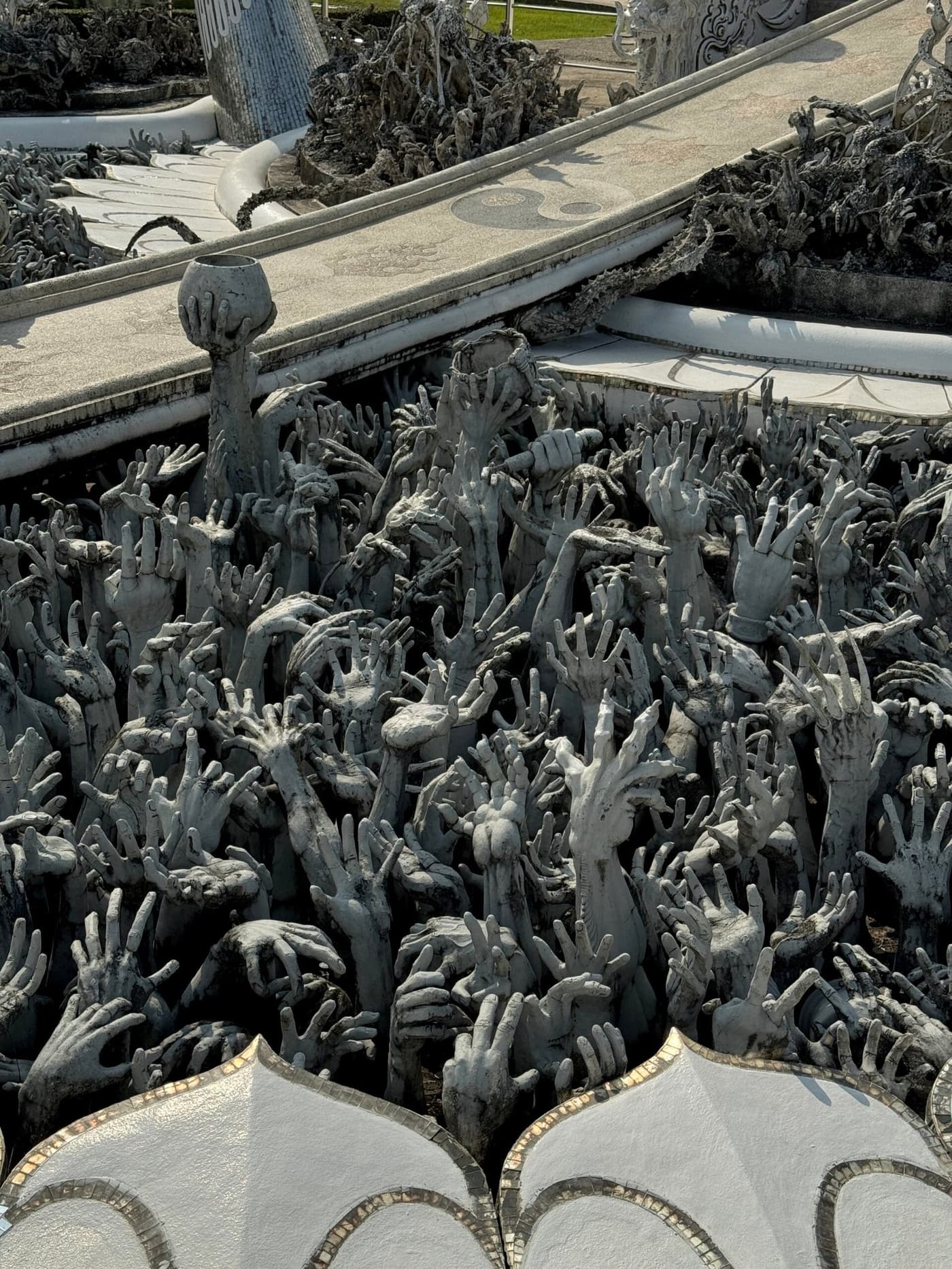
In front of the ubosot there is a pond, and a single bridge leads to the main building. The only way to reach the Buddha is across it, and that is no accident.
On both sides of the bridge, rising straight out of the water, are hundreds of plaster hands. The palms face up or forward and the fingers are stretched out, as if people were drowning and calling for help. This is a scene of hell: the hands stand for those who are stuck in desire and suffering. The bridge above them is the path you must cross to reach enlightenment. You cannot get past the hands, and by design this is exactly the feeling you are meant to have on the way to the temple: walking over an abyss.
Two figures stand at the start of the bridge. One is a half-decayed demon, a skull face with an outstretched hand. This is death, which waits for everyone. Next to it is a set of scales. The belief is that if you touch the scales and toss a coin, your wish will come true. But that is tourist folklore, not part of the original concept.
The bridge itself is narrow, visitors walk in a line, and at peak hours (10:00 to 14:00) there is a queue. Early in the day, right after opening, it is much quieter.
Inside the Ubosot: Murals and a Modern Pantheon
The ubosot is a place for prayer and meditation, not a museum. You can go in, but you must take off your shoes at the entrance, keep quiet and behave accordingly. Photography inside is forbidden, and this is strictly enforced.
The murals cover all the walls and the ceiling, painted by Kositpipat himself and his students. The lower part of the walls shows traditional Buddhist scenes: the Buddha, bodhisattvas, celestial beings. Higher up, another world begins: among the classic Buddhist images appear satellites, airplanes, Batman, characters from The Matrix, Darth Vader. One wall shows the Twin Towers on 9/11 and the explosion.
It is all one visual narrative. Death, suffering, human weakness before illusions, in every era and every culture. The Buddhist answer to that narrative is found in the same place: enlightenment, a way out of the cycle of desire. It is interesting to look at even if you are far from Buddhism, because the murals work like a huge interactive text.
In the center of the hall stands a statue of the Buddha, with a place for offerings in front of it. The atmosphere is serious, despite the pop-culture details on the walls.
When Will the Temple Be Finished?
Kositpipat is building Wat Rong Khun according to his own master plan. The project includes nine buildings within the main complex and several outer structures. By 2024 most of the central buildings were finished, but a few side buildings and the main gate are still in progress.
By the artist's own estimate, full completion is around 2070. He is in no hurry: the pace of construction is set by visitor donations and sales of his works, not by an outside budget. Kositpipat has repeatedly turned down government funding, explaining that he wants to keep complete control over every element.
After the 2014 earthquake, which damaged part of the building, he also rejected foreign help with the restoration. He rebuilt it himself, with his own funds. "Every stone here is my responsibility" is roughly how he puts it.
Visiting and Photography Tips
The best time to come is right after opening, at 8:00-9:00. The tour buses haven't arrived yet, the morning light is soft and clean, and the bridge is empty. At midday the temple's white glares in the sun and overexposes photos, so photos come out better in the morning or closer to 16:00.
Dress code: long pants and covered shoulders are required. You won't be let in wearing shorts and a tank top. At the entrance you can borrow shawls and skirts, free or for a small deposit.
You only take off your shoes at the entrance to the ubosot. Everywhere else on the grounds you can keep them on.
Bring cash: the entrance fee is paid at the ticket office, and cards may not be accepted. There is an ATM in the parking lot.
On the grounds there is a small cafe and a few food stalls, so you can grab a bite after your visit. Parking is free and large.
How to Get to the White Temple
The White Temple is 15 km south of the center of Chiang Rai and about 190 km from Chiang Mai.
- By car or motorbike from Chiang Mai — about 2.5-3 hours on Highway 1. The road is good and there are signs. This is the most convenient option if you plan to see all three Chiang Rai temples in one day: the Blue Temple, the White Temple and Baan Dam.
- Bus from Chiang Mai — from the Arcade Bus Terminal there are several departures a day to Chiang Rai, 3-4 hours, about 150 baht. It's handy to book tickets in advance on 12go.asia. From the Chiang Rai bus station to the White Temple, take a tuk-tuk or songthaew, 10-15 minutes, about 100-150 baht.
- From Chiang Rai itself — a tuk-tuk from the center costs 100-150 baht one way, and renting a motorbike in town starts at 200 baht a day. If you take a motorbike, it's easy to see all three sites on your own, but plan for a full day.
- Tour from Chiang Mai — full-day tours visiting the White, Blue and Black temples, plus the Golden Triangle as an option. A good choice if you don't want to deal with logistics. Look on Klook.
Opening Hours and Prices
Wat Rong Khun is open daily from 8:00 to 17:00. For foreign visitors entry costs 200 baht (since 1 January 2026; it used to be 100 baht), and the ticket covers the grounds. Entry is free for Thai citizens, children under 120 cm and visitors aged 70 and over. Parking is free.
Itinerary: Three Chiang Rai Temples in One Day
It's easy to do Chiang Rai as a loop: all three main sights are within 15 km of the city center, in different directions.
The best order is to start with the Blue Temple (Wat Rong Suea Ten), which opens at 7:00, has free entry and almost no tourists early in the morning. Then head to the White Temple (open from 8:00; it's best to arrive before 10:00, before the buses). After that comes Baan Dam (the Black House), which closes at 17:00, so don't linger too long.
Allow a full day to see all three properly. If you want to add the Golden Triangle (60 km from Chiang Rai), you need a full day and an early start. I also wrote a detailed guide to Chiang Rai.
I filmed our trip from Chiang Mai to Chiang Rai, seeing the White, Blue and Black temples and the Golden Triangle, in a YouTube episode.
Frequently Asked Questions
Here are answers to the questions I hear most often from people heading to Chiang Rai.
Is the White Temple worth visiting?
Yes. It's not an ordinary Buddhist temple but a unique art object, with nothing else like it anywhere in the world. Even if you are far from Buddhism or modern art, the architecture and the murals leave an impression. The trip takes one day from Chiang Mai.
How much does it cost to enter the White Temple?
For foreign visitors entry costs 200 baht (since 1 January 2026; it used to be 100 baht), and the ticket covers the grounds. Entry is free for Thai citizens, children under 120 cm and visitors aged 70 and over. Parking is free.
What time does the White Temple open and close?
Daily from 8:00 to 17:00, with no days off.
Can you take photos inside?
No. Photography inside the ubosot is strictly forbidden. On the grounds outside, there are no restrictions.
What should you wear to the White Temple?
Long pants (below the knee) and clothes that cover your shoulders. You won't be allowed in wearing shorts or tank tops. At the gate they hand out wraps and skirts if you're not dressed appropriately.
When is the best time to come to avoid the crowds?
Early in the morning, right after opening, at 8:00-9:00. By 10:30-11:00 tour groups arrive on buses and the bridge gets very crowded. In the evening, after 15:00, there are also noticeably fewer tourists.
Can you combine the White Temple with other places in one day?
Yes. The best route is the Blue Temple → the White Temple → Baan Dam. They are all in the same area of Chiang Rai and take a full day. If you leave Chiang Mai at 6:00-7:00 a.m. in your own car, you'll have time for everything.
Who built the White Temple, and will it ever be finished?
The artist Chalermchai Kositpipat began building it in 1997 with his own money. In his words, the complex is planned to be fully finished by 2070. By design the complex will have nine buildings; some are already built, the rest and the gate are still being finished, and work continues.