The Blue Temple, Wat Rong Suea Ten, stands just 3 km from the center of Chiang Rai and is almost always less crowded than its famous white neighbor. The name translates as "Temple of the Dancing Tiger." Everything here is blue, from the walls and columns to the decorative details. Entry is free.
What the Blue Temple Is and Why It's Blue
The Blue Temple is not just a building "painted blue." There is a concept behind the choice of color, and behind the architecture stands a specific artist with a name and a biography. Here is what to know before you go.
Wat Rong Suea Ten was built between 2005 and 2016. Its architect, Phuttha Kabkaew, is a student of Chalermchai Kositpipat, who created the White Temple. The two sites are like two views from the same school: one went into whiteness and mirrors, the other into a deep, saturated blue.
Blue is no random choice in Buddhist symbolism. It corresponds to the Dharma, the teaching of the Buddha, and also stands for wisdom and calm. In Thai Buddhism it is one of the five sacred colors linked to the Buddha's day of birth.
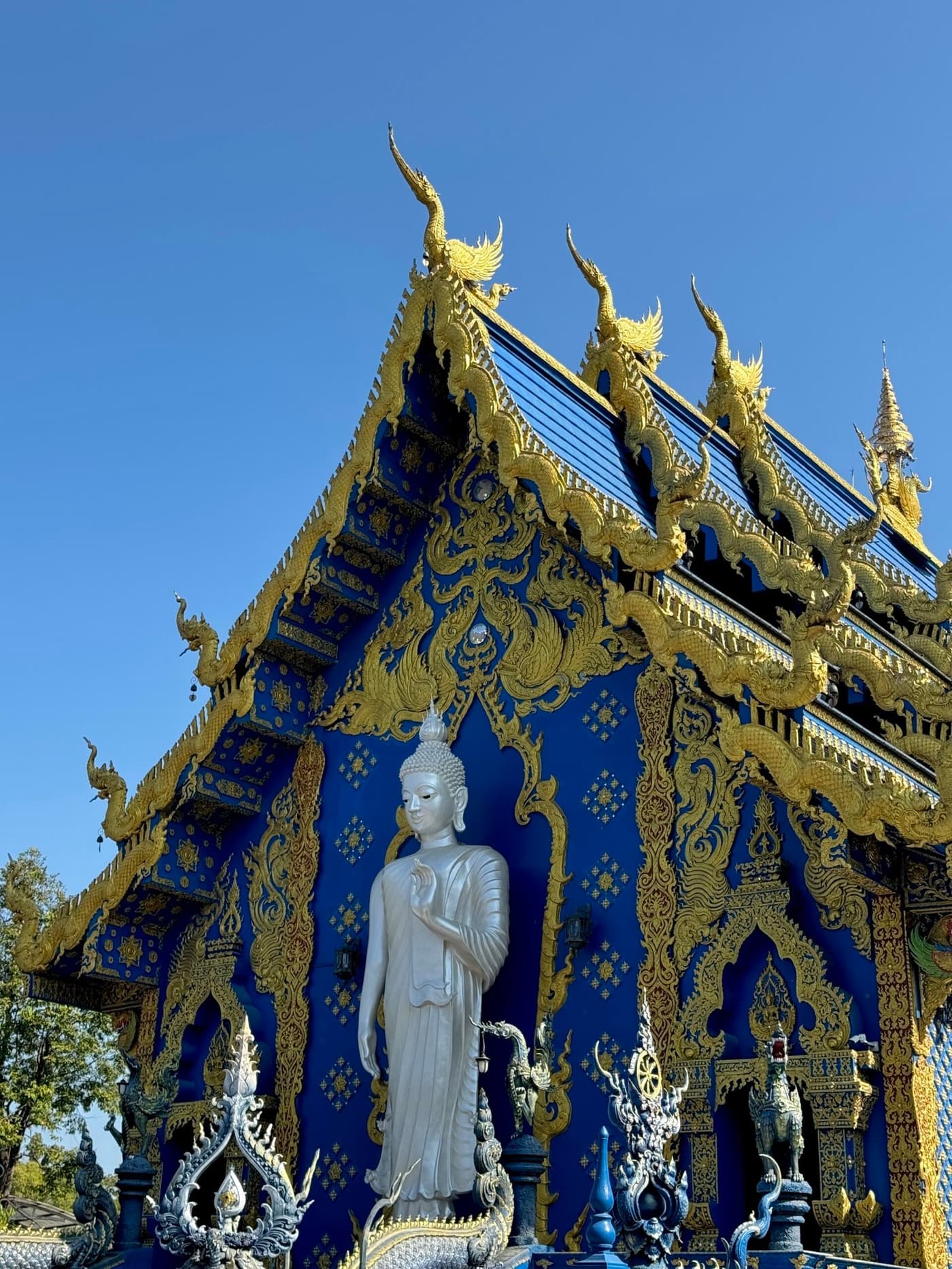
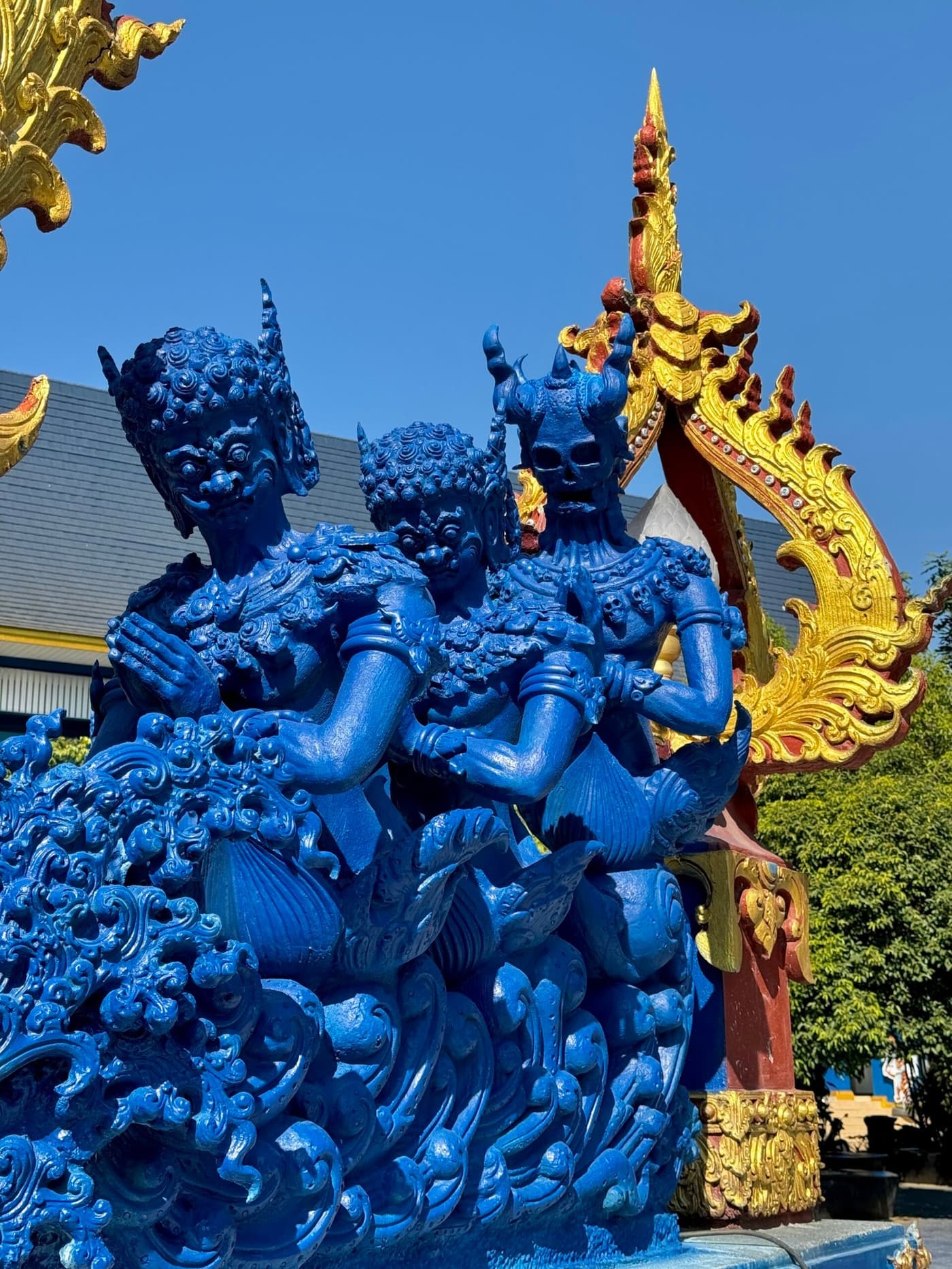
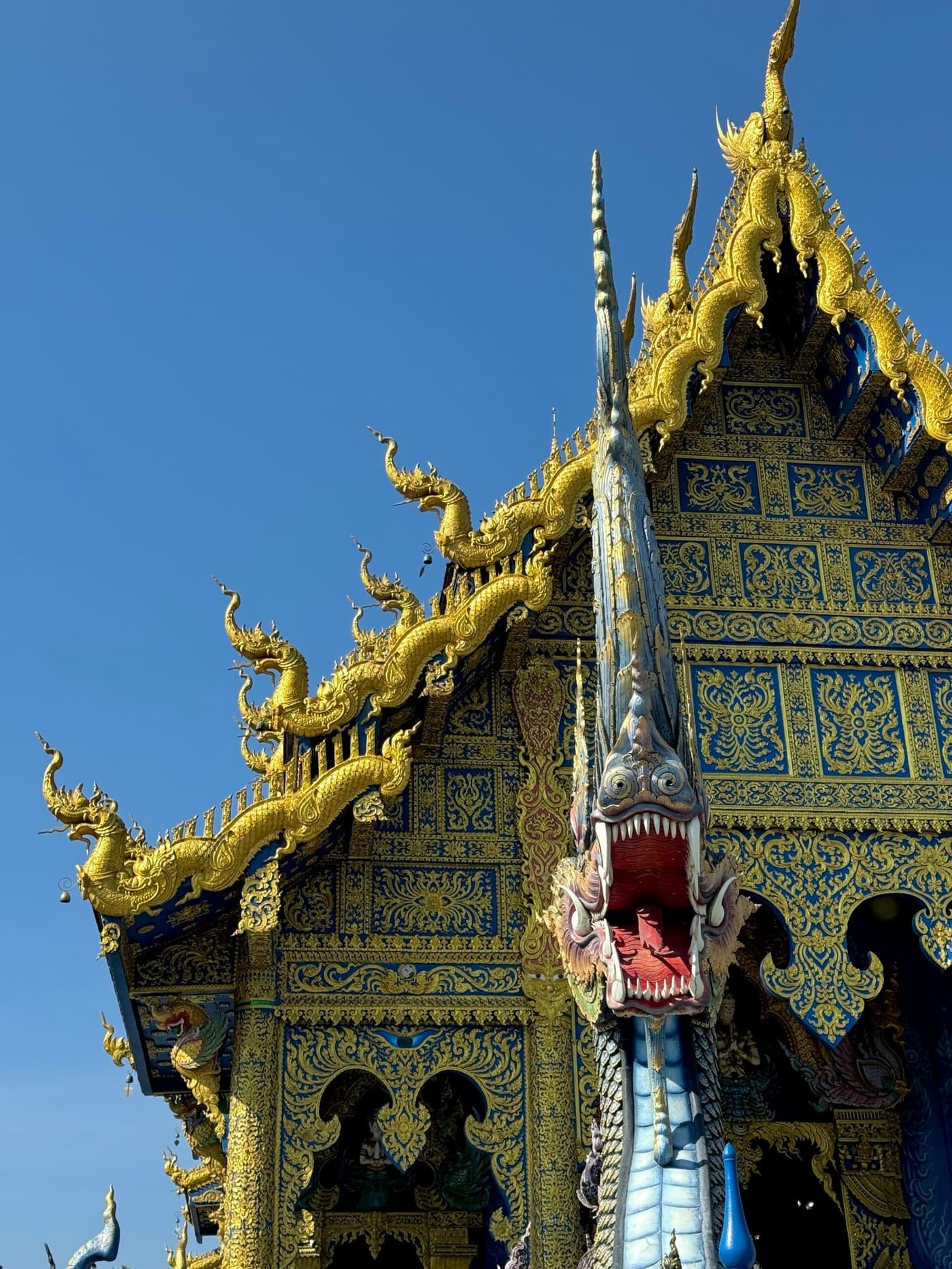
The outside of the building is covered in blue paint and blue mosaic. Unlike the White Temple, with its mirrored inlays and pop-culture references, the Blue Temple looks more restrained and unified. There is no irony and no Batman on the walls, just dense blue and gold.
What's Inside the Ubosot
The main ubosot (ordination hall) is open to visitors. Inside, a bluish half-light fills the room. The central place is taken by a huge white Buddha statue in a meditation pose, surrounded by smaller figures. The walls are painted with murals in blue and gold tones, showing Buddhist motifs and scenes from the Jataka tales (stories of the Buddha's past lives). The ceiling is a deep blue with golden ornaments.
The effect of the space is unusual: from outside, the bright blue seems almost loud, but inside there is stillness and focus. Let your eyes adjust, and once your vision settles, the paintings start to become readable.
Photography inside is allowed, but check on the spot, as the rules change from time to time.
The Nagas and the Grounds
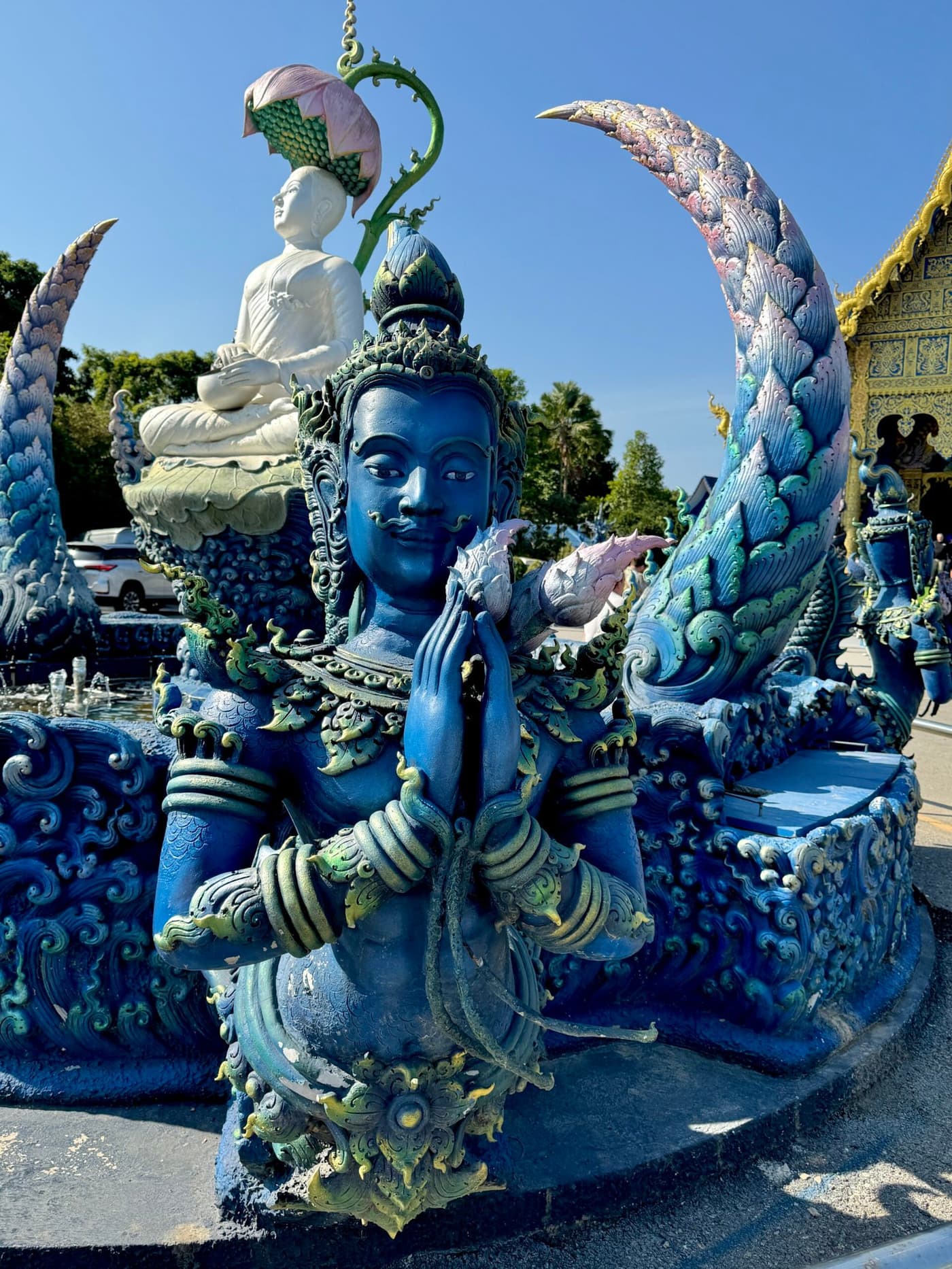
The entrance to the grounds is guarded by two multi-headed nagas, the serpent guardians of Thai Buddhist tradition. They have blue scales and golden crowns. A wide staircase leads between them up to the ubosot.
Besides the main building, the grounds have several smaller structures, a pond and garden areas. Everything is done in the same blue and gold palette. Walking around without hurrying takes about 30 to 40 minutes.
Who Is Phuttha Kabkaew: The Architect of the Blue Temple
Phuttha Kabkaew is a Thai artist and architect born in Chiang Rai Province. He studied under Chalermchai Kositpipat, the creator of the White Temple, and worked alongside him for a long time. In 2005, by then an independent master, he began his own project on the site of an abandoned temple in Chiang Rai.
Kabkaew chose blue deliberately, as a counterpoint to his teacher. Where Kositpipat works with whiteness, mirrors and postmodern irony, Kabkaew moved toward tradition and monochrome depth. Two sites, two answers to one question: what does it mean to create a Buddhist space today?
Construction lasted eleven years, from 2005 to 2016. During that time Kabkaew brought in local craftsmen, and many details were made by hand by local carvers and mosaic artists. That is why the Blue Temple feels more "alive" and less industrial than its more famous white neighbor.
History of the Place and the Architect
Before Wat Rong Suea Ten, an old, half-ruined temple stood on this spot, so neglected that the local community decided to build a new one. Construction began in 2005 and finished in 2016. The project was funded by local donations and the architect's own money.
Phuttha Kabkaew is a student and colleague of Chalermchai Kositpipat (the creator of the White Temple). But while the teacher's architectural language is built around white, mirrors and postmodern quotations, Kabkaew went in another direction, toward monochrome intensity and traditional Buddhist imagery. No irony, no superheroes. Just blue, gold and silence.
The name Wat Rong Suea Ten, "Temple of the Dancing Tiger," is tied to a local legend: it is said that tigers used to wade across the river here, and their movements looked like a dance.
How to Get to the Blue Temple from Chiang Mai
The Blue Temple is 3 km from the center of Chiang Rai, the closest of the city's three main temples.
By car or motorbike — about 2.5 hours from Chiang Mai. We visited all three Chiang Rai temples in one day. There is parking at the Blue Temple, and it is free.
By bus — from Chiang Mai to Chiang Rai from the Arcade Bus Terminal, 3 to 4 hours, around 150 baht. Tickets are easy to book on 12go.asia. From the Chiang Rai bus station to the Blue Temple, take a taxi or tuk-tuk (10 to 15 minutes, about 100 to 150 baht). Or walk from the center, which takes 30 to 40 minutes.
Tour from Chiang Mai — "three temples of Chiang Rai" tours include the White, Blue and Black temples. You can find options on Klook.
Opening Hours and Entry
- Opening hours: daily from 7:00 am to 8:00 pm
- Entry: free
- Dress code: long pants or a skirt below the knee, shoulders covered. You can pick up a cover-up at the entrance if you need one.
- Shoes are taken off at the entrance to the ubosot.
The Blue Temple stays open later than the White Temple (until 8:00 pm versus 5:00 pm). This matters when you plan your route.
The Best Time to Visit
In the morning (7:00 to 9:00 am) — the fewest people and soft side light. In morning light the blue looks softer and richer.
In the evening (after 6:00 pm) — the temple is lit by artificial lighting. The blue walls in the warm light of the spotlights give a completely different picture than in the daytime. If you have a chance to be here at sunset, it's worth it.
In the middle of the day, direct sunlight makes the blue look a little "washed out" in photos.
The Blue Temple in the Evening: A Different Experience
Wat Rong Suea Ten is open until 8:00 pm, later than any other sight in Chiang Rai. This is more than a scheduling convenience: the evening lighting changes the place completely.
In the daytime, the blue under direct sun looks bright and a little "loud." After sunset, when the warm, yellow-tinged spotlights come on, the blue walls seem to glow from within. The golden details and the white Buddha statue look different against this backdrop. Many photographers come specifically in the evening.
There are fewer tourists in the evening than in the morning, since most tourist routes end by 5:00 pm. If you can come back here after 6:30 pm, it's worth doing, especially if you plan to stay overnight in Chiang Rai.
Tips for Visiting and Photography
The Blue Temple is one of the most photogenic places in Chiang Rai. But the time of day and the weather strongly affect the result.
For photos of the ubosot's blue walls, the best conditions are an overcast sky or the time shortly before sunset: the colors are saturated, without harsh shadows. Shoot from the far point near the entrance, so the nagas and the wide staircase fit in the frame.
The ubosot interior is a low-light shooting situation, and you will have to raise the ISO. A phone will do worse than it does outside. If photos from inside matter to you, bring a camera with a good fast lens.
There are far fewer people on weekdays than on weekends. If you go on a weekend, arrive at opening time.
Practical Details and Dress Code
The Blue Temple is a working religious site, not a museum. Clothing: long pants (below the knee) or a skirt, shoulders covered. You won't be let in wearing shorts and a tank top. There are cover-ups at the entrance, but it's better to arrive dressed appropriately.
Shoes are taken off before entering the ubosot. Inside it is quiet and calm, and loud conversation is out of place.
You can leave cash behind, since everything here is free. Parking is free too. There are no souvenir stalls or cafes on the grounds, just the temple. It's refreshing after the commercial bustle at the White Temple.
If you arrive in the evening, keep in mind that the nearest gas station and ATM are in the center of Chiang Rai (3 km). Plan your logistics in advance, especially if you are heading on to the White Temple or the other side of town.
What Else to See Nearby
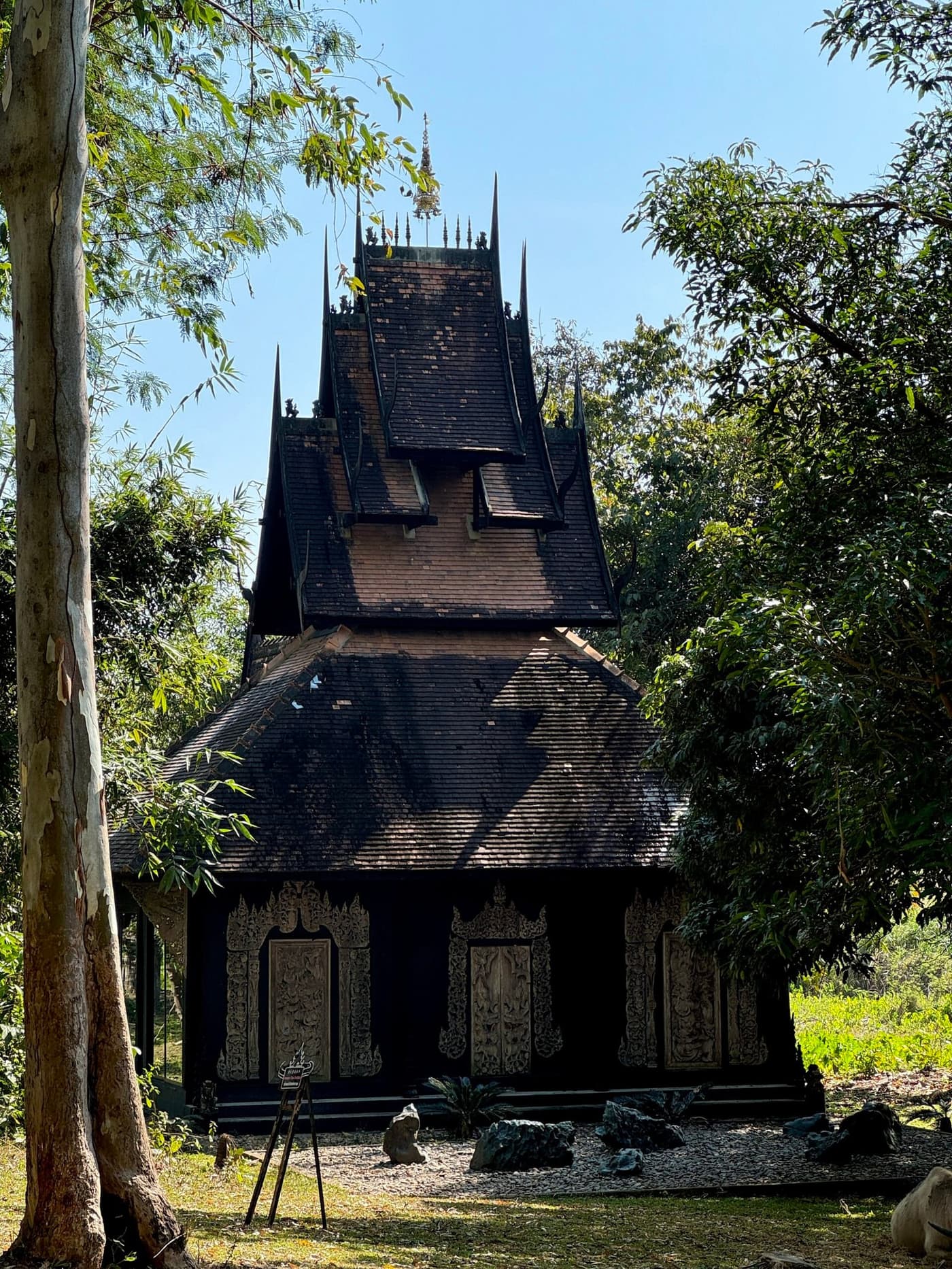
After visiting the Blue Temple in Chiang Rai, explore the region's other sights. Visit the famous White Temple (Wat Rong Khun) and stop by the Black House (Baan Dam), which is mostly a museum rather than a temple. If you have time left, head to the border of three countries and see the Golden Triangle, which is about an hour's drive from the city. If you decide to stay in the city for a few days, I recommend reading my detailed guide to Chiang Rai.
Route: The Three Temples of Chiang Rai
The Blue Temple opens earliest, at 7:00 am, and that makes it the best start to the day. Arrive at opening time, before the tour buses, look around at an unhurried pace and be on your way to the White Temple by 9:00 am.
The best order: Blue (7:00 to 9:00 am) → White (9:00 to 11:00 am, before the main flow of tourists) → Baan Dam (after lunch, no later than 4:00 pm, since it closes at 5:00 pm). All three sites are within a 15 km radius of the center of Chiang Rai, and you get around by motorbike or car.
The Blue Temple wins twice here: it suits the start of the day, and it is worth coming back in the evening if you stay overnight, because the lighting after 6:00 pm changes how the place feels completely.
Comparison with the White Temple
The White and Blue temples are often compared, and rightly so, since they are different in character.
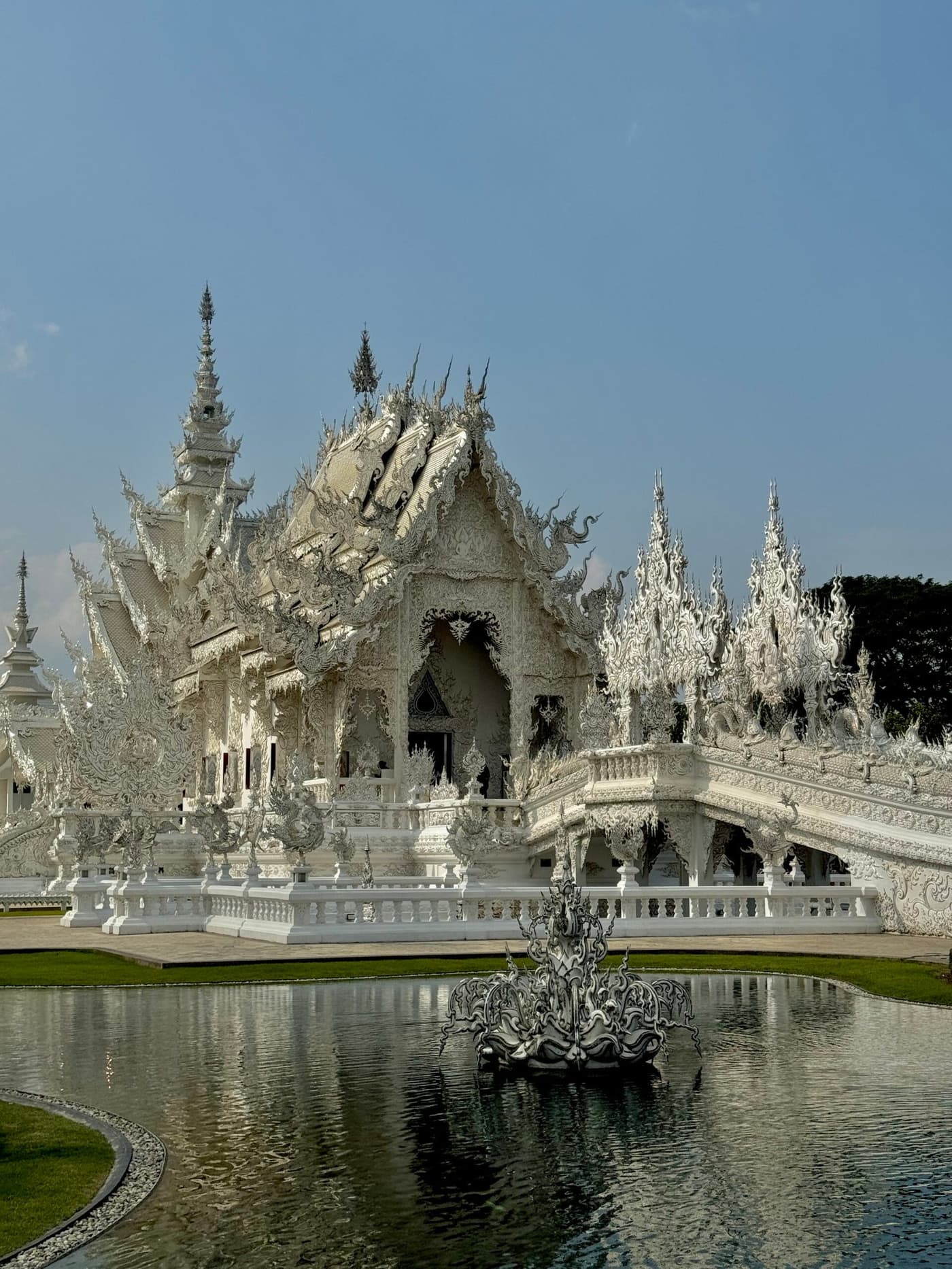
The White Temple (Wat Rong Khun) is bright and eclectic, with mirrors and pop-culture references. Entry to the ubosot costs 100 baht, and it is open until 5:00 pm. There are noticeably more tourists.
The Blue Temple (Wat Rong Suea Ten) is more unified and traditional in mood. Entry is free, and it is open until 8:00 pm. There are fewer people. If you have to pick one place, go to the White Temple, because it is more unique. But both in one day make a full itinerary.
I filmed an episode on YouTube about how we rode from Chiang Mai to Chiang Rai and saw the most interesting places that few people get to. I invite you to watch, and if you aren't subscribed to the YouTube channel yet, be sure to subscribe!
Frequently Asked Questions
Where is the Blue Temple?
3 km from the center of Chiang Rai, the closest of the city's three famous temples.
How much does entry cost?
It's free.
What are the opening hours?
Daily from 7:00 am to 8:00 pm.
Why is the temple blue?
Blue symbolizes the Dharma, the teaching of the Buddha. The architect Phuttha Kabkaew chose it as a deliberate concept, setting it against the whiteness of his teacher's temple.
How does it differ from the White Temple?
The White Temple is brighter and more eclectic, with pop culture. The Blue Temple is calmer and more unified, entry is free, it is open until 8:00 pm and has fewer tourists. Both are worth seeing.
Can I walk there from the center of Chiang Rai?
Yes, it's about 30 to 40 minutes on foot. You can also take a tuk-tuk or taxi, 10 to 15 minutes.
Can I take photos inside?
Usually yes, but check on the spot, as the rules sometimes change.
What time is best to visit?
In the morning before 9:00 am there are fewer people. In the evening after 6:00 pm the lighting is beautiful.