Baan Dam is the most unexpected place in Chiang Rai. People call it the Black Temple, but it is not a temple. It is an open-air art museum: 40 dark buildings, a brooding aesthetic, and sculptures made of animal bones and hides, bamboo and wood. One man created all of it, the Thai artist Thawan Duchanee, who worked on this place his whole life. He died in 2014, and Baan Dam remained his legacy.
Who Was Thawan Duchanee
Thawan Duchanee (1939–2014) was one of the most significant Thai artists of the 20th century. He was born in Chiang Rai province. In the 1960s he went to study fine art in the Netherlands, in Amsterdam and The Hague. He came back to Thailand as an artist of international standing: his work was exhibited in Europe and the United States.
But the main project of his life was Baan Dam, the "Black House," in his home region of Chiang Rai. Duchanee began building it in the 1970s and kept working on it until the end of his life, forty years. He designed every building himself and personally collected or made every exhibit.
The artist was a Buddhist, but his art is a deliberate engagement with the dark side of existence: death, flesh, primal force. The aim was not to scare or shock but to make sense of these things, as he explained his aesthetic. Baan Dam is an attempt to create a space where a person thinks about mortality and strength.
What Is Baan Dam
"Baan" means "house" in Thai. The official name is Baan Dam Museum, the Black House Museum. Tourists call it the Black Temple, but Duchanee himself never called it a temple. There is no religious space here; it is an art environment.
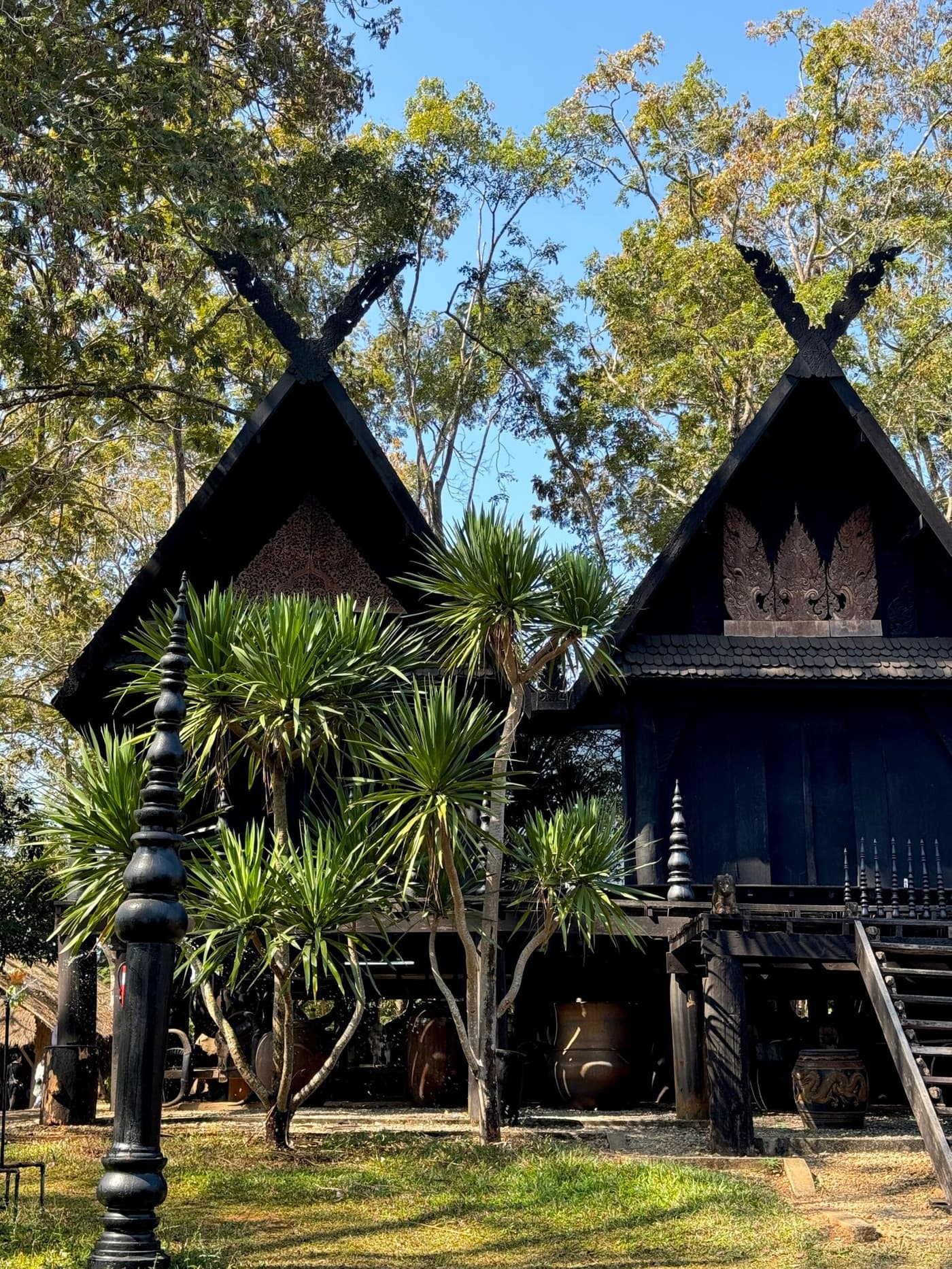
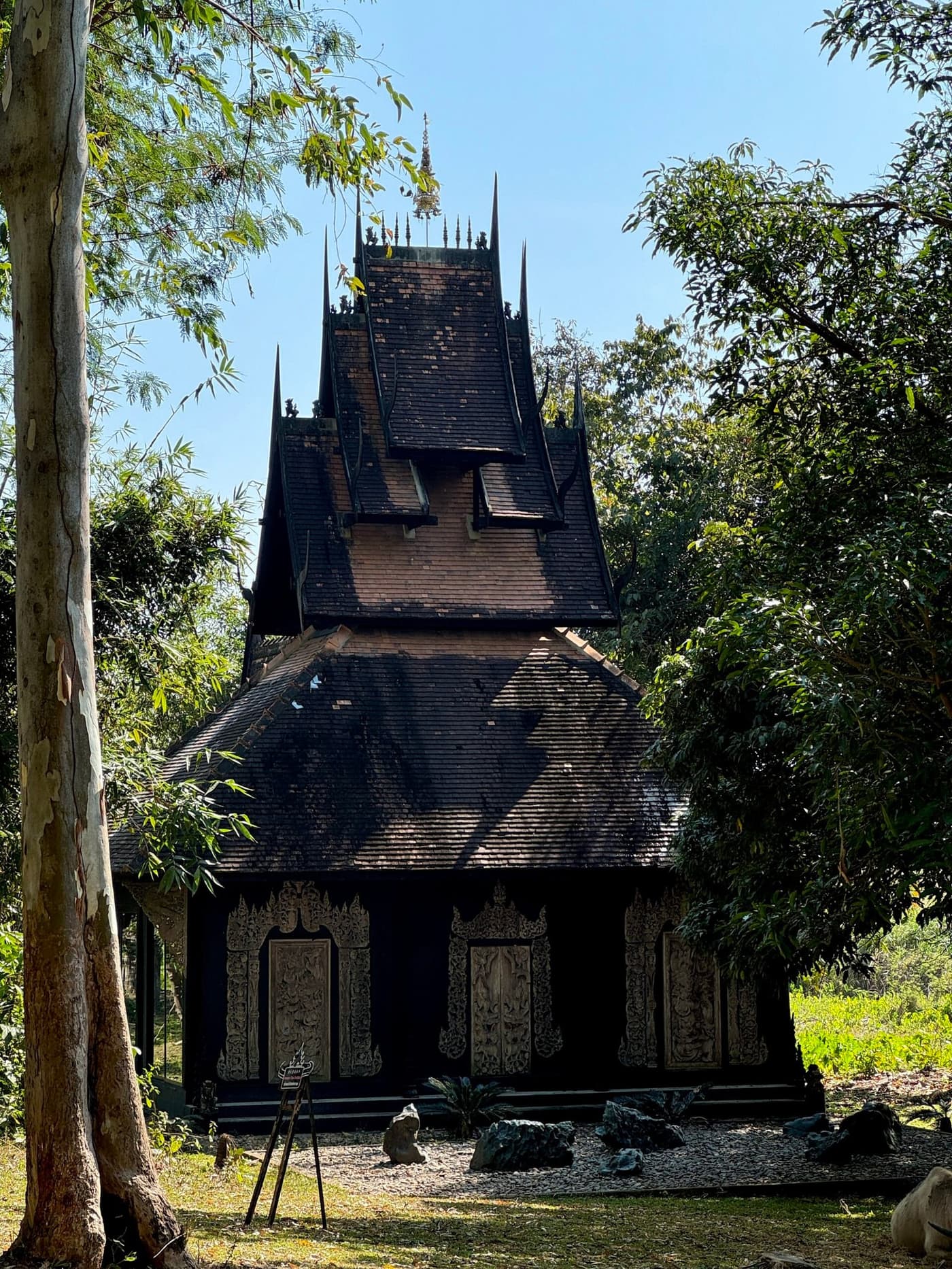
The grounds are a large park with 40 structures of different sizes. The main ubosot stands in the center: a tall building with a steep dark roof in the Northern Thai style. The other buildings are studios, galleries, the artist's living quarters, barns and bathhouses, all in one consistent dark style: black wood, black roof tiles, dark red details.
The architecture draws on the Lanna tradition, but condensed to the extreme: where an ordinary Thai temple is white and gilded, here everything is dark and heavy.
What to See Inside
There are 40 structures on the grounds, and not all of them are equally interesting. Here is what to look at first.
The Main Ubosot
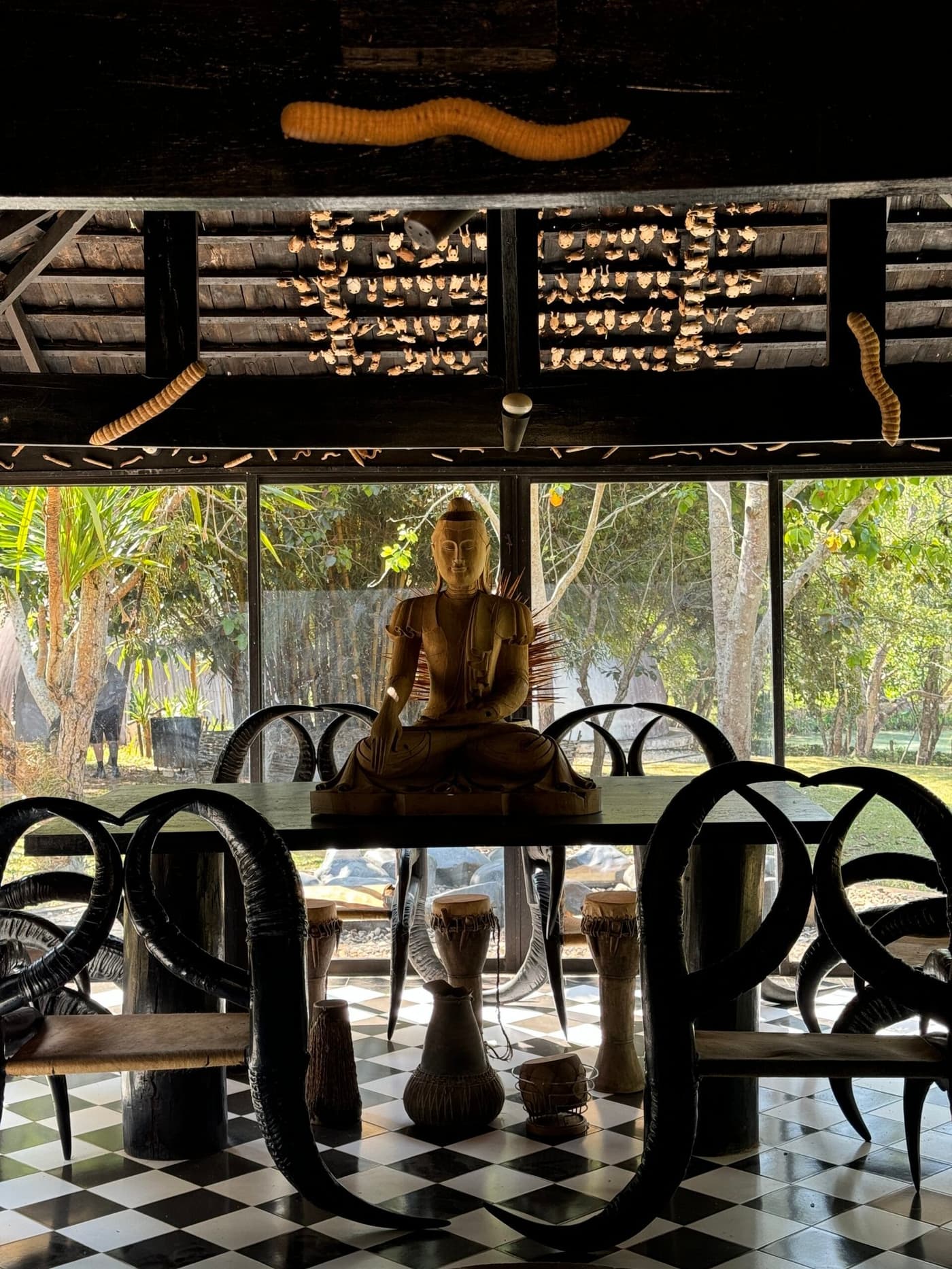
This is the most impressive building and the center of the grounds. The main exhibition is inside. The detail everyone notices is a long table made of the spines of large animals, which works as either a dining table or an altar, depending on how you look at it. The chairs are covered in crocodile hides. The walls are hung with snakeskins, horns and skulls.
This is neither kitsch nor gore for its own sake. The materials are real, but the way they are used is artistic. Every object is thought through and placed with intention. Duchanee collected these items over the years: some he bought, some he made himself.
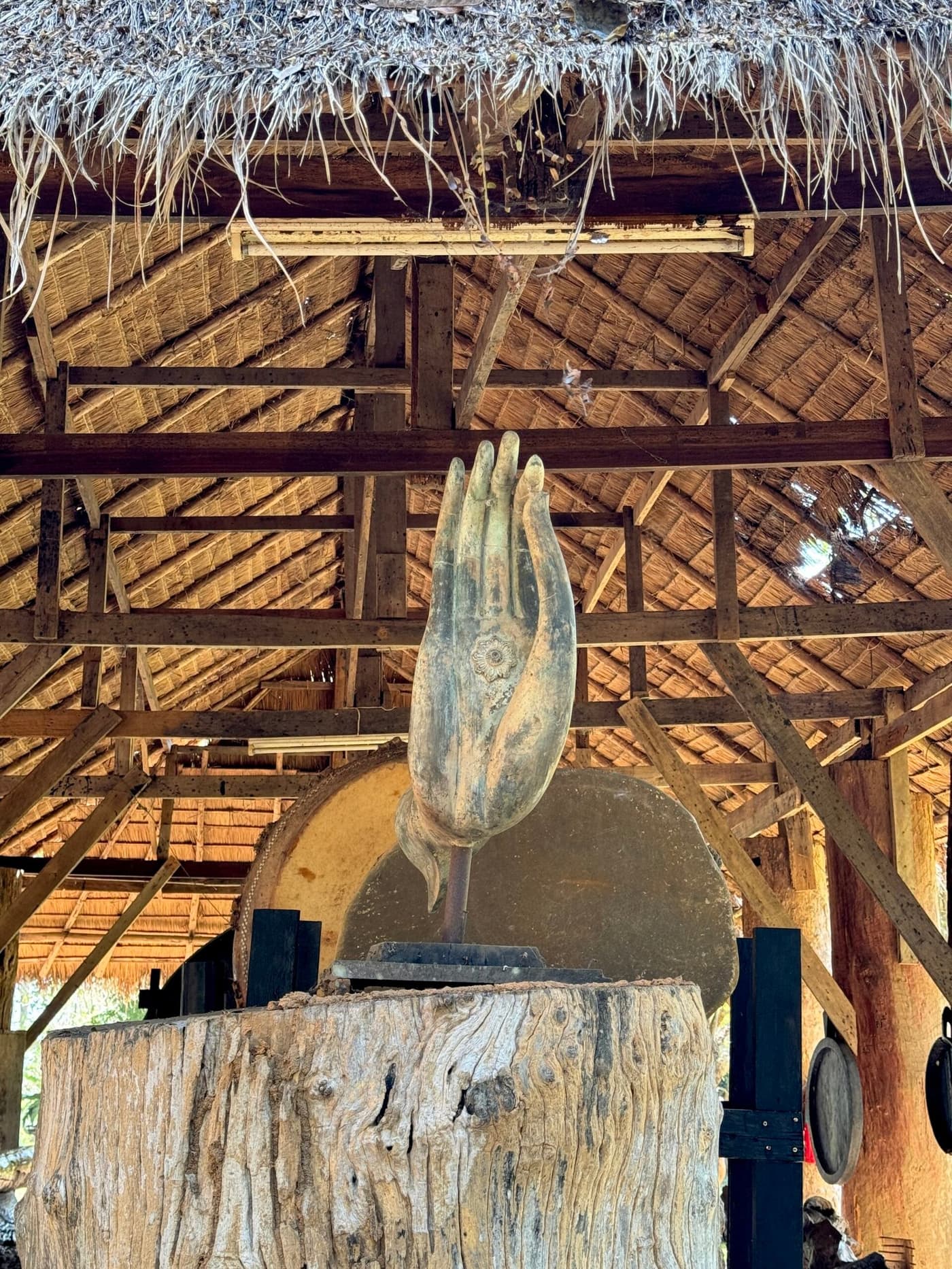
Next to the ubosot stands a white statue of the Buddha. The contrast is deliberate: light and dark, calm and power, two poles that Duchanee kept in dialogue all his life.
Other Buildings
The grounds have many smaller structures: wooden galleries with paintings (Duchanee was also a painter, with a distinctive style of dark, saturated colors and Buddhist motifs), studios, and bathhouses with wooden benches. Some hold additional sculptures and installations.
You can walk into many of the buildings, and the doors are open. Some are locked: these are private spaces preserved as they were.
Garden and Ponds
Ponds and a garden surround the grounds. There is fish in the ponds and there are wooden sculptures along the banks. It is a pleasant place to stroll between the buildings. The atmosphere is dense but not oppressive.
Thawan Duchanee's Paintings
Besides the architecture and sculpture, Baan Dam holds a substantial body of Duchanee's own paintings. His canvases are an artistic world of their own: large formats, a dark palette with flashes of ochre and red, and figures on the border between abstraction and Buddhist iconography.
Several galleries on the grounds display works from different periods. In the early ones the influence of his European training is clear: dense paint and an almost brutal texture. In the later ones there are more and more Thai motifs, such as the naga, the Buddha and scenes from the Jataka tales, but handled in the artist's personal language, far from canonical images.
If you are interested in painting, Baan Dam is worth more time than the average visit: it is not just a backdrop for the sculptures but a full retrospective.
The Philosophy of the Space
Duchanee built Baan Dam on purpose as a counterweight to the Buddhist tradition of whiteness and light. An ordinary Thai temple is light tones, gilding and flowers. Baan Dam is dark wood, bones, hides and enclosed spaces.
The artist explained this not as an anti-Buddhist stance but as a complement: if a temple speaks of enlightenment and peace, Baan Dam speaks of what comes before them. Death, flesh and primal force are not fear but honesty. "I want people to think about life, not about the afterlife" is roughly how he put his goal.
Next to the main ubosot, where everything is at its darkest, stands a white statue of the Buddha. This is not a mistake and not contrast for contrast's sake; it is a dialogue. Two poles of one reality.
How to Get to Baan Dam from Chiang Mai
The Black Temple is 10 km from the center of Chiang Rai.
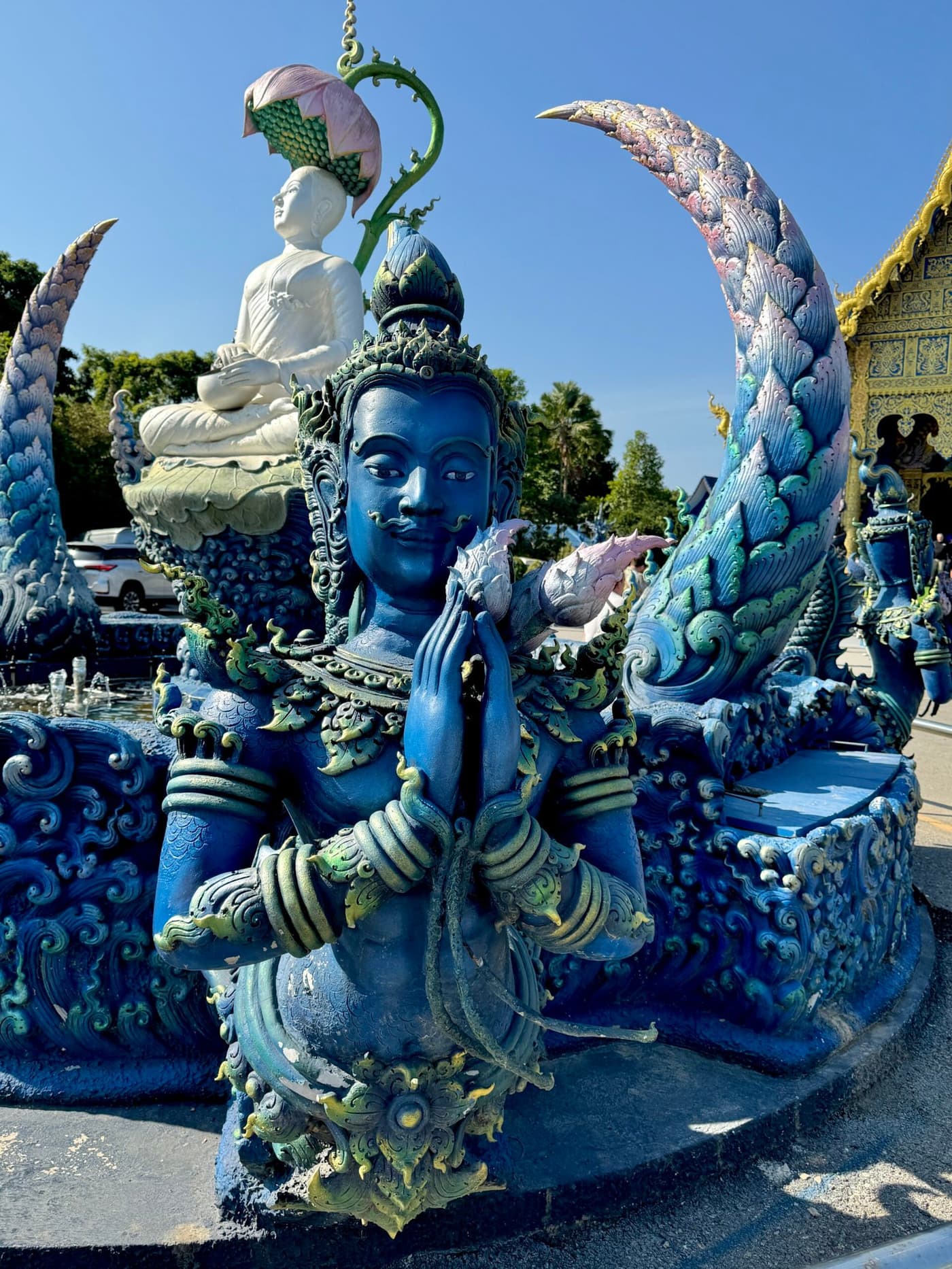
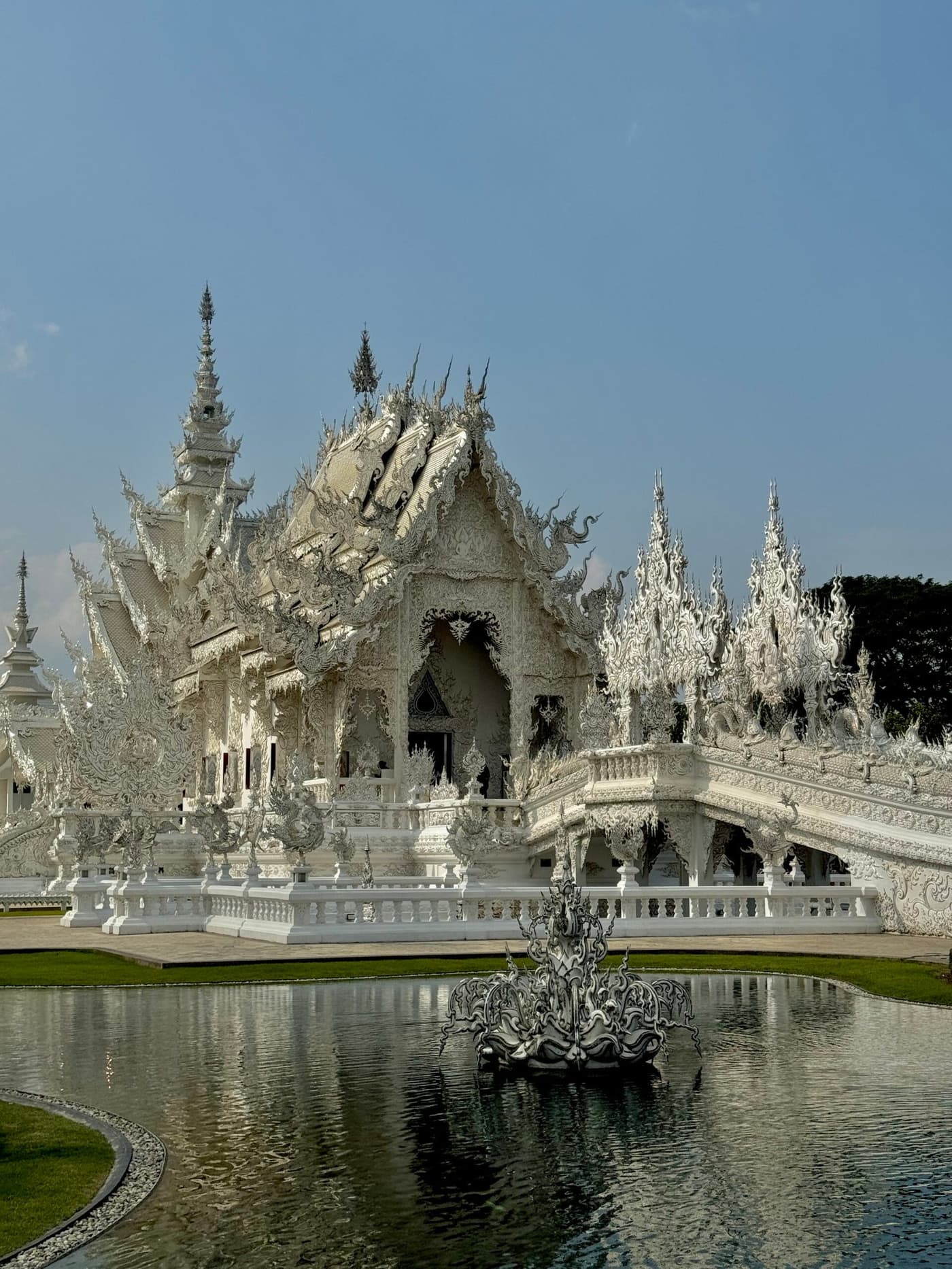
By car or motorbike — about 2.5 to 3 hours from Chiang Mai. Parking at Baan Dam is free and large. We covered other interesting places in Chiang Rai in a single day: the Blue Temple, the White Temple and Baan Dam.
Bus plus local transport — there is a bus from Chiang Mai to Chiang Rai (3 to 4 hours, about 150 baht, tickets on 12go.asia). From the Chiang Rai bus station to Baan Dam, take a songthaew or a taxi, about 10 to 15 minutes.
Tour from Chiang Mai — "three temples of Chiang Rai" tours. You can find options on Klook.
Opening Hours and Prices
- Opening hours: daily from 9:00 to 17:00
- Entry: 80 baht
- Parking: free
Baan Dam closes earlier than the Blue Temple. If you plan to see all three in a day, start with the Blue Temple (opens at 7:00), then the White Temple (until 17:00), then Baan Dam (also until 17:00, so you can make it).
Photography on the Grounds
You can shoot almost anywhere at Baan Dam; it is not a religious site with strict restrictions. It is dark inside some buildings: raise your ISO or use flash. But turn off auto flash at the entrance to the main ubosot: the harsh light kills the gloomy atmosphere that Duchanee created on purpose.
The best light outdoors is in the morning and after 15:00: dark wood looks more three-dimensional in side light. At noon the contrast is harsh and the details disappear into shadow.
The ponds reflect the buildings, and if you shoot from low down at the edge of a pond, you get unusual frames with a mirror reflection. It is worth experimenting.
How Much Time You Need
At least 1 hour to walk through the main ubosot and around the grounds. An hour and a half to two hours if you read everything carefully and go into every open building. You can't hurry here; it is the kind of place where you want to stop and look.
Where to Eat Near Baan Dam
Right by the parking lot and on the grounds there is a small cafe with Thai food. The menu is simple: fried rice, noodles, drinks. Prices are standard, 80 to 120 baht. It works for a light snack between temples.
The center of Chiang Rai is 10 km away and has far more options. If you are doing the "three temples" route, you will usually finish the White or Blue Temple around lunchtime and head back to the city, so have lunch there. Chiang Rai is small, and its restaurants are concentrated around the central square and along the Kok River. There is a separate article with more about Chiang Rai.
As for local food in Chiang Rai: khao soi is here too, as everywhere in the north. The local specialty, khanom jin nam ngiao (noodles in a tomato broth with pork ribs), is less common than in Chiang Mai, but you can find it at roadside stalls.
Visiting Tips
Cash: the entry fee is paid at the ticket booth, and cards are not accepted. Shoes come off at the entrance to the main ubosot. The dress code is moderate: covered shoulders and long pants are appreciated.
Children may find the place creepy: skulls, hides, dark halls. Some kids like it, others get frightened. There are many 18+ exhibits on the grounds. Keep this in mind.
There are more tourists on weekends and almost none on weekdays. If you want some time alone in this space, go on a weekday.
Baan Dam and the White Temple: Why See Both
People often set them against each other: white vs. black, light vs. darkness, Kositpipat vs. Duchanee. It is a simplification, but there is some sense in it.
The White Temple (Wat Rong Khun) is being built by a living artist who has not yet finished his project. It is bright and ironic, with pop-culture references and a glossy finish. There is a huge flow of tourists, a row of vendors in the parking lot, and a line for the bridge.
Baan Dam is the legacy of someone who has died. The space is finished and left as it is. Quiet and dense, with no irony. Commerce is minimal. There are fewer people.
Together they give you the full contrast of contemporary Thai art: two artists of the same generation, two different strategies for working with Buddhist themes. If you can only go to one, choose the White Temple. But if you have a day for all three, Baan Dam gives you a final chord that is hard to forget.
Context: Why This Place Matters
Thailand has many Buddhist temples, and that is normal in itself, since it is a religious country. But Baan Dam stands out: it is a private art project that the artist dedicated not to the Buddha or the king but to his own artistic exploration of life and death. In the Thai context this is rare.
Thawan Duchanee was part of a generation of Thai artists who left to study in Europe in the 1960s and 70s and came back with a fundamentally different view of what art is. Most of his contemporaries worked in the galleries of Bangkok. Duchanee went back to his home region of Chiang Rai and built a whole world there.
Baan Dam now operates as a private museum, but the original idea, a place for the artist to live and work, has been preserved. His personal belongings, studios and living quarters have been left as they were.
I filmed a YouTube episode about our trip from Chiang Mai to Chiang Rai and how we saw the most interesting places that few people get to.
Frequently Asked Questions
Where is the Black Temple (Baan Dam)?
10 km from the center of Chiang Rai, in Chiang Rai province in northern Thailand.
How much does entry cost?
80 baht. Parking is free.
When is it open?
Daily from 9:00 to 17:00.
Is it a real temple?
No, it is an art museum. The Baan Dam Museum was created by the artist Thawan Duchanee as a space for his sculptures and installations, not as a religious site.
Who is Thawan Duchanee?
One of the greatest Thai artists of the 20th century. He studied in the Netherlands and exhibited in Europe. He worked on Baan Dam from the 1970s until his death in 2014.
Is it worth going if you have already seen the White Temple?
Yes, they are fundamentally different. The White Temple is bright and mirrored, with pop culture. Baan Dam is dark and dense, with a serious artistic context. Together they give the full contrast.
Is it suitable for children?
It depends on the child. Skulls, hides and dark halls: some children are fascinated, others frightened. There are many 18+ exhibits on the grounds. Keep that in mind.
How much time do you need?
1 to 2 hours, depending on your pace. Seeing the whole grounds without rushing takes 1.5 hours.