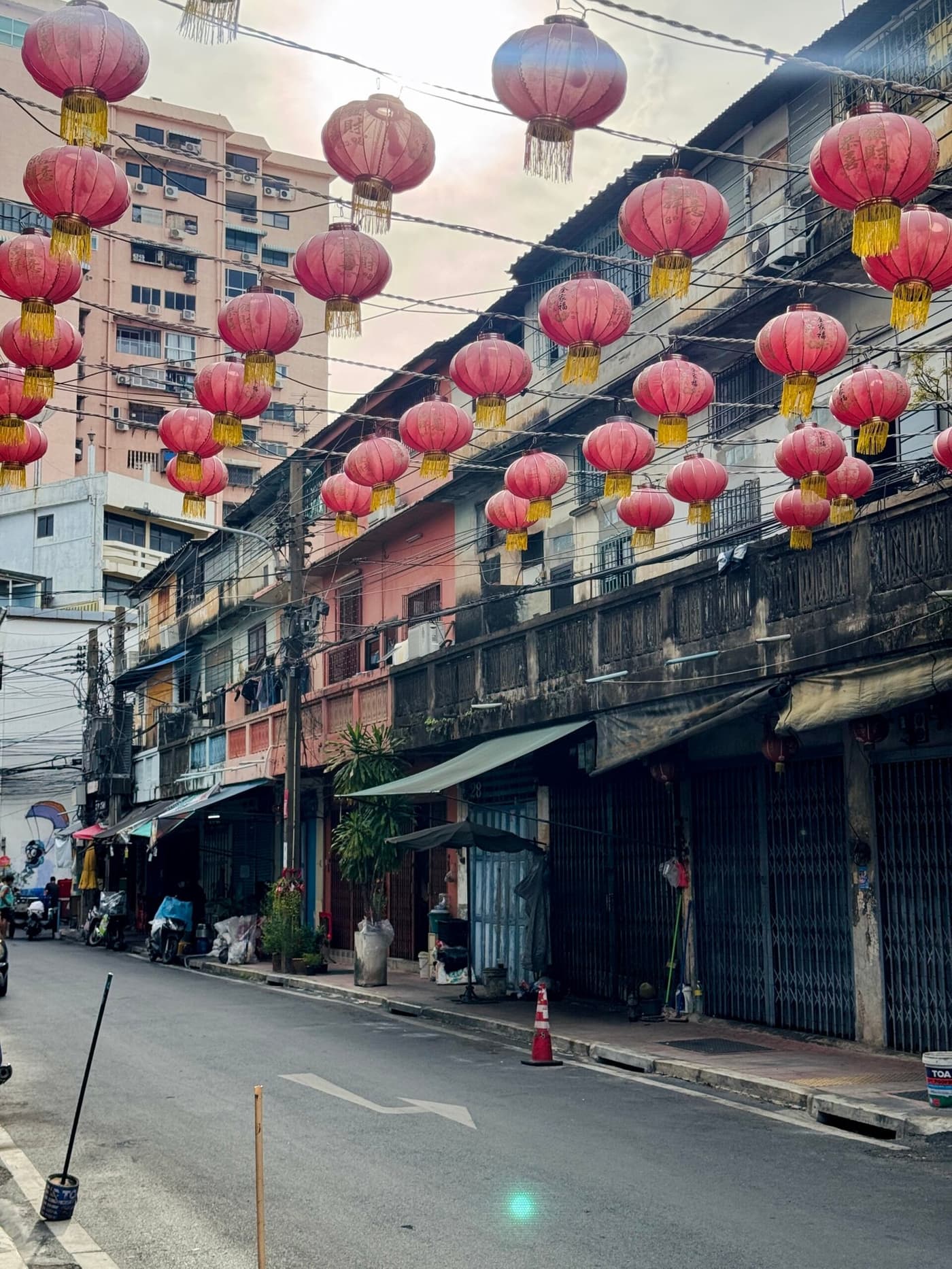
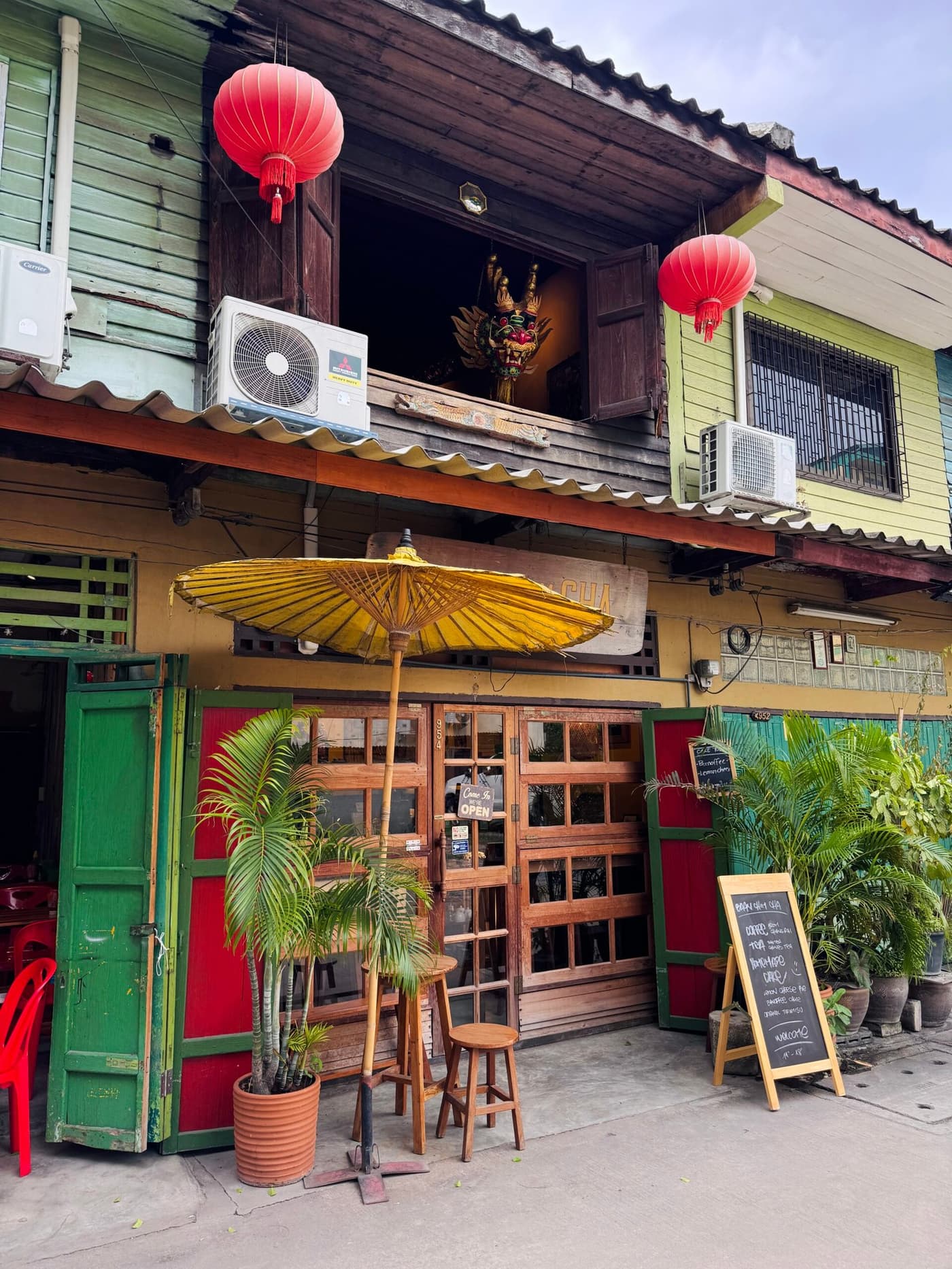
Talat Noi is a neighborhood just steps from Chinatown that most tourists walk right past on their way from the Golden Buddha temple to Yaowarat Road. That's a mistake. On a single street here you'll find a rusty Fiat 500 next to street art, an old Chinese shrine beside a workshop where engines are being rebuilt, and a former warehouse serving coffee with a view of the Chao Phraya.
The name means "little market." Portuguese settlers sailed here from Ayutthaya in the 18th century, Hokkien Chinese traders settled after them at the turn of the 18th and 19th centuries, and the neighborhood has lived at the crossing of three cultures ever since. People still live in the houses along the river, and the garages still repair engines.
Below is the route I put together and walked myself: what to see, in what order to go, what it costs and when each place opens.
If you're only planning your trip to Thailand's capital, I recommend my detailed Bangkok guide.
The History of Talat Noi
Portuguese settlers made their home here as early as the 1700s and brought Catholicism with them, which is why there's a Gothic church in the middle of the neighborhood alongside the Buddhist and Chinese temples. From the late 18th to the early 19th century, Chinese merchants from Fujian province were drawn to the river, and thanks to a convenient landing on the Chao Phraya, Talat Noi quickly became one of the main trading hubs of old Bangkok. That's where its name comes from.
Today's contrast is a natural layer of new life on top of the old: since the mid-2010s, young Thai entrepreneurs have been opening cafes and art spaces right inside the historic buildings, without pushing out the longtime residents.
How to Get There and How Much Time to Plan
By metro — The easiest way is to take the MRT (blue line) to Hua Lamphong station, exit 1 or 2, then walk 10 minutes west to the river.
By boat — If you're combining the walk with Wat Arun, Wat Pho or a stroll along the waterfront, take the Chao Phraya Express ferry (orange flag) to Marine Department Pier (N4) or Si Phraya Pier (N3), then walk a few minutes.
By taxi or Grab — Possible, but on the narrow lanes (sois) you're often dropped a couple of minutes' walk from where you want to be. The neighborhood is mostly pedestrian, apart from motorbike taxis.
Allow a couple of hours for an unhurried walk of the route. If you want to stop in several cafes and take your time with the murals, it can easily stretch longer. Some places here are closed on Mondays, so it's best to plan the walk for Wednesday through Sunday.
The Route: Which Order to Go In
Below is a route through the neighborhood from the MRT to the river, in the order that's easiest to follow without doubling back.
Starting Point: Sunset Coffee Roaster
A cafe serving brunch at 741 Charoen Krung Road, a couple of minutes from exit 1 of Hua Lamphong MRT. Open daily from 7:30 to 17:30. Good coffee from beans sourced around the world, plus desserts.
Talat Noi Museum
A three-story museum about the history of the area (Talad Noi Museum). It opened quite recently, so compared with the other sights it's the newest point on the map. Hours: Tuesday to Friday 8:30–16:30, Saturday, Sunday and public holidays 10:00–18:00. On the first weekend of every month, the "Talakkia Friendly Market" flea market is held outside the museum.
Chow Sue Kong Shrine
The oldest Hokkien place of worship in Bangkok (Chow Sue Kong), built in 1804 in the style of Qing-dynasty China. The shrine was originally built in memory of a revered local doctor. Open daily from 7:00 to 16:00, free entry.
The Rusty Fiat 500
Near Chow Sue Kong stands an abandoned rusty Fiat 500, so overgrown with plants that it looks like a turtle shell. Technically it's just an old car in the middle of the street, but it has become the symbol of the neighborhood on Google Maps. There's honestly nothing remarkable about it, but it's worth walking past for a photo (location of the rusty turtle Fiat).
Siang Gong Workshops
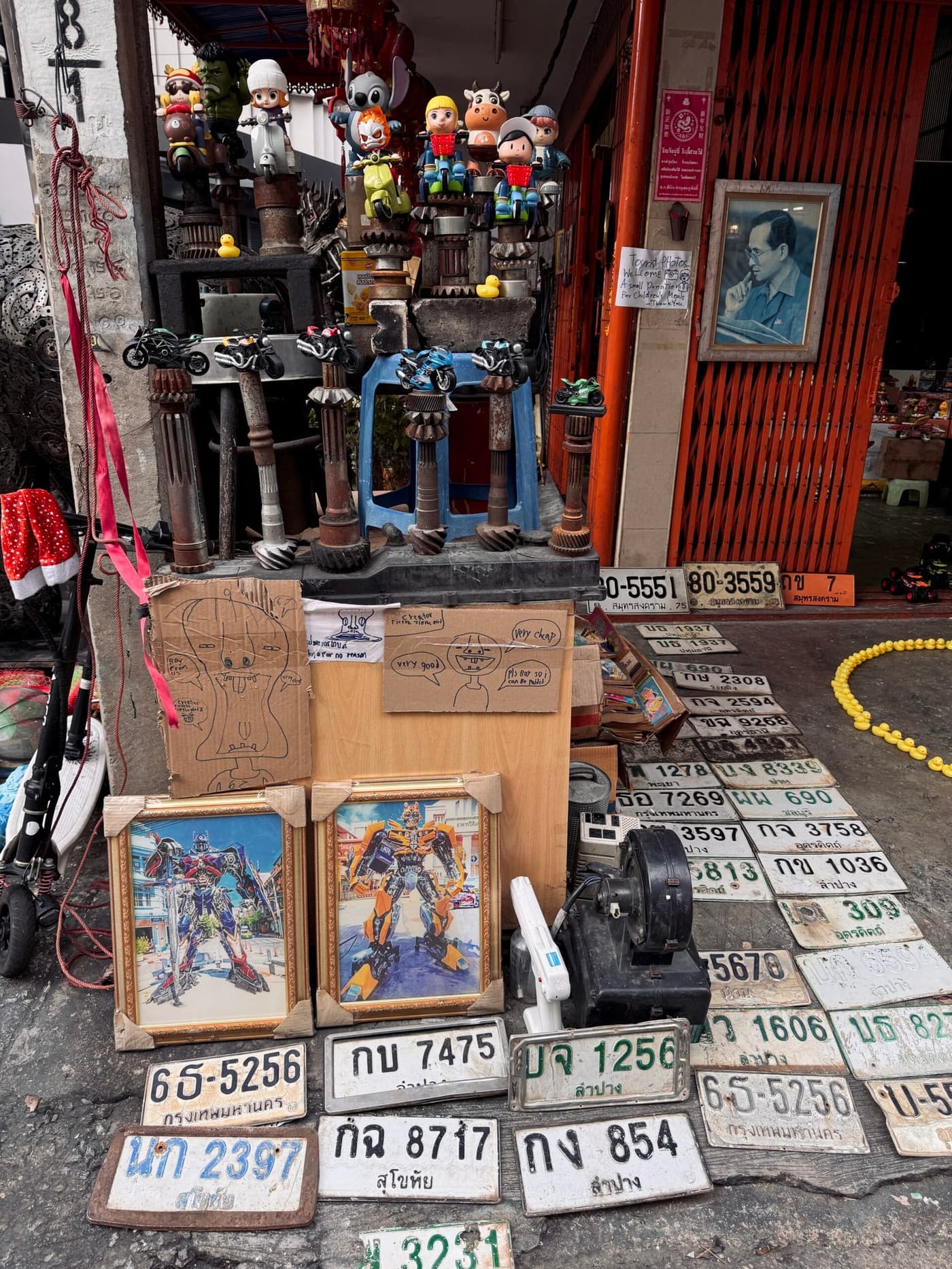
A district of auto workshops and scrap-metal dealers on Soi Wanit 2, with stacks of gearboxes and engines right on the sidewalk. People genuinely work here, so look without getting in the way and don't walk deep into the workshops without an invitation.
Mother Roaster, the Cafe Above the Scrapyard
A cafe on Soi Charoenkrung 22 (no. 1172) with a wooden interior and some of the best coffee in the neighborhood. You enter by a graffiti-covered staircase straight from the courtyard of an auto workshop, and if you don't know in advance, it feels like you're going the wrong way. The cafe is open Wednesday to Sunday, 10:00 to 18:00, and closed on Monday and Tuesday.
Trok San Chao Rong Kueak Alley
It connects the workshops with the river and is considered the main street-art alley of Talat Noi. The murals here have been refreshed regularly since the 2016 Buk Ruk festival, so the specific works change from year to year, but the concentration of art per square meter is still one of the highest in the city.
Hong Wong Shrine (Rong Kueak)
At the end of the same alley, Trok San Chao Rong Kueak. A riverside Hakka-style shrine with an octagonal entrance and a tower with a view of the Chao Phraya, built during the reign of Rama V. Open daily from 7:00 to 17:00, free entry.
Sohn Heng Tai Mansion
A Chinese mansion about 200 years old on Soi Wanit 2, with an inner courtyard and a second floor built entirely from teak without a single nail. On the ground floor there's a pool added in 2004, and on weekends a freediving school unexpectedly operates right in the courtyard of the antique house. Entry is 50 baht, and that amount is credited toward drinks at the cafe by the entrance. Open daily 9:00–18:00, except Monday. You need to take off your shoes on the second floor, and the floors are uneven in places, so watch your step.
Hong Sieng Kong, a Cafe in a House With History
A restored house about two centuries old on Soi Wanit 2 with a river view, antique furniture and a signature coffee made with sweet potato or coconut milk. Open Tuesday to Sunday from 10:00 to 20:00. Location of the Hong Sieng Kong cafe.
Timo and Tintin, a Loft Cafe with a River View
A loft cafe in a converted shophouse on Soi Wanit 2 (location) with a rooftop terrace and river views, plus a small art gallery inside. Hours: Tuesday to Friday 9:00–17:00, Saturday and Sunday 9:00–18:00.
Holy Rosary Church
A Catholic church founded by the Portuguese community in 1787; the present neo-Gothic building dates from 1891–1897. It's open to visitors daily, with free entry, and you can take photos as long as you don't disturb people who came to pray. The best time to visit is closer to sunset, when light comes through the stained glass. If you arrive during a service, it's best to check the schedule on site, and visitors are asked not to take photos inside before a service begins.
End of the Route: The Pier
From the church it's a few minutes' walk to Si Phraya (N3) or Marine Department (N4) piers. From here it's easy to continue by ferry along the river: north toward Wat Arun and Wat Pho, or across to the other bank toward ICONSIAM.
Where to Eat Along the Way
- Kway Teow Roo (Noodle in the Hole) — A legendary street noodle shop tucked into a tiny alley. Known for its egg noodles and homemade fish balls. The atmosphere of real old Bangkok, and a portion costs around 50–60 baht. (location)
- 32 Bar Specialty Chocolate — a cafe next to the rusty Fiat 500. An unusual cafe in a very old building selling Thai craft chocolate, from 60 baht a bar. (location)
- Mother Roaster Talat Noi — One of the most iconic specialty cafes in the area. It's on the second floor of an old garage, above a junkyard stacked with car parts. A mix of industrial heritage and hipster culture (location).
- Khun Phu Curry Puff — For more than 30 years they've been making crispy flaky pastries by hand, filled with chicken and curry, taro or sweet coconut. They cost 9–10 baht each. (location)
- Naam 1608 — a restaurant right on the river serving Thai curries, with gorgeous views. Beautiful and tasty, but fairly pricey. (location)
- Citizen Tea Canteen — A bright cafe in a traditional wooden house, created by the local brand Citizen of Nowhere. Here you'll find several kinds of Thai milk tea from different regions of Thailand, plus handmade sweets and pastries. (location)
Practical Tips
This is a residential neighborhood. All along the route are ordinary homes where families have lived for three or four generations. When you photograph facades and murals, don't point your camera into open doors and windows, and certainly don't ask workshop owners to pose unless you've bought something or asked permission.
Shoes for uneven sidewalks. The streets here are narrow, with rough surfaces in places, and some buildings have high thresholds. Wear sneakers or comfortable sandals for the walk.
Heat. The route has almost no shade, so wear light but covered-up clothing or use sunscreen. Be sure to bring a hat.
Combine it with Chinatown. Talat Noi connects to a walk along Yaowarat and Song Wat Road, which also has plenty of street food, color and murals.
Monday is the worst day. Many places, sights and cafes are closed on exactly that day, so it's best to plan the walk for Wednesday through Sunday.
My latest vlog from Bangkok
Talat Noi FAQ
How much time do you need in Talat Noi?
At least 2 hours to see the main points, if you want to stop in cafes and not rush your photos. At a relaxed pace, 3 hours.
How do you get to Talat Noi?
The easiest way is the MRT to Hua Lamphong station, then a 10-minute walk. You can also take the Chao Phraya Express ferry to Si Phraya Pier (N3) or Marine Department Pier (N4).
What's the best day to visit Talat Noi?
Wednesday through Sunday. On Mondays the Sohn Heng Tai mansion and the local cafes Hong Sieng Kong and Mother Roaster are closed (Mother Roaster is also closed on Tuesday).
Do you have to pay to enter Talat Noi?
Walking the streets and alleys is free. The only paid entry is the Sohn Heng Tai mansion, at 50 baht.
Is it worth combining Talat Noi with Chinatown?
Yes, it's a logical continuation of the same walk. From Talat Noi to Yaowarat Road and Song Wat Road is a 10–15 minute walk via Charoen Krung.
Is it safe to walk around Talat Noi?
Yes, it's a quiet residential neighborhood with no particular risks. The main recommendation is to respect the privacy of local residents and not walk deep into courtyards and workshops without an invitation.
What's the most photogenic spot in Talat Noi?
The rusty Fiat 500 near the Chow Sue Kong shrine is the neighborhood's most hyped spot, plus the murals in Trok San Chao Rong Kueak alley and the river view from the Timo and Tintin terrace.