Malaysia is a Southeast Asian country in two parts: a peninsula between Thailand and Singapore, and the northern part of the island of Borneo. In a single trip you can see the skyscrapers of Kuala Lumpur, the colonial quarters of Malacca and George Town, tea plantations in the hills, islands with reefs, and jungle with orangutans. In infrastructure and English, Malaysia is closer to Singapore; in prices, closer to Thailand. The beaches are weaker than Thailand's and alcohol is expensive, so a pure beach holiday is not its strongest side.
Entry is simple. When I checked in October 2026, eligible passports got a stamp for 30 days at the border with no visa, and you fill in the MDAC electronic arrival card in advance. Rules depend on your passport, so confirm them with the Malaysian immigration authority before you book. When to go depends on the coast: in the west (Langkawi, Penang) December to March is best, in the east and on Borneo it is March to September. A budget trip, not counting the flight, costs roughly 150-250 ringgit per person per day, which is about $35-60.
Below I go through everything in detail and in order: regions and what to see in each, seasons, routes, transport, prices, food, local rules and safety. At the end, how to stay in the country longer on the DE Rantau digital nomad visa or the MM2H program. I checked all the data before writing, in October 2026.
Malaysia at a glance
| Parameter | Data as of October 2026 |
|---|---|
| Capital | Kuala Lumpur (the government sits in Putrajaya) |
| Population | 34.4 million people |
| Structure | a federation of 13 states and 3 federal territories |
| Two parts of the country | Peninsular Malaysia, and Sabah and Sarawak on the island of Borneo |
| Currency | Malaysian ringgit (MYR, RM) |
| Exchange rate | 1 USD ≈ 4.09 MYR |
| Visa | checked in October 2026: 30 days without a visa for eligible passports, MDAC required |
| Time zone | UTC+8 |
| Languages | Malay is official, English is understood almost everywhere in cities |
| Religion | Islam is the state religion, but there are large Buddhist, Hindu and Christian communities |
| Plugs | British type G, 240 V |
| Emergency number | 999 |
| UNESCO sites | Malacca and George Town, Kinabalu Park, Gunung Mulu, Lenggong Valley, Niah Caves, FRIM forest park |
In the first half of 2026, 21.12 million foreigners visited Malaysia, and almost three-quarters of them came from neighboring ASEAN countries.
Malaysia is three cultures under one roof. Muslim Malays are the majority, while the Chinese and Indian communities have lived here for generations, each with its own neighborhoods, temples, holidays and cuisine. In a single food court you can order halal nasi lemak, Cantonese noodles with pork and a South Indian dosa. Nowhere else in the region offers this on the same scale; even Singapore has much the same, only pricier.
Pros and cons of Malaysia
I will start with what makes the trip worth it. The infrastructure is closer to Singapore than to Indonesia or Vietnam: decent roads, commuter trains, a fast train from the airport, clean shopping malls, and Grab almost everywhere. Shop staff, taxi drivers and hotel receptionists understand English. The food is varied, and you can eat well for 10-15 ringgit. The country has a megacity, UNESCO colonial towns, hills with tea plantations, islands with reefs, and the real Borneo jungle with orangutans. For eligible passports, all of it is possible without a visa.
Now the downsides.
The beaches on the west coast lose to Thailand's. In Penang the water at Batu Ferringhi is murky, and in Langkawi it is clean but lacks the turquoise of Phi Phi. For truly clear sea you go to the eastern islands or to Borneo, which means separate logistics and a seasonal window.
It is humid and hot all year. In Kuala Lumpur it is usually +31…+33 °C by day, and a downpour often comes in the afternoon. The city is hard to walk: sidewalks stop abruptly in places, and many distances that look short on the map are easier to cover by Grab.
Alcohol is expensive because of excise duties. A half-liter of beer in an ordinary Kuala Lumpur pub costs about 23 MYR, and a cocktail in a club is close to 40 MYR. The exceptions are the duty-free islands of Langkawi, Tioman and Labuan.
A 30-day visa-free stay (for eligible passports, as of October 2026) is short for a winter escape. Thailand has also allowed 30 days since September 2026, and Vietnam allows 45.
Local laws are stricter than in neighboring countries, which can take the fun out of it.
Entry requirements for Malaysia
When I checked in October 2026, eligible passports received a free 30-day stamp at passport control, with no visa. Your passport must be valid for at least 6 months from the date of entry. You need to fill in the MDAC electronic arrival card within 3 days before arrival, separately for each traveler, children included. Please confirm the rules for your own passport with the Malaysian immigration authority. Below is only what matters for planning.
MDAC: fill it in only on the official website
The Malaysia Digital Arrival Card is filled in on the website of the immigration service, imigresen-online.imi.gov.my, no earlier than 3 days before arrival. If you are asked for your card details, you are on the wrong site.
Extensions and visa runs
Extending the 30 days inside the country is possible only in special cases, such as illness or an accident: under the immigration department's rules you must apply in person at an immigration office with your passport, evidence of the reason and a confirmed onward ticket, and the officer decides. In practice almost nobody managed to extend their stay.
Most visa runs go to Thailand overland: from Penang through Bukit Kayu Hitam, or by train through Padang Besar to Hat Yai. Note that from September 15, 2026 Thailand's visa-free stay is 30 days for eligible passports and requires the TDAC card; details are in the article TDAC arrival card. Singapore is close, but check its entry rules for your passport before planning a bus from Kuala Lumpur to Singapore.
Borneo: bring your passport even on a domestic flight
Sabah and Sarawak have their own immigration control. If you fly from Kuala Lumpur to Kota Kinabalu or Kuching, take your passport with you, because there is a check after landing. The 30-day counter does not reset, since it is still Malaysia.
Getting to Malaysia
Most international flights land at KLIA, the Kuala Lumpur international airport. It has two terminals: Malaysia Airlines and full-service carriers use the first, and AirAsia uses the second (formerly klia2). The KLIA Transit train runs between them in about 3 minutes.
The fastest way from the airport to the center is the KLIA Ekspres to KL Sentral station, about 30 minutes. A ticket currently costs 55 MYR. From January 1, 2027 it will rise to 65 MYR, and a child ticket (ages 6-15) will cost 29 MYR. The bus is cheaper but takes an hour or longer because of traffic. Grab is handy if there are two or three of you with a lot of luggage: the app shows the price in advance, and it depends on the time of day.
When to go to Malaysia: seasons by region
Malaysia has no single high season for the whole country. Two monsoons set the weather, and the coasts run on opposite schedules. Air temperature barely changes: +29…+34 °C by day and +23…+26 °C at night. What changes is the amount of rain and whether boats run to the islands.
| Region | Best time | Difficult time |
|---|---|---|
| West coast (Langkawi, Penang, Pangkor) | December to March | September to October, the rainiest months |
| East coast (Perhentians, Redang, Tioman) | March/April to September | November to February, monsoon, some hotels closed |
| Sabah and Sarawak (Borneo) | March to September | November to February, more rain |
| Kuala Lumpur, Malacca, Ipoh | all year | April and October to November, frequent thunderstorms |
| Cameron Highlands | all year | +20…+25 °C by day, down to +14 °C at night |
Seasonality matters most for the eastern islands. From November to February the sea is rough around the Perhentians and Redang, boats run irregularly or not at all, and many resorts close. If you are flying to Malaysia in winter for the sea, your choices are Langkawi and Borneo on the Kota Kinabalu side.
Haze is a separate factor. In some years, most often from August to October, smoke from forest fires in Indonesia covers Kuala Lumpur and the west coast. Visibility drops and the air quality index reaches a level where it is better not to spend long outdoors. You can check it in an app or on the API Malaysia index site.
Holidays affect prices and tickets more than weather does. The big ones are Chinese New Year, Hari Raya Aidilfitri after Ramadan, and Deepavali. This is when half the country travels home, buses and trains sell out, and hotels at the resorts get more expensive. Ramadan in 2027 is expected from about February 8 to March 8-9. It hardly bothers tourists: restaurants are open, but it is impolite to eat on the street in front of people who are fasting, while the evening Ramadan bazaars are a food event of their own.
Where to go in Malaysia: regions and cities
Below are the main destinations, with what people go there for and how to get there. For a first trip, Kuala Lumpur, Penang or Malacca, and one beach spot are usually enough.
Kuala Lumpur
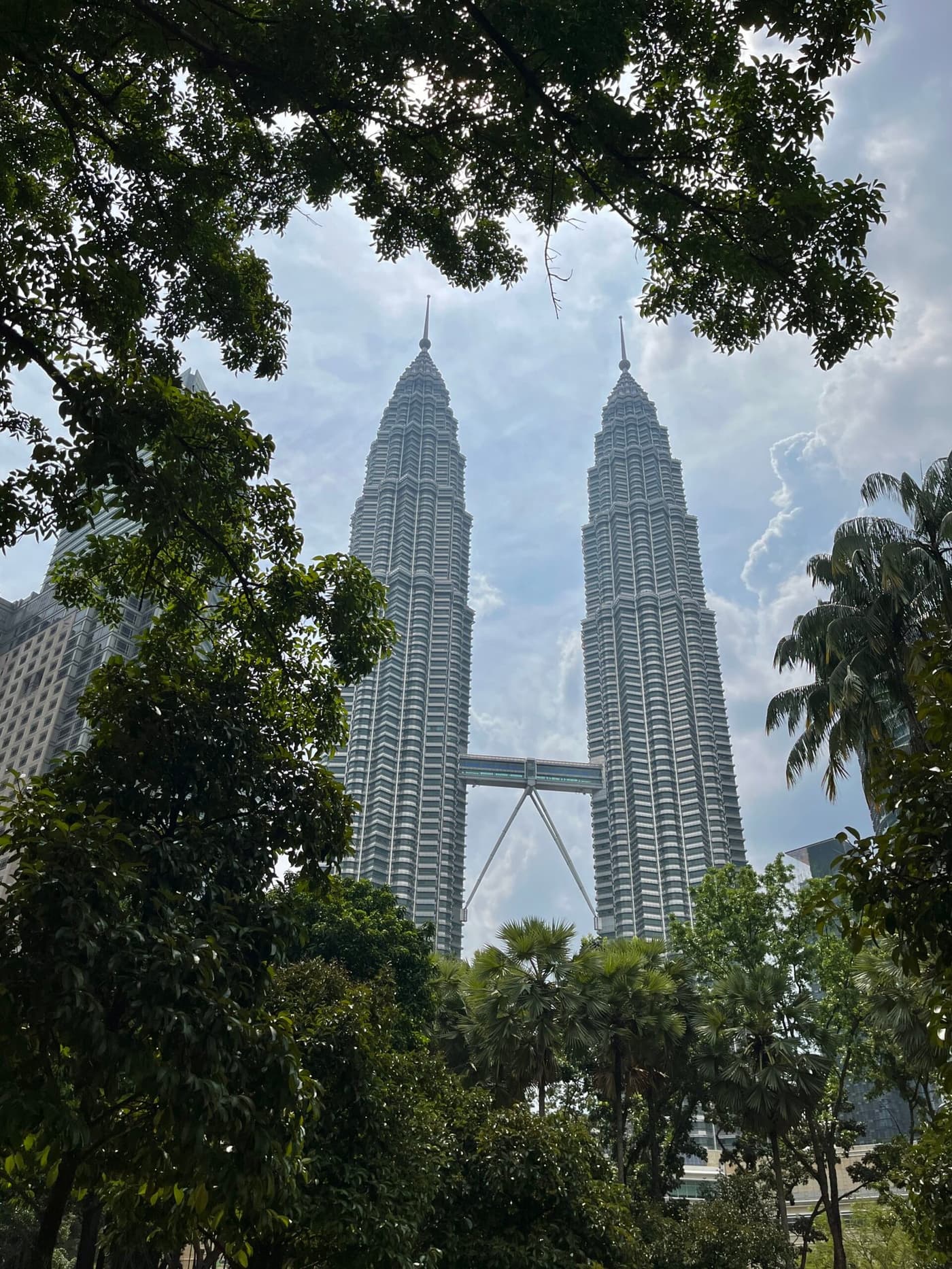
The capital is where you will almost certainly land. The city is vertical and colorful: the 452-meter Petronas Towers, right beside them the Merdeka 118 skyscraper, the second-tallest building in the world, and 30-40 minutes away by train, the Hindu Batu Caves. You need 3-4 days to see it without rushing.
The Petronas Towers, with the Skybridge on the 41st floor and the observation deck on the 86th, are the country's main symbol. Buy tickets in advance on the official website, because in high season they sell out several days ahead. I covered prices, opening hours and how to choose a slot in the article everything about the Petronas Towers.
Batu Caves: a staircase of 272 colorful steps leads to the main cave temple, past the golden statue of the god Murugan. Entry to the main cave is free, the Ramayana Cave costs 5 MYR, and Cave Villa costs 15 MYR for foreigners. The famous Dark Cave is closed to tours. Shoulders and knees must be covered. You can get there by KTM Komuter train from KL Sentral to Batu Caves station, about 30-40 minutes. In January-February the Thaipusam festival takes place here, when hundreds of thousands of pilgrims climb the hill.
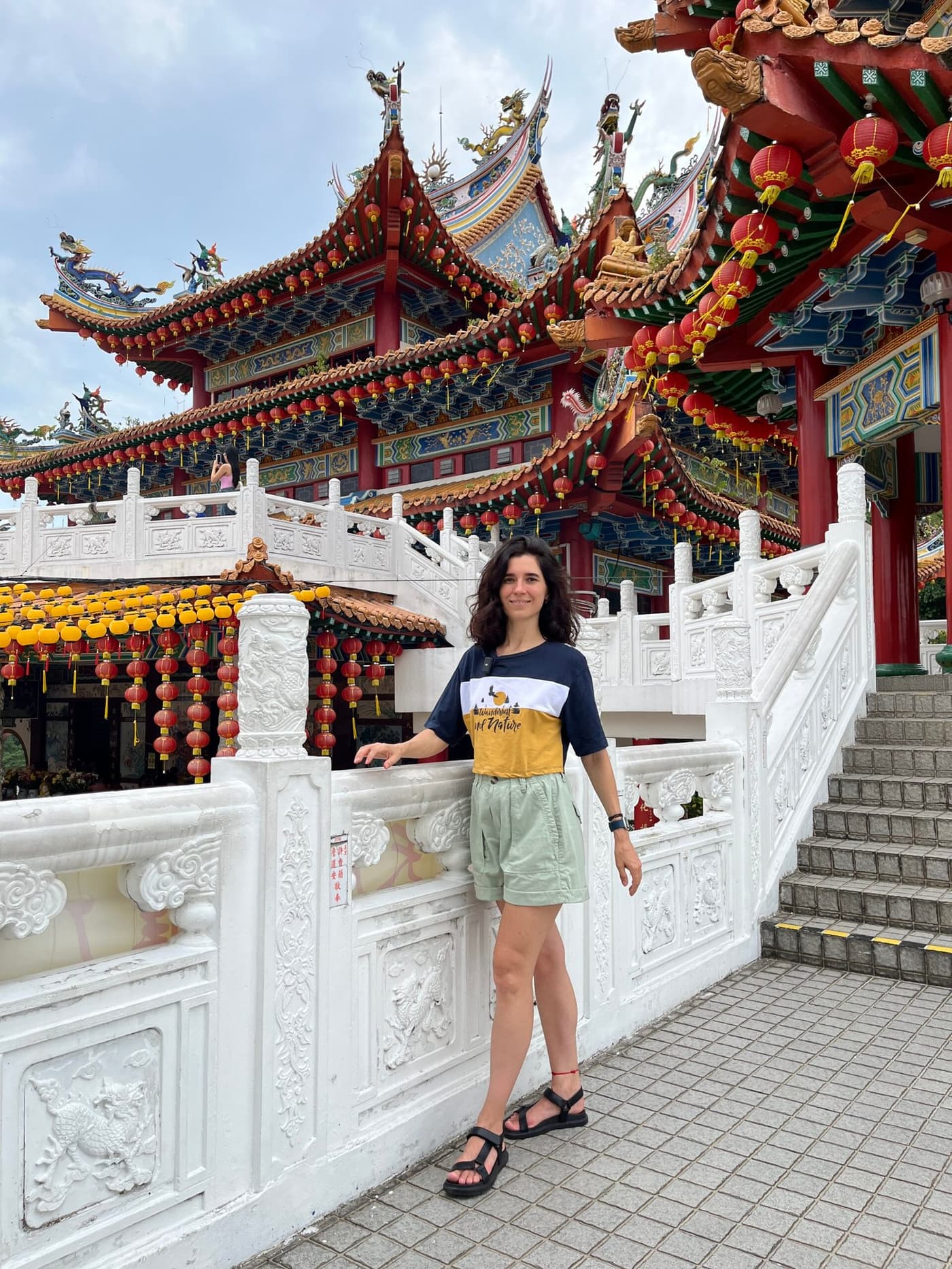
Thean Hou Temple is a six-tier Chinese temple on a hill with a view of the city, one of the most photogenic in the country. More in the article Thean Hou Temple in Kuala Lumpur.
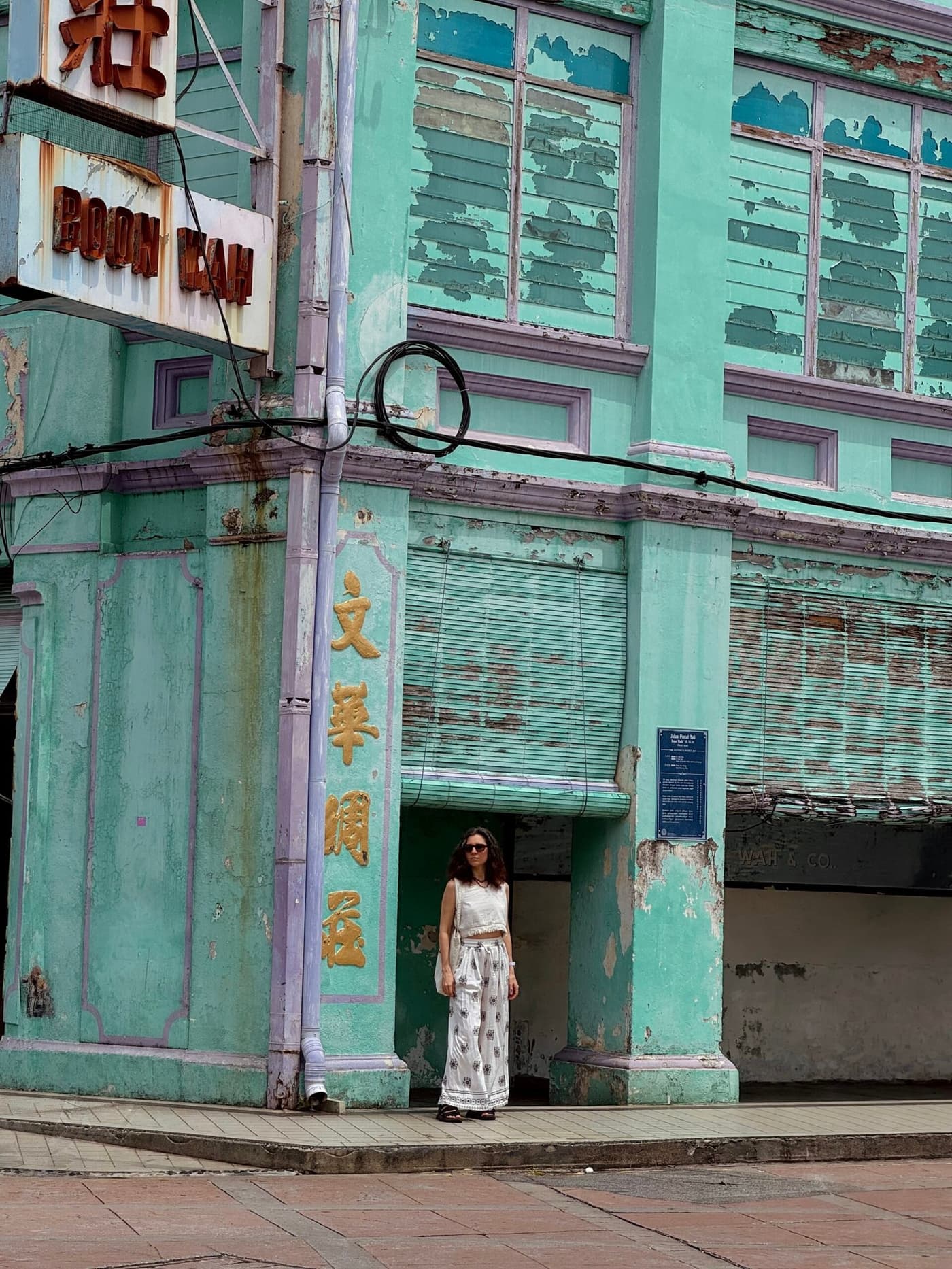
Most tourists choose to stay in Bukit Bintang. The area is packed with malls, bars and the street-food strip Jalan Alor. The KLCC area is next to the Petronas Towers, but it is pricier. Chinatown around Petaling Street is cheaper. Bangsar is more of a restaurant district and closer to an expat lifestyle. Districts, transport and prices are in the detailed Kuala Lumpur guide.
Genting Highlands
A mountain resort about an hour's drive from the capital: a casino (the only legal one in the country), a shopping mall, a theme park and the Awana Skyway cable car. It is cool at the top, around +18…+24 °C. If casinos and rides do not interest you, I would choose the Cameron Highlands over it for a trip from the capital, even though they are farther away.
Malacca
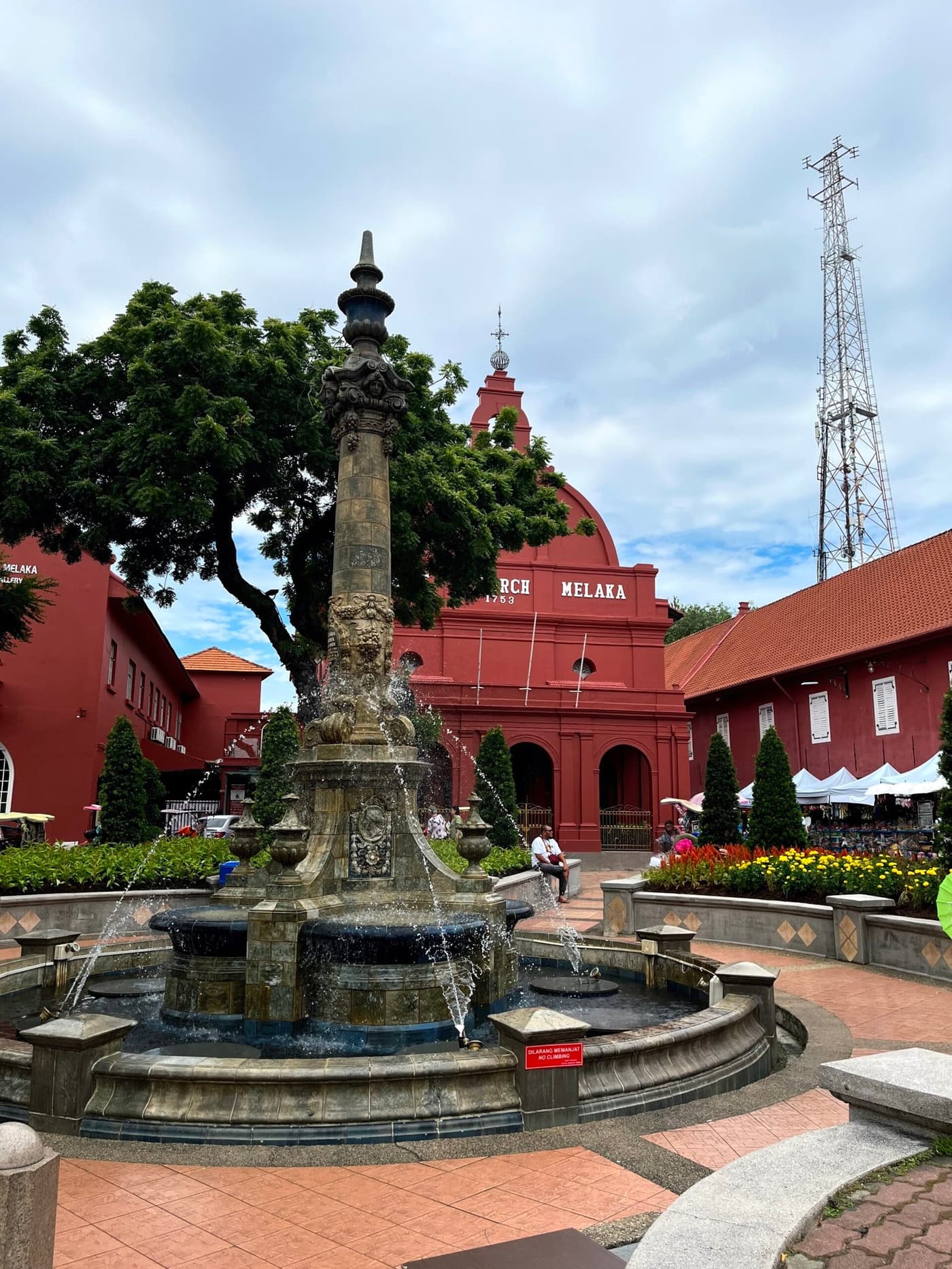
A port city two hours south of Kuala Lumpur by bus. In the 15th century it was a sultanate, in 1511 the Portuguese took the city, in 1641 the Dutch, and later the British. Something has survived from every era: the Porta de Santiago gate from the Portuguese fortress A Famosa, the red Dutch Stadthuys town hall of 1650, British churches. In 2008 the historic center, together with George Town, was added to the UNESCO list.
From Friday to Sunday evening, Jonker Street turns into a night market with street food. Try chicken rice served as rice balls and the local dessert cendol with gula melaka palm sugar. People usually visit Malacca for a day or with one overnight stay. Buses run from the TBS bus terminal in Kuala Lumpur several times an hour.
Ipoh
A city between Kuala Lumpur and Penang that many people drive past, and they shouldn't. It is the former capital of the tin rush, with a colonial old town, Concubine Lane, Buddhist temples inside limestone cliffs (Sam Poh Tong, Kek Lok Tong) and its own cuisine. Ipoh is famous for "white" coffee and chicken with bean sprouts. From Kuala Lumpur you can take the ETS train, about 2.5 hours, so it is a convenient overnight stop on the way to Penang.
Cameron Highlands
A plateau at about 1,500 meters where the British came to escape the heat. By day it is +20…+25 °C, and at night it can drop to +14, so bring a sweater. There are BOH tea plantations (the company was founded in 1929) with a cafe right over the slopes, strawberry farms, markets and trails through the "mossy forest". The most convenient base is the town of Tanah Rata.
The bus from the TBS terminal in Kuala Lumpur takes about 5 hours along winding roads and costs roughly 30-55 MYR. If you get carsick, take a pill beforehand. On weekends and holidays there are traffic jams and crowds of local tourists, so it is better to go on weekdays.
Taman Negara
A national park in the center of the peninsula with one of the oldest rainforests on the planet, estimated at around 130 million years old. The best-known things here are the canopy walkway of about 500 meters, night walks through the jungle and boats on the Tembeling River. The base for overnight stays is the village of Kuala Tahan. People usually come for 2-3 days, and the easiest option is a package with a transfer from Kuala Lumpur. There are leeches, especially after rain: you need closed shoes and long socks.
Penang and George Town
An island in the northwest of the country, connected to the mainland by two bridges and by a ferry from Butterworth. People go first of all to George Town, the UNESCO historic center with shophouses, clan jetties on stilts and street art. In 2012 the Lithuanian artist Ernest Zacharevic painted a series of murals here, the most famous being "Children on a Bicycle" on Lebuh Armenian. Now people hunt for them with a map.
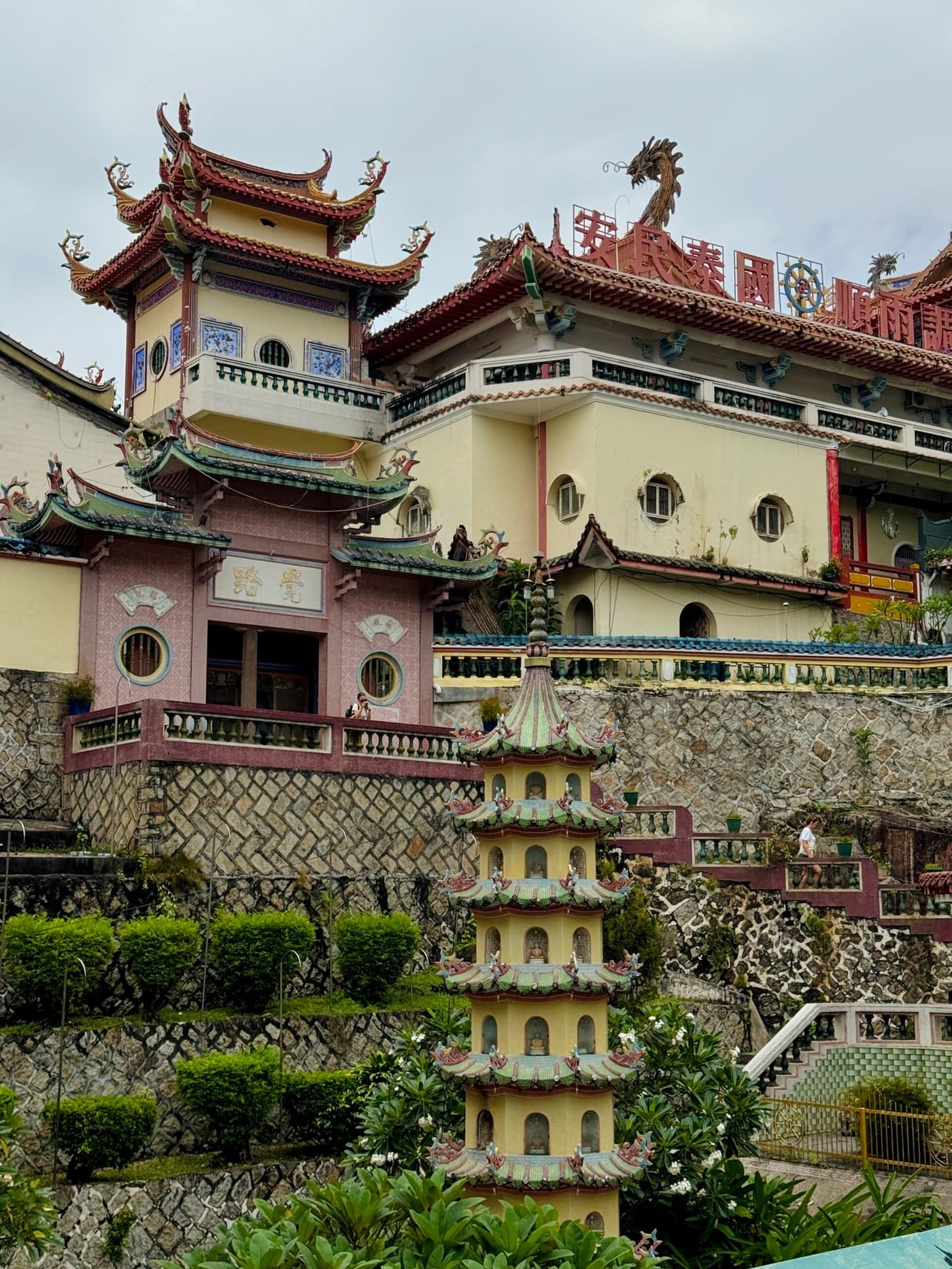
Penang is considered the food capital of the country: asam laksa with fish and tamarind, char kway teow, nasi kandar with a dozen curries. Outside George Town there is the Kek Lok Si temple with its seven-tier pagoda, the funicular up Penang Hill, and a national park in the northwest of the island. The Batu Ferringhi beaches are great for an evening walk but not for swimming: the water is murky and there are sometimes jellyfish.
From Kuala Lumpur the most convenient way to Penang is the ETS train to Butterworth: about 4 hours, from 63 MYR. Then take the ferry or a Grab across the bridge. There are also direct flights to Penang International Airport. Before you go, be sure to read my Penang guide.
Langkawi
An archipelago on the border with Thailand that has been a duty-free zone since 1987. That is why alcohol and cigarettes here are many times cheaper than on the mainland. The main beach is Pantai Cenang, with bars and sunsets, and Tanjung Rhu in the north is quieter. The SkyCab cable car climbs Mount Mat Cincang to the curved 125-meter Sky Bridge. It is also worth taking a boat tour through the Kilim mangroves to see eagles.
Langkawi is the most straightforward beach resort in Malaysia, and the one most often sold in package tours. The flight from Kuala Lumpur takes about an hour. There are ferries from Penang and from Kuala Perlis. Getting around the island without your own transport is inconvenient: taxis are expensive, Grab works but there are few cars, so many people rent a car or a bike.
East coast islands: Perhentians, Redang, Tioman
If you want clear sea and coral reefs right off the shore, go here rather than to Langkawi. But only from March to September.
The Perhentians are two islands: Besar (calmer, family hotels) and Kecil (backpackers, dive schools). Boats leave from the Kuala Besut jetty. There are no proper ATMs on the islands, so bring cash. Redang is pricier and more resort-like, with white sand and snorkeling, departing from Merang and Kuala Terengganu. Tioman is a large hilly island with jungle and diving, a duty-free zone, with ferries from Mersing.
Keep in mind that Terengganu and Kelantan are the most conservative states in the country. At the resorts you barely notice it, but in mainland towns dress more modestly. From mid-December 2026 a new ECRL railway is due to start running here, from Gombak near Kuala Lumpur to Kota Bharu. The test train covered 519 km in 3 hours 19 minutes. Ticket prices are promised by the end of the year, so for now plan the trip with a backup option of a plane or bus.
Sabah: Kota Kinabalu, Mount Kinabalu and Sipadan
Sabah is the northern part of Malaysian Borneo and arguably the main reason to choose Malaysia over its neighbors. People start from Kota Kinabalu: a seaside city with a night market and access to the islands of Tunku Abdul Rahman Marine Park, 15 minutes away by boat.
Mount Kinabalu (4,095 m) is the highest point of Malaysia and Borneo. The climb takes two days with a night at the Panalaban hostel, and a guide is mandatory. Prices for the 2026 season: a package for a foreigner with the permit, insurance, overnight stay and meals is 1,043.25 MYR, plus a conservation fee of 50 MYR and a guide at 350 MYR per group of up to five people. There are about 30 beds in the hostel per day, so travelers book several months ahead on the Sabah Parks website.
Climbing Kinabalu: prices and booking rules, see the official website.
Sepilok near Sandakan is an orangutan rehabilitation center. A ticket for foreigners costs 30 MYR, and feeding is at 10:00 and 15:00. Nearby are the sun bear center and the Kinabatangan River, where from a boat you can see proboscis monkeys, elephants and hornbills.
Sipadan is one of the best-known dive spots in the world. The number of diving permits per day is limited. They are allocated by the dive centers of Mabul and Semporna, so book in advance. It is also important to know about safety in this area, which I cover below.
Sarawak: Kuching, Bako and Mulu
Sarawak is calmer and less touristy than Sabah. The capital, Kuching, is a riverside city with a waterfront, museums and Sarawak laksa, which people eat for breakfast. From Kuching people go to Bako National Park for proboscis monkeys and to the Semenggoh center for semi-wild orangutans.
Gunung Mulu National Park is a UNESCO site with huge caves, including Deer Cave and the Sarawak Chamber, one of the largest underground chambers in the world. There are no roads to it, only a flight from Miri. The Niah Caves near Miri were added to the UNESCO list in 2024, and traces of people about 40,000 years old were found there.
Johor Bahru
A city in the far south, across the strait from Singapore. It is less interesting for travelers who would need a visa to enter Singapore, since they cannot cross over without one. But since December 2025 the Gemas to Johor Bahru section of the railway has been electrified, and direct ETS trains run between Kuala Lumpur and Johor Bahru.
Malaysia itineraries for 7, 10 and 14 days
I planned the routes so that no single transfer is longer than 5 hours while still covering different locations actively. If you have less than a week, do not try to combine the peninsula and Borneo.
7 days: Kuala Lumpur (3 days, including Batu Caves), then the ETS train to Penang (3 days), and fly back from there. For a beach option: Kuala Lumpur (3 days) and a flight to Langkawi (4 days).
10 days: Kuala Lumpur (3 days) + Malacca with an overnight stay (1-2 days). Back through Kuala Lumpur to the Cameron Highlands (2 days), then Ipoh (1 day), then Penang (2-3 days). You can fly out of Penang.
14 days: Kuala Lumpur (3 days), Penang (3 days), a ferry or flight to Langkawi (3 days), a flight to Kota Kinabalu (5 days: islands, Sepilok and Kinabatangan, or the Kinabalu climb). In summer you can take the Perhentians instead of Langkawi.
Getting around Malaysia
Malaysia is one of the easiest countries in Asia for independent travel.
Trains. The KTM ETS electric trains link Kuala Lumpur with Ipoh, Butterworth (Penang), Padang Besar on the Thai border and now Johor Bahru. A KL Sentral to Butterworth ticket costs from 63 MYR, and to Padang Besar from 79 MYR. Tickets are sold in the KTMB app and sell out in advance on Fridays and holidays. The slow "Jungle Railway" from Johor Bahru to Wakaf Bharu near Kota Bharu takes 18.5 hours, from 44 MYR in a seat, and is worth it for the views.
Buses. Intercity buses in Kuala Lumpur leave from the TBS terminal (Terminal Bersepadu Selatan). They are cheaper than trains and comfortable, with reclining seats. It is convenient to buy tickets online, including through the 12Go service.
Planes. Domestic flights are operated by AirAsia, Batik Air, Malaysia Airlines and Firefly. To Borneo and Langkawi it is almost always faster and more sensible to fly than to travel overland. Domestic tickets are cheap if bought in advance, but low-cost carriers charge for luggage separately.
City transport. Kuala Lumpur has the LRT and MRT metro, a monorail and commuter trains. A ride costs about 1-5 MYR, and a monthly pass is 50 MYR. It is convenient to pay with a Touch 'n Go card, sold in shops and at stations.
Grab. This is the country's main taxi service: it works in cities, in Langkawi and on Borneo. The price is visible in advance, and there is no need to haggle or argue about the meter.
Car rental. Traffic drives on the left, the roads are good, and toll roads are paid with a Touch 'n Go card. You need an international driving permit. A car makes the most sense in Langkawi, Penang and Borneo.
How much a trip to Malaysia costs in 2026
Malaysia is pricier than Vietnam, roughly on par with Thailand and much cheaper than Singapore. The prices in the table are a guide as of October 2026.
| What | Price |
|---|---|
| A dish at a hawker center or kopitiam | 8-15 MYR |
| Lunch at an inexpensive restaurant | about 20 MYR |
| 0.5 l of beer in a pub (mainland) | about 23 MYR |
| A metro ride in Kuala Lumpur | 1-5 MYR |
| Express from the airport to the center | 55 MYR (65 from 2027) |
| Kuala Lumpur to Penang train | from 63 MYR |
| Hostel or budget hotel in Kuala Lumpur | 95-140 MYR per night |
| 3* hotel or boutique hotel | 240-310 MYR per night |
| 5* hotel or apartment | 470-640 MYR per night |
| Tourism tax | 10 MYR per room per night |
The Tourism Tax is paid by all foreigners, 10 MYR per room per night. It is often collected at check-in even if you paid for the booking online. Restaurants usually add a 10% service charge and the SST service tax to the bill. This is not a scam, just keep in mind that the total will be higher than the menu price.
By my estimate, a budget trip without the flight will cost 150-250 MYR ($35-60) per person per day, but you will stay in a guesthouse or hostel, eat in food courts and use public transport. A comfortable trip is from 400-600 MYR ($100-150) per day, which means a 3-4* hotel, restaurants, Grab and excursions. Count the islands, the Kinabalu climb and diving at Sipadan separately, as they are the main expenses.
Cost of living in Kuala Lumpur
If you plan to stay longer, here are benchmarks for the capital in 2026. A one-bedroom apartment in the center is around 2,400 MYR ($600) per month, and outside the center around 1,500 MYR ($350). One person's budget without rent is around 2,500 MYR ($650) per month. So a frugal life, with an apartment outside the center and cooking at home, is about 3,000-4,000 MYR ($750-1,000) per month. A moderate life in a good area, eating lunch out, comes to 5,000-6,000 MYR (~$1,300-1,500). Penang and Ipoh are cheaper, and KLCC and Bangsar are noticeably more expensive.
Money, cards and connectivity
In cities, cards and e-wallets are accepted almost everywhere. Cash is needed at markets, at street food courts, on the islands and in Borneo villages. If the terminal offers to charge the amount in your card's currency, choose to pay in ringgit, as it is cheaper.
For cash, the most reliable approach is to bring dollars or euros in new bills and change them at money changers in shopping malls. The rate at the airport is worse. If your own bank card works abroad, it solves almost everything.
Mobile internet is fast and inexpensive. The main operators are CelcomDigi, Maxis (Hotlink) and U Mobile. Tourist packages cost roughly 15-60 MYR, and a SIM is registered with your passport at the airport, at telecom shops or at 7-Eleven. The airport is the most expensive place. If you do not want to bother with a SIM, it is easier to set up an eSIM in advance.
Malaysian food: what to try
People come to Malaysia for the food no less than for the beaches. I am not a fan of Malaysian cuisine, but there are a few dishes I would recommend trying.
- Nasi lemak is rice cooked in coconut milk with spicy sambal sauce, fried peanuts, anchovies and an egg. It is eaten mostly for breakfast, and a portion at a simple eatery costs a few ringgit.
- Laksa is the name for a whole family of noodle soups. Penang's asam laksa is sour, in a fish broth with tamarind. Curry laksa in Kuala Lumpur is coconut-based and spicy. And in Sarawak laksa is eaten in the morning, and it tastes completely different.
- Roti canai is an Indian flatbread with curry for dipping. It is served at "mamaks", Indian-Muslim cafes, many of which are open around the clock. That is also where people drink teh tarik, sweet milk tea that is "pulled" by pouring it from glass to glass from a height.
- Char kway teow is fried rice noodles with shrimp over high heat.
- Bak kut teh is a Chinese pork rib soup with herbs, originally from the city of Klang.
- Satay is skewers with peanut sauce.
- Rendang is beef stewed in coconut milk until dark.
- Cendol is shaved ice with green rice noodles, coconut milk and palm sugar, a lifesaver in the heat.
The cheapest places to eat are hawker centers. These are covered areas under an awning with dozens of small stalls: each cooks one or two dishes, and the tables are shared. You order noodles at one stall and satay at another, drinks are brought by a separate seller, and you pay each one on the spot, most often in cash. A similar format exists in shopping malls, only with air conditioning and slightly higher prices. Another cheap option is the kopitiam, an old Chinese cafe with coffee, toast and a couple of stalls with hot food.
Chinese restaurants and food courts serve pork and alcohol freely, while Malay establishments are halal. If you want a beer with dinner, look for a Chinese neighborhood or a restaurant where alcohol is clearly listed on the menu.
Durian: why people come to Malaysia for it
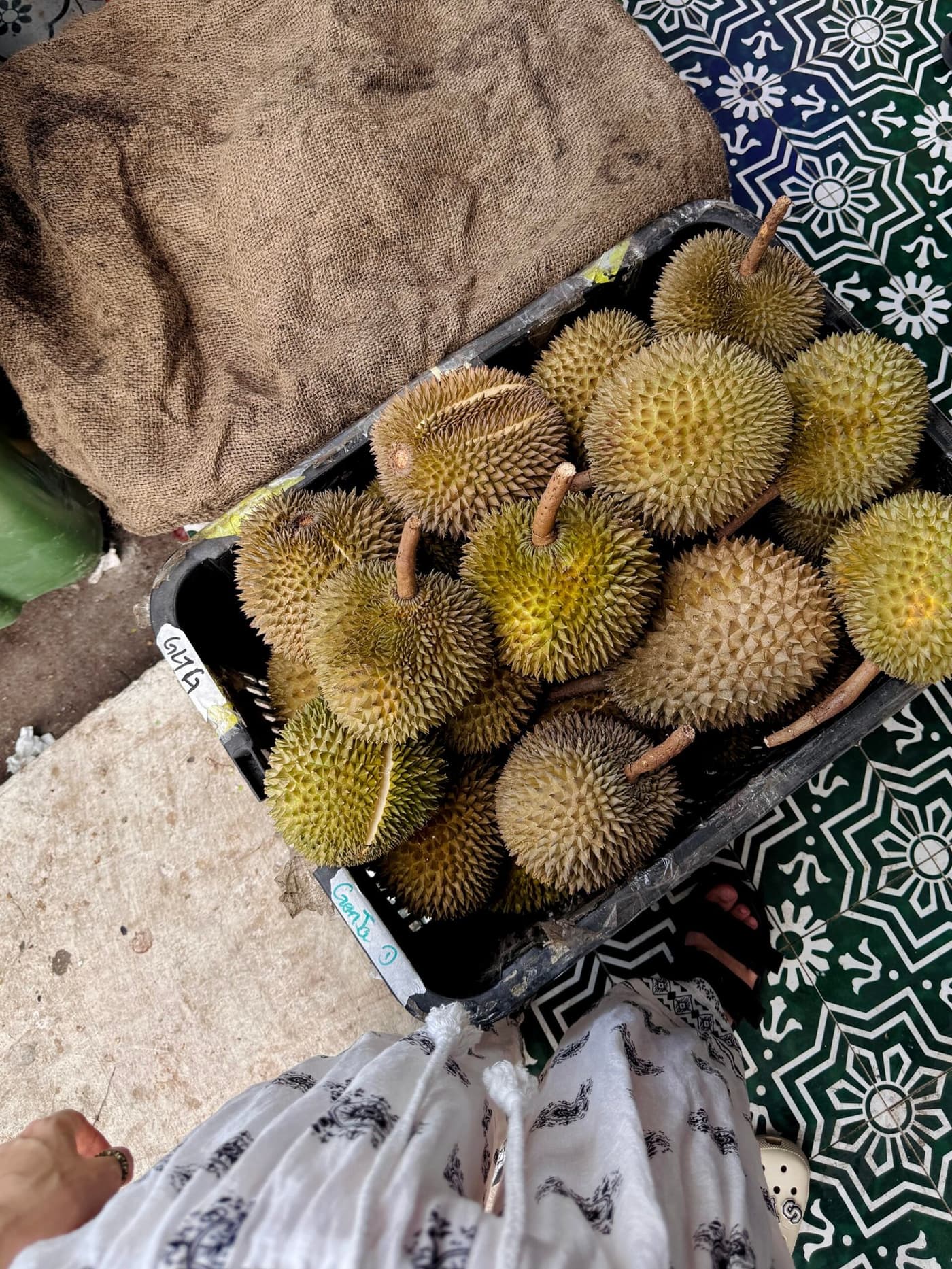
Durian grows all over Southeast Asia, but in Malaysia people have a special attitude toward it. The Ministry of Agriculture has kept a register of varieties since 1934, and it now holds around 200 registered clones, each with its own number starting with D. More than half of the roughly 30 known durian species grow on the island of Borneo, including wild species with red and orange flesh that you will almost never meet outside Sabah and Sarawak.
The taste differs not only because of the varieties. In Thailand, durian for export, for example the Monthong variety, is cut from the tree unripe, which is why it is milder and sweeter. In Malaysia, people traditionally wait until the fruit ripens and falls from the tree by itself. The flesh turns out softer and creamier, with a bitter note and an alcoholic aftertaste. Many people value durian precisely for this combination of sweetness and bitterness. If you only tried durian in Thailand and did not see the point, it is worth trying again in Malaysia.
The most popular varieties:
- Musang King (D197) is the main and most expensive one: bright yellow flesh, thick as custard, sweet with a slightly bitter edge;
- Black Thorn (D200, Ochee) has flesh with a reddish tint, is even creamier and sweeter, and often costs more than Musang King;
- D24 (Sultan) is a classic with a balanced sweet-bitter taste and a lower price;
- Red Prawn (D175, Udang Merah) is orange-red, dense and very sweet;
- D101 is mild and sweet, without sharp bitterness, a good option for a first time;
- XO has pronounced bitterness and a fermented aftertaste, for those who have already acquired the taste.
The main season is roughly June to August, when the harvest is collected at once in Pahang, Johor, Penang and Perak. The second season is December to January, but it is smaller. Prices in 2026 swung more than usual. At the peak of the season Musang King usually costs 60-90 MYR per kilogram. In January 2026, because of overproduction, it fell to 20-30 MYR, and in June 2026, amid a record harvest, it was sold in places for 9 MYR per kilogram. So find out the exact price on the spot.
Where to go for durian. The town of Raub in Pahang is the birthplace of Musang King, and people visit its farms for a day from Kuala Lumpur, as they do the neighboring Bentong. In the Balik Pulau area of Penang, old trees grow on the hills, and in season many farms hold "eat all you can" tastings. In Kuala Lumpur itself the easiest place to try it is SS2 street in Petaling Jaya: you pick the durian, it is weighed, and you eat it right at the tables by the stall, and a D24 buffet costs about 50 MYR per person.
How not to overpay. Ask for the variety number: a D-number is harder to fake than an attractive name. Agree on the price per kilogram before the fruit is opened, and watch it being weighed. A good seller will offer you a taste. The stem of a fresh fruit is green and damp if you scratch it. Dry and brown means the durian has been lying around for a long time.
There are also rules. You cannot bring durian into hotels, the metro, trains and buses, signs about this are everywhere, and a hotel can bill you a cleaning fee for the smell in the room. Many airlines do not take it on board even vacuum-packed, so it is best to eat it right at the stall. Locals advise against combining durian with alcohol: in a 2009 laboratory study, durian's sulfur compounds suppressed the enzyme that breaks down alcohol, so a hangover can be worse than usual.
Rules of conduct and laws
In Malaysia Islam is the state religion, and most of the population is Muslim, so it is better to know a few rules in advance.
Mosques and Hindu temples are entered with shoulders and knees covered, and shoes are taken off at the entrance. At large mosques such as the National Mosque in Kuala Lumpur or the Pink Mosque in Putrajaya, tourists are given cover-ups for free. In the cities of the west coast you can dress as in any Asian metropolis. In Kelantan and Terengganu, outside the resorts, it is better to avoid shorts and bare shoulders.
Drugs are the most serious topic. The penalties are among the harshest in the world: the mandatory death penalty was abolished in 2023, but it remains a possible punishment for trafficking. Never take other people's bags or parcels.
Same-sex relationships are prohibited by law. In practice tourists are almost never prosecuted under this provision, but it is better to save public displays of affection for another country, and that applies to any couple.
As of October 2026, vapes are legal for adults, but the government is preparing a nationwide ban and plans to introduce it before the end of the year, and in some states sales are already banned. Smoking in restaurants and cafes, including open terraces, is prohibited and is fined.
The left hand is considered "unclean" among Malays and Indians, as it is used in the toilet. So money, purchases, business cards and food are handed over and taken with the right hand, or with two hands if you want to show respect. If you eat with your hands, use only the right one. Pointing at a person or object with the index finger is impolite: Malays point with the thumb of the right hand, with the other fingers curled. Tipping is not required: restaurants already add a service charge.
Safety and health
On the whole, Malaysia is a calm country for tourists. The most common problems in Kuala Lumpur are pickpocketing in crowds and bag snatching from passing motorcycles. Carry your bag on the side away from the road. Taxi drivers without meters are no longer an issue if you ride with Grab.
About eastern Sabah in particular. As of October 2026, the UK Foreign Office advises against all but essential travel to the islands and dive sites off the east coast of Sabah between Sandakan and Tawau, including Lankayan island, because of the risk of kidnapping. The warning does not cover mainland Sabah. The Malaysian authorities periodically extend a nighttime sea curfew in this area. Many tourists travel to Semporna and Sipadan without problems, but check current advisories before you go, and keep in mind that insurance may not cover an incident if you went somewhere your government or insurer advises against.
The main health risk is dengue fever. It is carried by mosquitoes during the day, there is no vaccine, so repellents and long sleeves in the evening are what help. There are no mandatory vaccinations for entry. A yellow fever vaccination certificate is needed only if you are arriving from a risk country, for example Brazil. Tap water in cities is formally drinkable, but most locals boil or filter it. I would drink bottled water.
Healthcare in the private clinics of Kuala Lumpur and Penang is good, and foreigners come here specifically for treatment. But it costs accordingly, so insurance with coverage from $50,000 is a must-have expense, although it is not checked at the border. If you plan to ride a bike in Langkawi or go diving, check that these activities are covered by your policy.
Living and working remotely in Malaysia
Malaysia is one of the few countries in the region where a remote worker has a legal and not-too-expensive way to stay for a year or more. That is its main difference from Thailand, where the DTV visa rules tightened in August 2026 (details in the table below).
DE Rantau: the digital nomad visa
The DE Rantau Nomad Pass is issued by the digital economy agency MDEC. You apply yourself through the MDEC portal, with no intermediary needed. The main conditions for 2026:
- income from foreign sources of at least $24,000 a year for IT and digital professions (development, design, cybersecurity, data, digital marketing and content) or at least $60,000 a year for other remote professionals;
- contracts or work for employers and clients outside Malaysia;
- age 18 or older, health insurance valid in Malaysia for the whole period;
- a passport valid for at least 14 months.
The pass is issued for 3 to 12 months with one possible extension of another 12, up to 24 months in total. The extension is not automatic: MDEC checks income and insurance again. The fee is 1,080 MYR ($265) for the main applicant and 540 MYR ($130) for a family member. Since May 2025 the fee is not refunded if you are refused. After approval you have 6 months to enter the country.
It is valid on the peninsula. Sarawak has its own separate DE Rantau Sarawak program (run by SDEC) for digital professionals and remote workers, and you cannot hold both at the same time. On taxes: if you spend 182 days or more a year in the country, you may become a tax resident. Malaysia generally does not tax foreign income, but the rules on money you remit into the country change, so a consultation with a tax adviser will not hurt.
Coworking spaces, cafes with outlets and the remote-worker community are concentrated in Kuala Lumpur (Bangsar, Mont Kiara, KLCC) and in George Town in Penang.
Official MDEC links for DE Rantau:
- Program page: https://mdec.my/derantau
- Application: https://malaysiadigital.mdec.my/ — First you register, then you submit the application.
- Official FAQ (PDF): https://www.mdec.my/api/media/file/DE-Rantau_Pass_FAQ_v10.pdf
MM2H: Malaysia My Second Home
MM2H is a long-term program for affluent people. It was relaunched in 2024, and these conditions apply in 2026. You cannot work under it, except at the platinum level; it is a visa for living, not for working.
| Level | Deposit | Property purchase | Visa term | Work |
|---|---|---|---|---|
| Silver | $150,000 | from 600,000 MYR | 5 years | no |
| Gold | $500,000 | from 1,000,000 MYR | 15 years | no |
| Platinum | $1,000,000 | from 2,000,000 MYR | 20 years | director and shareholder of a company |
| SEZ/SFZ (special economic zones, for example Forest City in Johor) | $65,000 (under 50) or $32,000 (50+) | per state rules | 10 years | no |
General rules: age 25 or older at the main levels (21 or older for SEZ/SFZ), a mandatory deposit in a Malaysian bank, and a property purchase that cannot be sold for 10 years, except to swap for a more expensive one. If you are under 50, you must spend at least 90 days a year in the country. After buying property you can withdraw up to 50% of the deposit. Plus fees: about 5,000 MYR for processing, a one-time fee from 1,000 MYR ($250) at the silver level to 200,000 MYR ($50,000) at the platinum level, and an annual pass fee of 500 MYR (~$130). You can include a spouse, children and parents.
Sarawak has a separate S-MM2H program. Since January 1, 2025 it requires age 30 or older, a deposit of 500,000 MYR in a Sarawak bank and 30 days a year in the state. Buying property is not required. The term is 5 years, extendable for another 5.
Malaysia or its neighbors: what to choose for a long stay
| Country | Visa-free stay (as of October 2026, eligible passports) | Long-term status for a remote worker | What it is in terms of status |
|---|---|---|---|
| Indonesia (Bali) | none; visa on arrival, 30 + 30 days | KITAS, including E33G for remote workers | a full residence permit (KITAS), which you can use when applying for other countries' visas, including Schengen and US |
| Thailand | 30 days (from Sept. 15, 2026) | DTV for 5 years | a long-term visa, not a residence permit; from Aug. 31, 2026 you can apply only from your country of citizenship or residence, with a police clearance certificate |
| Malaysia | 30 days | DE Rantau up to 2 years, income from $24,000 a year for IT | a long-term visa (professional visit pass), not a residence permit; you can apply online from any country |
| Vietnam | 45 days (until March 2028) | no separate visa, only a 90-day e-visa | a tourist visa |
In short: for a long stay on paper, Bali is the strongest. The Indonesian KITAS is a full residence permit, not a visa, and with it you can get visas for other countries, including Schengen and the US. Neither the Malaysian DE Rantau nor the Thai DTV gives that status. Between the two, the choice is this: the DTV wins on duration (5 years against a maximum of 2), and DE Rantau on ease of getting it: you can apply online from anywhere, while the DTV can now only be applied for from your country of citizenship or residence. A full residence permit in Malaysia is MM2H, but it requires serious money. Malaysia's own strengths are infrastructure, English and prices below Singapore's, while for sea and nightlife Thailand and Bali are more interesting. For more, see my complete guide to Vietnam; I also have separate articles about Bali and what you need to know about the Philippines.
Malaysia FAQ
Do I need a visa for Malaysia in 2026?
When I checked in October 2026, eligible passports got a free 30-day stamp at the border. You need a passport valid for at least 6 months, an onward ticket and the MDAC electronic arrival card, which is filled in within 3 days before arrival. Confirm the rules for your own passport with the Malaysian immigration authority.
When is the best time to go to Malaysia?
It depends on the region. For Langkawi and Penang, go from December to March; for the east coast islands (Perhentians, Redang, Tioman), from March to September; for Borneo, from March to September. Kuala Lumpur and Malacca can be visited all year.
How much does a trip to Malaysia cost?
Without the flight, a budget trip costs roughly 150-250 MYR ($35-60) per person per day, and a comfortable one 400-600 MYR ($100-150).
How do I get to Malaysia by air?
Most international flights land at KLIA, the Kuala Lumpur airport. From there the KLIA Ekspres takes about 30 minutes to KL Sentral station and currently costs 55 MYR. Grab is handy if you have a lot of luggage.
Where is the best sea in Malaysia?
On the east coast islands (Perhentians, Redang, Tioman) and around Borneo. The water there is clear and the reefs are right off the shore, but it is worth going only from March to September. In winter, Langkawi is the one for the beach.
Langkawi or Penang: which should I choose?
Langkawi is better for beach time, nature and cheap duty-free alcohol. Penang is for culture, unusual food, colonial architecture and George Town's street art, but the sea there is poor. If you have 10 days, you can combine both: ferries run between them.
What is the best way to pay in Malaysia?
In cities, cards and e-wallets are accepted almost everywhere, but you need cash at markets, on the islands and in villages. The most reliable approach is to bring cash dollars or euros and change them at city money changers. If your own bank card works abroad, it solves almost everything.
Is Malaysia safe?
On the whole, yes. The main risks in cities are pickpockets and bag snatching from motorcycles. The exception is the islands off the east coast of Sabah between Sandakan and Tawau: several governments advise against traveling there because of the risk of kidnapping.
Can I live in Malaysia and work remotely?
Yes, there is the DE Rantau visa for this. You need income from foreign clients or an employer of at least $24,000 a year for IT and digital professions or at least $60,000 for others. The pass is issued for up to 12 months with one more year of extension.
How much does the MM2H program cost in 2026?
The minimum silver level requires a $150,000 deposit in a Malaysian bank and a property purchase from 600,000 MYR, and the visa is issued for 5 years. Gold is $500,000 and property from 1 million MYR, platinum is $1 million and property from 2 million MYR.
How much does it cost to climb Kinabalu?
For the 2026 season, a package for a foreigner with the permit, insurance and a night at the Panalaban hostel costs 1,043.25 MYR. On top of that come a conservation fee of 50 MYR and a mandatory guide at 350 MYR per group of up to five people.
What is the ringgit exchange rate?
In October 2026, 1 US dollar is about 4.09 ringgit.